

Build Audit Systems That Reveal Truth and Improve Performance
Disclaimer.
This article provides general guidance, frameworks, and examples to support the development of maintenance audit programs.
It is intended for educational and informational purposes only and does not constitute legal, regulatory, safety, or compliance advice.
Every organization operates within its own technical, operational, and regulatory environment. The concepts and examples presented here should be adapted to your specific context, risk profile, and jurisdictional requirements. They are illustrative only and not prescriptive standards.
Organizations remain solely responsible for their own decisions, risk assessments, and compliance obligations.
Where appropriate, consult qualified professionals or auditors with experience in your industry before implementing or modifying audit processes.
Any views or interpretations expressed are those of the author and do not represent the positions of any employer, client, government body, or vendor referenced in this article.
Article Summary.
Most organizations know they need audits, what they struggle with is turning that intention into a program that actually improves performance.
This article closes that gap. It breaks down the practical mechanics of building a maintenance audit framework that is consistent, credible, and capable of driving real operational change.
Instead of abstract principles, you’ll find concrete methods for structuring audit teams, designing scoring systems that eliminate subjectivity, creating audit calendars that don’t disrupt operations, and training auditors who know how to uncover truth rather than confirm assumptions. The focus is simple: audits that reveal what’s really happening, not what people hope is happening.
Drawing on implementation experience across multiple industries, this article tackles the realities most audit frameworks ignore, limited resources, skeptical stakeholders, inconsistent documentation and the challenge of maintaining objectivity when auditing your own colleagues.
You’ll get practical solutions, ready‑to‑use templates, and a roadmap for turning audit findings into actions that stick.
If you want an audit program that does more than generate reports, this is where you start.
Top 5 Takeaways.
1. Start Small, Then Scale With Purpose: Trying to audit everything at once spreads resources thin and produces shallow results. Begin with your highest‑impact pain point, build a repeatable process, and expand only when the foundation is solid.
2. Calibrate Auditors to Eliminate Subjectivity: Five auditors should not produce five different scores. Joint calibration sessions create consistency, strengthen confidence in results, and prevent “opinion‑based” auditing.
3. Separate Discovery From Decision‑Making: The people who uncover findings shouldn’t be the ones deciding corrective actions. This separation reduces defensiveness, increases honesty, and leads to more actionable outcomes.
4. Make Findings Impossible to Ignore: Audit reports hidden in shared drives don’t change behaviour. Use visible, persistent systems that keep findings, actions, and progress in front of the people responsible for fixing them.
5. Audit the Audit Program Itself: High‑maturity organizations continuously evaluate their own audit process. Identify what adds value, what creates noise, and where auditors spend time without improving performance.
Table of Contents.
1.0 Designing Your Audit Program Architecture.
1.1 Deciding What to Audit First.
1.2 Setting Audit Frequency and Depth.
1.3 Resource Planning for Audit Activities.
1.4 Creating Your Audit Calendar.
1.5 Balancing Breadth Versus Depth.
2.0 Building Effective Audit Criteria and Scoring Systems.
2.1 Moving Beyond Subjective Assessments.
2.2 Developing Observable Evidence Requirements.
2.3 Creating Meaningful Scoring Rubrics.
2.4 Weighting Criteria by Impact.
2.5 Testing Your Criteria Before Rollout.
3.0 Assembling and Training Your Audit Team.
3.1 Selecting Auditors with the Right Mindset.
3.2 Internal Versus External Auditors.
3.3 Cross-Functional Audit Benefits.
3.4 Auditor Training Programs That Work.
3.5 Maintaining Auditor Objectivity and Independence.
4.0 Conducting the Physical Audit.
4.1 Pre-Audit Preparation and Communication.
4.2 Opening Meetings That Set the Right Tone.
4.3 Evidence Gathering Techniques.
4.4 Real-Time Documentation Methods.
4.5 Managing Difficult Conversations During Audits.
5.0 Mastering the Art of Audit Questioning.
5.1 Why Most Auditors Ask Terrible Questions.
5.2 The STAR Technique for Behavioral Auditing.
5.3 Following the Evidence Trail.
5.4 Detecting Social Desirability Bias.
5.5 When to Push and When to Pivot.
6.0 Documenting Findings That Drive Action.
6.1 Writing Findings That Can’t Be Ignored.
6.2 Classifying Finding Severity Appropriately.
6.3 Linking Findings to Business Impact.
6.4 Photographic Evidence and Work Samples.
6.5 Creating Finding Statements That Survive Challenges.
7.0 Turning Audit Results Into Improvement Plans.
7.1 Prioritization Frameworks for Findings.
7.2 Assigning Ownership and Accountability.
7.3 Developing Realistic Timelines.
7.4 Resource Allocation for Corrective Actions.
7.5 Creating Feedback Loops That Close the Gap.
8.0 Tracking and Reporting Audit Outcomes.
8.1 Dashboard Design for Audit Programs.
8.2 Trend Analysis Across Multiple Audits.
8.3 Executive Reporting That Drives Decisions.
8.4 Celebrating Improvements and Recognizing Progress.
8.5 Using Data to Refine Future Audits.
9.0 Overcoming Common Audit Program Challenges.
9.1 Dealing with Audit Fatigue.
9.2 Managing Defensive Responses.
9.3 Preventing Audit Preparation Theater.
9.4 Maintaining Momentum Between Audit Cycles.
9.5 Avoiding the Compliance Checkbox Trap.
10.0 Specialized Audit Approaches for Complex Scenarios.
10.1 Auditing Newly Implemented CMMS Systems.
10.2 Post-Incident Root Cause Audits.
10.3 Vendor and Contractor Maintenance Audits.
10.4 Pre-Acquisition Due Diligence Audits.
10.5 Benchmarking Audits Against Industry Standards.
11.0 Technology Tools for Modern Maintenance Auditing.
11.1 Digital Audit Platforms and Mobile Apps.
11.2 Automated Data Collection from CMMS.
11.3 AI-Assisted Anomaly Detection.
11.4 Photograph and Video Documentation Systems.
11.5 Collaborative Audit Workflow Software.
12.0 Building a Culture That Welcomes Audits.
12.1 Shifting from Blame to Learning.
12.2 Transparent Communication About Audit Purpose.
12.3 Involving Front-Line Staff in Audit Design.
12.4 Sharing Audit Insights Across Departments.
12.5 Recognizing Teams That Embrace Audits.
13.0 Conclusion.
14.0 Bibliography.
1.0 Designing Your Audit Program Architecture.
Before you audit anything, you need a plan. Not a vague intention to “check things more often,” but an actual architecture that defines scope, frequency, resources and success criteria. Most organizations skip this step and wonder why their audit efforts feel chaotic and deliver inconsistent value.
1.1 Deciding What to Audit First.
You can’t audit everything simultaneously and you shouldn’t try. The organization that attempts comprehensive audits across all maintenance modules in month one typically produces shallow assessments that miss critical issues while consuming enormous resources.
1.1.1 Start with your biggest pain point.
If your backlog is getting far too big, audit your work planning and scheduling processes first.
If you’re experiencing repeat failures on critical equipment, focus on your preventive maintenance strategy and execution. If work orders sit incomplete for months, examine your work identification and completion processes.
Here’s a practical prioritization approach: gather your leadership team and list your maintenance challenges.
For each challenge, rate it on two dimensions, business impact (how much does this hurt us?) and audit feasibility (how easily can we assess this?).
Plot these on a simple matrix. Your first audit target sits in the high-impact, high-feasibility quadrant.
1.1.2 Consider your CMMS implementation status.
Organizations with recently implemented systems should audit master data quality and user adoption before diving into complex process audits.
You can’t meaningfully assess work planning quality if your equipment register contains duplicate assets and your parts catalog is chaos. Fix the foundation first.
1.1.3 Think about political realities.
Some areas are politically sensitive, tightly controlled by powerful managers or historically resistant to external scrutiny.
While these might need auditing eventually, starting there can doom your entire program. Build credibility by delivering value in more receptive areas first.
Success creates momentum and political capital for tackling harder challenges later.
1.2 Setting Audit Frequency and Depth.
How often should you audit each module? The frustrating answer: it depends. However, some principles can guide your decisions.
1) High-risk, high-variability processes need more frequent audits: If you operate in industries with stringent safety requirements, audit your isolation procedures, pre-job briefings and hazard identification processes quarterly. These aren’t “check the box” exercises, they’re proactive defenses against incidents that could injure people or shut down operations.
2) Stable, well-controlled processes can be audited less frequently: If your master data management has been solid for three years running, an annual audit might suffice. Redirect those audit resources toward areas showing more volatility.
3) Distinguish between comprehensive and surveillance audits: Comprehensive audits examine every aspect of a module in detail. These might occur annually or biennially. Surveillance audits target specific high-risk elements or recently identified problem areas. These lighter-touch assessments can happen monthly or quarterly, keeping attention focused without overwhelming resources.
4) Consider your improvement velocity: Organizations implementing major changes should audit affected processes more frequently to verify improvements are taking hold. Once changes stabilize and become routine, you can reduce frequency. Audit frequency should flex based on need, not follow a rigid calendar.
1.3 Resource Planning for Audit Activities.
Audits consume time and time is your scarcest resource. Realistic resource planning prevents audit programs from collapsing under their own ambition.
1.3.1 Calculate the actual hours required.
A comprehensive module audit isn’t a two-hour walkthrough.
Planning, preparation, interviews, observations, documentation review, analysis, report writing and follow-up meetings easily consume 40-80 hours depending on facility size and complexity.
Multiply that by your intended frequency and number of modules.
Does that total fit within available resources? If not, either reduce scope or secure additional resources.
1.3.2 Don’t rely solely on maintenance managers for auditing.
They’re already stretched thin managing daily operations. Expecting them to conduct thorough audits in their “spare time” guarantees superficial results.
Consider dedicating reliability engineers, creating rotating audit teams, engaging external consultants for specialized assessments or training coordinators specifically for audit activities.
1.3.3 Account for auditee time too.
The people being audited need time to participate in interviews, locate documentation, explain processes and respond to findings.
An audit that shows up unannounced demanding immediate attention creates resentment and disrupts operations.
Schedule audits during periods of lower operational intensity when possible and communicate time requirements upfront.
1.3.4 Build buffer capacity.
Audits uncover issues requiring immediate attention.
If you schedule every available hour for planned activities, unexpected findings derail everything downstream.
Maintain at least 20% buffer capacity in your audit resource planning for investigation and urgent responses.
1.4 Creating Your Audit Calendar.
A well-structured audit calendar provides predictability, ensures coverage and prevents conflicts. It’s the difference between strategic assessment and random inspection.
1.4.1 Map out your full year.
Start with a blank annual calendar and block out periods when audits would be disruptive or impractical, major shutdowns, peak production periods, holiday weeks. These blackout periods protect operations and respect the reality that timing matters.
1.4.2 Distribute audits evenly.
Conducting all audits in Q4 creates a crushing workload and positions findings as “year-end problems” rather than continuous feedback.
Spread audits throughout the year, creating steady rhythm rather than frantic bursts.
1.4.3 Coordinate with other assessment activities.
Your organization likely conducts safety audits, quality audits, environmental audits and financial audits.
Coordinate timing to avoid audit fatigue, where teams face back-to-back assessments with no breathing room.
Consider combining related audits where appropriate, safety and work readiness audits often examine overlapping topics.
1.4.4 Communicate the calendar widely.
Publish your audit schedule at least 60 days in advance. This transparency allows teams to prepare properly, schedule key personnel to be available and eliminate the “surprise audit” dynamic that breeds defensiveness.
Some organizations resist this transparency, fearing people will “put on a show” for audits. That’s actually a good sign, if people feel compelled to improve things before audits, your program is already creating value.
1.5 Balancing Breadth Versus Depth.
Every audit involves tradeoffs between breadth (how much ground you cover) and depth (how thoroughly you examine each topic). Finding the right balance determines whether you spot systemic issues or just skim the surface.
1.5.1 Shallow audits across many topics reveal patterns.
If you’re trying to establish baseline performance across all modules, broader coverage makes sense.
You’re looking for “red flag” areas that warrant deeper investigation, not conducting forensic analysis of each process. This approach works well in early audit program stages when you’re still mapping the landscape.
1.5.2 Deep dives reveal root causes.
Once you’ve identified problem areas, subsequent audits should go deeper. Interview more people at different levels.
Examine multiple work orders rather than representative samples. Shadow technicians during actual work execution.
Follow processes end-to-end rather than checking discrete elements. This depth uncovers why problems persist despite previous “fixes.”
1.5.3 Consider rotating focus.
Some organizations conduct broad annual audits supplemented by quarterly deep dives into specific modules.
Q1 might examine work planning in detail while touching other modules lightly.
Q2 deep dives into CMMS data quality.
Q3 focuses on maintenance strategy.
This rotation ensures everything gets examined while maintaining manageability.
1.5.4 Let findings drive depth decisions.
If a broad audit reveals excellent performance in an area, you don’t need to dig deeper, acknowledge success and move on.
Conversely, superficial findings that hint at deeper issues warrant immediate follow-up investigation.
Audit depth should follow evidence, not predetermined plans.
2.0 Building Effective Audit Criteria and Scoring Systems.
Audit criteria answer the fundamental question: “What does good look like?”
Without clear, observable criteria, audits devolve into opinion contests where different auditors reach wildly different conclusions about the same evidence.
Effective criteria transform subjective assessment into objective measurement.
2.1 Moving Beyond Subjective Assessments.
“How good is your work planning?” This question invites subjective responses and produces unreliable data.
One auditor might think planning is excellent because written procedures exist.
Another might rate it poor because actual practice diverges from procedures. Both are looking at the same reality but applying different standards.
2.1.1 Define specific, observable behaviors and artifacts.
Instead of asking “Is work planning effective?” ask “What percentage of planned work orders include complete parts lists verified against inventory before scheduling?” This specificity transforms a fuzzy concept into something measurable.
2.1.2 Create clear performance levels.
Rather than “good/bad” or “satisfactory/unsatisfactory,” define what performance looks like at different levels. For work order planning, you might specify:
1) Advanced (90-100%): All planned work orders contain detailed task lists, accurate time estimates validated against historical data, complete parts lists cross-referenced with inventory, safety requirements identified, required permits specified and quality standards defined. Work packs include relevant drawings, procedures and reference materials.
2) Proficient (70-89%): Planned work orders consistently include task lists, time estimates and parts lists. Most reference required permits and safety measures. Work packs contain basic documentation though some materials may be missing. Estimates generally align with historical performance.
3) Developing (50-69%): Work orders have basic task descriptions and parts lists, but time estimates are often inaccurate. Safety requirements and permits are sometimes overlooked. Work pack documentation is incomplete. Significant variance between planned and actual execution.
4) Beginning (Below 50%): Work orders lack detailed task breakdowns. Parts lists are incomplete or missing. Time estimates are guesses. Safety requirements not systematically identified. Minimal documentation provided to technicians.
This specificity allows different auditors to assess the same evidence and reach consistent conclusions.
You’re no longer debating opinions; you’re comparing observations against defined standards.
2.2 Developing Observable Evidence Requirements.
Audit criteria should specify what evidence auditors need to collect and evaluate.
This requirement prevents audits from relying on anecdotal impressions or selective examples that don’t represent typical performance.
2.2.1 Quantitative evidence provides objectivity.
For assessing preventive maintenance compliance, don’t just ask “Are PMs being completed?” Specify: “Review the past 90 days of scheduled PMs.
Calculate the percentage completed within the specified time window.
Sample 20 completed PM work orders and verify actual tasks performed match the PM task list.”
2.2.2 Qualitative evidence adds context.
Numbers tell you what’s happening; conversations reveal why. For that same PM assessment, interview technicians about barriers to PM completion.
Observe technicians performing PMs to verify written procedures match actual practice. Ask supervisors how they prioritize work when PMs conflict with urgent corrective work.
2.2.3 Multiple evidence types triangulate truth.
The most reliable audit findings rest on evidence from multiple sources:
1) Documentation: What do procedures, work orders, inspection records and system reports say?
2) Interviews: What do people at different levels tell you about how things actually work?
3) Observations: What do you see when you watch processes in action?
4) System data: What do trends in your CMMS reveal about performance over time?
When all four evidence types align, you’re likely seeing reality.
When they contradict each other, procedures say one thing, people say another, observations show a third reality, you’ve found an important gap to explore.
2.2.4 Specify sample sizes appropriate to confidence needs.
Reviewing three work orders doesn’t provide reliable insight into overall planning quality. Statistical validity requires adequate sample sizes.
For most maintenance audits, examining 20-30 examples of a given work type provides reasonable confidence. Critical processes or those with high variability might warrant larger samples.
2.3 Creating Meaningful Scoring Rubrics.
Scoring rubrics translate audit evidence into ratings that allow comparison across time and between different areas. However, poorly designed rubrics create false precision or obscure important nuances.
2.3.1 Choose scale granularity carefully.
A three-point scale (below expectations, meets expectations, exceeds expectations) provides enough differentiation for many purposes without overwhelming auditors with hairsplitting distinctions.
Five-point scales work when you need finer gradations. Scales with more than seven points typically produce unreliable results because auditors can’t consistently distinguish between adjacent levels.
2.3.2 Consider numerical versus categorical scales.
Percentage-based scales (0-100%) feel precise but often mask subjective judgments, the difference between 73% and 78% rarely reflects measurable distinction. Pass/fail scales simplify but lose nuance.
Many organizations use hybrid approaches: numerical scores for criteria with clear quantitative evidence, categorical ratings for qualitative assessments.
2.3.3 Weight criteria by importance.
Not all audit criteria matter equally. Incomplete parts lists on planned work orders directly impact wrench time and schedule adherence, major operational impacts. Missing revision dates on procedures is a documentation gap with minimal operational impact.
Your scoring system should reflect these differences.
One approach: assign weight factors to each criterion based on its connection to safety, equipment reliability and cost.
1) Safety-critical criteria might carry 3x weight.
2) Reliability-critical criteria 2x weight.
3) Nice-to-have best practices 1x weight.
Multiply individual scores by their weight factors before calculating overall module scores.
2.3.4 Provide scoring guidance and examples.
Create a reference document that shows example scenarios for each score level.
“A score of 1 (partial) for PM task completion means technicians complete most tasks but consistently skip time-consuming activities like vibration readings or oil sampling.” These examples calibrate auditor judgment and reduce scoring variability.
2.4 Weighting Criteria by Impact.
Some audit findings matter more than others. Your scoring system should reflect this reality rather than treating all criteria equally.
2.4.1 Start with consequence analysis.
For each audit criterion, ask: “If this were deficient, what would likely happen?”
Consequences might include safety incidents, equipment failures, regulatory violations, cost overruns or missed production targets.
Severity and probability of these consequences should influence criterion weight.
2.4.2 Consider strategic importance.
Your organization’s strategic priorities should influence audit weighting.
If asset life extension is a strategic priority, criteria related to condition monitoring and predictive maintenance deserve higher weighting.
If reducing emergency maintenance costs is the top priority, criteria assessing work identification quality and planning effectiveness merit emphasis.
2.4.3 Balance technical and process factors.
Technical excellence means little if processes prevent that excellence from being applied consistently.
Weight both technical capability criteria (do people have the skills, tools and information they need?) and process execution criteria (do established processes actually get followed?).
High technical capability with poor process execution signals different improvement needs than good processes hampered by capability gaps.
2.4.4 Document your weighting rationale.
When stakeholders challenge audit scores and they will, you need clear justification for why certain criteria carried more weight.
“We weighted isolation procedure compliance heavily because our incident history shows three serious events in the past 18 months related to inadequate isolation” is defensible.
“We weighted it that way because it seemed important” isn’t.
2.5 Testing Your Criteria Before Rollout.
Never launch audit criteria organization-wide without pilot testing.
What seems clear and measurable in conference room discussions often proves ambiguous when auditors encounter real-world complexity.
1) Conduct trial audits with multiple auditors:
a. Select a representative process or area.
b. Have three different auditors independently assess it using your draft criteria. Compare their findings and scores.
c. If they reach substantially different conclusions, your criteria need clarification.
2) Identify ambiguous language:
a. Words like “appropriate,” “adequate,” “sufficient” and “reasonable” invite subjective interpretation.
b. During pilot testing, note where auditors hesitate or debate interpretation.
c. Revise criteria to eliminate ambiguity.
d. Replace “adequate parts inventory” with “critical spare parts as defined in BOMs are in stock with lead times not exceeding 72 hours for order-on-demand items.”
3) Check criterion achievability:
a. Sometimes criteria reflect ideal states that few organizations actually achieve.
b. If pilot testing reveals that even high-performing organizations score poorly, either your criteria are unrealistic or you’ve identified a universal industry weakness.
c. Distinguish between aspirational targets (useful for long-term improvement direction) and practical assessment criteria (must reflect achievable performance levels).
4) Refine evidence requirements:
a. Pilot auditors will quickly discover if evidence requirements are too burdensome, too vague or require data not readily available.
b. “Verify that all equipment has criticality rankings” is straightforward.
c. “Verify that criticality rankings were derived from formal risk assessments within the past two years” requires access to assessment documentation that may not exist or be easily located.
d. Adjust requirements to balance thoroughness with practicality.
5) Iterate based on feedback:
a. After pilot testing, gather auditors and discuss what worked and what didn’t. Which criteria produced consistent, useful findings?
b. Which generated debate without adding value?
c. What evidence proved difficult to collect?
d. Use this feedback to refine criteria before full rollout.
3.0 Assembling and Training Your Audit Team.
Audit quality depends heavily on auditor quality. The most sophisticated audit criteria and elegant scoring rubrics can’t overcome poor auditor judgment, inadequate training or wrong mindset.
Building an effective audit team requires careful selection, comprehensive training and ongoing calibration.
3.1 Selecting Auditors with the Right Mindset.
Technical knowledge matters for auditing, but mindset matters more. An auditor with average technical skills but excellent interpersonal abilities and genuine curiosity will outperform a technical expert who views auditing as fault-finding.
3.1.1 Look for people who ask “why” naturally.
Good auditors possess innate curiosity about how things work and why things happen. They’re not satisfied with surface explanations.
When someone says “that’s just how we do it,” skilled auditors probe for the underlying rationale. This curiosity isn’t aggressive, it’s genuine interest in understanding root causes.
3.1.2 Avoid auditors who need to prove they’re the smartest person in the room.
Auditing isn’t a demonstration of superior knowledge.
Auditors who can’t resist showing off their expertise or correcting minor errors create defensive environments where people hide problems rather than revealing them. The goal is discovering truth, not establishing hierarchy.
3.1.3 Seek objectivity over advocacy.
Some people excel at identifying problems but struggle to separate observation from opinion.
They see a gap between current and ideal states, assume incompetence or laziness caused it and communicate their findings with judgment rather than neutrality.
This approach destroys audit effectiveness. You need auditors who can describe what they observe without layering interpretation onto it.
3.1.4 Value emotional intelligence highly.
Auditing involves navigating sensitive conversations, managing defensive responses and building trust with people who may view audits as threatening.
Auditors need to read social cues, adjust their approach when tension rises and maintain composure when confronted with hostility.
Technical brilliance without emotional intelligence produces useless audits.
3.1.5 Consider diverse perspectives.
Audit teams composed entirely of maintenance managers think like maintenance managers. Including planners, technicians, engineers and operations personnel brings varied viewpoints that spot different issues.
Cross-functional teams also build broader organizational support for audit findings, it’s harder to dismiss recommendations when they come from peers across multiple departments.
3.2 Internal Versus External Auditors.
Should you use internal staff, external consultants or a combination? Each approach offers distinct advantages and limitations.
3.2.1 Internal auditors understand context.
They know your equipment, your history, your people and your constraints. They spot deviations from normal patterns quickly because they know what normal looks like. They’re available continuously for follow-up questions and ongoing monitoring. Internal auditors also cost less than external consultants and build organizational capability that remains after the audit concludes.
However, internal auditors face familiarity blind spots. They’ve become accustomed to workarounds and compromises that outsiders would immediately flag as problems. They may hesitate to report findings that implicate colleagues or superiors. Their availability for auditing competes with operational responsibilities, often losing priority battles when urgent issues arise.
3.2.2 External auditors bring fresh perspectives.
They haven’t become desensitized to your normal. They readily challenge “that’s how we’ve always done it” thinking because they’ve seen how other organizations handle similar situations.
External auditors typically provide more critical assessments because they have no internal relationships to protect and face no career consequences from delivering uncomfortable truths.
The downsides? External auditors require time to understand your specific context, potentially misinterpreting practices that make sense given your unique circumstances. They’re expensive.
Their involvement is episodic rather than continuous, limiting relationship building and follow-through capability.
Some organizations struggle to act on external audit findings because internal staff weren’t invested in the audit process.
3.2.3 Hybrid approaches balance strengths.
Many organizations use internal auditors for routine surveillance audits while engaging external auditors for comprehensive biennial assessments or specialized deep dives.
External auditors can also train and calibrate internal audit teams, improving their effectiveness between external visits.
This combination provides continuous internal monitoring supplemented by periodic external validation and expertise injection.
3.3 Cross-Functional Audit Benefits.
Maintenance system audits should include voices beyond maintenance leadership. Cross-functional audit teams produce more comprehensive assessments and build broader organizational buy-in.
3.3.1 Operations personnel understand how maintenance activities impact production.
They can assess whether maintenance communication is effective, whether planned outages align with operational needs and whether equipment handover processes work smoothly. Operations input prevents maintenance-centric audit myopia that optimizes maintenance activities while ignoring operational impact.
3.3.2 Engineering staff spot technical gaps.
Design engineers understand equipment capabilities and limitations that maintenance might not fully appreciate.
They can assess whether maintenance strategies align with manufacturer recommendations and industry standards. Reliability engineers bring statistical thinking and failure analysis expertise that deepens root cause identification.
3.3.3 Supply chain representatives illuminate materials management issues.
Procurement staff understand lead times, supplier reliability and inventory economics that maintenance planners may not consider.
Their participation in audits examining parts management and inventory practices produces more actionable findings.
3.3.4 Cross-functional participation builds ownership.
When operations, engineering and supply chain contribute to audits, they own the findings and recommendations.
This ownership increases implementation success rates.
Audit recommendations become shared improvement priorities rather than maintenance asking other departments for favors.
3.3.5 Start with willing participants.
Don’t force cross-functional participation on unwilling departments.
Begin with groups that see value in collaboration, demonstrate the benefits through successful joint audits, then expand participation as word spreads about positive experiences.
3.4 Auditor Training Programs That Work.
Throwing untrained auditors at complex maintenance systems produces superficial, inconsistent results. Effective auditor training combines technical content, interpersonal skills and practical application.
3.4.1 Start with audit fundamentals.
Many potential auditors have never conducted formal audits.
They need foundational concepts: audit purpose and value, ethical conduct expectations, evidence types and quality, documentation standards and reporting protocols. Don’t assume this knowledge, teach it explicitly.
3.4.2 Teach the specific audit framework and criteria your organization uses.
Walk auditors through your criteria documents section by section. Discuss the rationale behind each criterion and its weighting.
Show examples of strong and weak performance for each criterion.
This detailed orientation prevents auditors from imposing their personal standards rather than applying organizational criteria.
3.4.3 Develop questioning skills through practice.
Effective audit questioning doesn’t come naturally to most people. Create practice scenarios where trainees interview role-players about fictional maintenance processes.
Record these practice sessions and review them together, identifying effective questions and missed opportunities.
Focus on open-ended questions, follow-up probes and techniques for overcoming evasive responses.
3.4.4 Practice evidence evaluation and scoring.
Present trainees with sample audit evidence, work orders, procedures, interview transcripts, observation notes and have them independently score scenarios using your criteria.
Compare scores and discuss differences. This calibration exercise surfaces interpretation variances before they occur in real audits.
3.4.5 Shadow experienced auditors.
Classroom training only goes so far. New auditors should participate in several audits alongside experienced team members before conducting solo audits.
Shadowing provides context that classroom discussion can’t replicate, how to navigate facility environments, manage time constraints, handle unexpected discoveries and maintain professional demeanor under challenging conditions.
3.4.6 Provide feedback loops.
After new auditors complete their first independent audits, have experienced auditors review their work.
This review should examine both audit process (did they collect appropriate evidence?) and audit product (are findings clearly stated and well-supported?).
Constructive feedback during early audits prevents bad habits from becoming entrenched.
3.5 Maintaining Auditor Objectivity and Independence.
Auditor objectivity can erode over time.
Organizations need safeguards to maintain independence and prevent conflicts of interest from compromising audit quality.
3.5.1 Rotate audit assignments periodically.
An auditor who examines the same process repeatedly may develop relationships with auditees that compromise objectivity.
They might become blind to persistent issues or hesitant to report findings about people they’ve come to know personally.
Rotating assignments every 2-3 audit cycles prevents excessive familiarity while preserving learning curve benefits.
3.5.2 Avoid auditing areas where you have direct responsibilities.
Maintenance managers shouldn’t audit processes they control. This creates obvious conflicts, they’re essentially evaluating their own work.
Even with good intentions, they’ll struggle to maintain objectivity. Independent auditors from other departments or external consultants should assess areas where conflict potential exists.
3.5.3 Create reporting structures that protect auditors.
If auditors report to the managers whose areas they’re auditing, they face career pressures that undermine candor.
Audit teams should report to organizational levels above the functions being audited, or to independent quality/compliance departments.
This reporting structure protects auditors from retribution when they identify uncomfortable truths.
3.5.4 Separate audit findings from corrective actions.
The person identifying a problem shouldn’t be the same person implementing the fix. This separation preserves auditor independence while ensuring auditees own improvements. Auditors discover and describe; auditees decide how to address findings. This division of responsibilities reduces audit defensiveness.
3.5.5 Watch for “going native” syndrome.
Auditors who spend years examining the same organization gradually adopt that organization’s norms and blind spots.
What initially shocked them becomes normal. Regular calibration against external benchmarks or periodic inclusion of external auditors helps reset perspective and prevents this drift.
4.0 Conducting the Physical Audit.
The rubber meets the road when auditors walk into facilities, open conversations and start examining evidence. This phase transforms preparation into discovery. How you conduct physical audits determines whether you uncover truth or just hear what people want you to hear.
4.1 Pre-Audit Preparation and Communication.
Showing up unannounced might work for surprise regulatory inspections, but it’s terrible strategy for internal improvement audits. Preparation and communication set up successful audits.
1) Send notification at least two weeks ahead: Your notification should specify audit scope, expected duration, key personnel who’ll need to be available and information or documentation you’ll want to review. This advance notice isn’t about giving people time to “clean up”, it’s about respecting their time and ensuring the right people and resources are available.
2) Request specific documentation in advance: Rather than asking “Can we see your procedures?” request specific documents: “Please provide copies of your work planning procedure, last six months of backlog reports and samples of 10 planned work orders from the past 30 days.” Specificity helps auditees gather what you need and reduces time spent hunting for documents during the audit.
3) Identify your evidence sampling strategy: Before arriving, determine how you’ll select work orders, equipment records or other items for examination. Random sampling reduces selection bias. Stratified sampling ensures you examine examples from different equipment types, work priorities or time periods. Document your sampling method so findings can’t be dismissed as cherry-picking.
4) Review previous audit findings: If this isn’t your first audit of this area, review prior findings and verify whether corrective actions were implemented. This historical context helps you assess improvement trajectory and identify recurring issues that previous fixes didn’t actually resolve.
5) Prepare your audit checklist and tools: Convert your audit criteria into a structured checklist that ensures consistent evidence collection. Bring tools you’ll need, camera for documenting conditions, tablet or laptop for real-time documentation, voice recorder if you’ll record interviews, measuring devices if you’ll verify physical conditions.
4.2 Opening Meetings That Set the Right Tone.
The first 15 minutes of an audit set the emotional tone for everything that follows. Get this wrong and you’ll spend the rest of the audit fighting defensive reactions.
1) Start with purpose, not process:
a. Begin by reminding everyone why audits exist:
i. “We’re here to help identify opportunities for improvement and share best practices.
ii. This isn’t about finding fault, it’s about discovering what’s working well and where small changes could deliver big benefits.”
b. Mean it when you say it. If your tone, body language or word choices contradict this message, people will trust the nonverbal signals over your words.
2) Acknowledge the disruption:
a. “I know audits take time away from your regular work. We appreciate you making room for this and we’ll do our best to be efficient with everyone’s time.”
b. This acknowledgment shows respect and builds cooperation.
3) Explain what you’ll do and what you need from them:
a. Walk through your planned activities:
i. “Today we’ll spend about an hour touring the facility, interview about six people for 20-30 minutes each and review a sample of work orders and procedures.
ii. Tomorrow we’ll wrap up any loose ends and have a brief closeout meeting to share preliminary findings.”
b. Clear expectations reduce anxiety.
4) Clarify confidentiality and attribution:
a. Tell people how you’ll handle sensitive information:
i. “Specific comments won’t be attributed to individuals in our report.
ii. We’re looking for patterns across multiple sources, not calling out specific people.”
b. This assurance encourages honesty.
5) Invite questions and concerns:
a. “Before we start, what questions or concerns do you have about the audit?”
b. Sometimes people need to voice anxiety before they can move past it. Address concerns directly and honestly.
c. If you can’t promise something, don’t. Better to disappoint upfront than lose credibility later.
6) Watch for emotional temperature:
a. If the room feels tense, slow down.
b. If someone seems particularly anxious or hostile, acknowledge it:
i. “I sense some concern. Want to talk about what’s on your mind?”
c. Sometimes simply naming the elephant in the room reduces its power.
4.3 Evidence Gathering Techniques.
Effective evidence gathering blends multiple techniques, each revealing different aspects of reality. Strong auditors know when to use each approach and how to synthesize varied evidence types into coherent findings.
4.3.1 Document review reveals what’s supposed to happen.
Start with procedures, standards and documented processes.
These documents represent the organization’s stated intent.
However, don’t stop there, the gap between documented and actual practice often contains your most important findings.
As you review documents, note questions to explore during interviews: “This procedure says supervisors approve all work orders before release, but how consistently does that actually happen?”
4.3.2 Interviews uncover how things actually work.
Talk to people at multiple organizational levels, managers explain strategy, supervisors describe coordination challenges, technicians reveal ground-level reality. The magic happens when you compare these perspectives.
Managers might believe planners provide comprehensive work packs; technicians might report receiving minimal documentation. This gap matters more than either perspective alone.
4.3.3 Physical observations catch what people don’t tell you.
Walk through maintenance areas and watch work happening.
Are tools organized and accessible? Do work orders accompany technicians or sit on clipboards elsewhere?
When technicians pick up work orders, do they read them carefully or glance and ignore? These observations reveal cultural realities that interviews might miss.
4.3.4 CMMS data analysis quantifies patterns.
Pull reports on work order completion times, PM compliance rates, backlog age, planner productivity and other metrics.
Numbers provide objectivity that qualitative evidence lacks.
They also reveal trends invisible in individual examples, one late work order is an anecdote, 40% of work orders exceeding planned completion dates is a pattern requiring explanation.
4.3.5 Photographic evidence documents conditions.
Pictures capture physical realities, cluttered work areas, missing safety equipment, deteriorated assets, well-organized tool rooms, excellent visual management.
Photos also protect you from “that’s not how it usually looks” responses. You documented what you saw when you saw it.
4.3.6 Sampling strategies determine representativeness.
You can’t examine every work order or interview every employee.
Your sampling approach determines whether findings reflect typical performance or exceptional cases. Random sampling prevents cherry-picking.
Stratified sampling ensures coverage across equipment types, work categories or time periods. Document your sampling method in your report so readers understand the basis for your conclusions.
4.4 Real-Time Documentation Methods.
Waiting until after the audit to document findings is a recipe for forgotten details, lost context and reconstruction errors. Document as you go, using approaches that capture information without disrupting audit flow.
1) Use structured note templates:
a. Create templates for each evidence type, interview notes, observation records, document review findings.
b. Templates ensure you capture essential information consistently and reduce cognitive load during evidence collection.
c. Your interview template might include fields for: interviewee name/role, date/time, key topics discussed, direct quotes (in quotation marks), your observations (clearly labeled as such) and follow-up questions.
2) Distinguish facts from interpretations:
a. In your notes, separate what you observed or were told from your interpretation.
b. Use different formats, facts in regular text, interpretations in italics or brackets.
c. This distinction preserves evidence integrity and prevents premature conclusions from contaminating raw data.
d. “The Planner/Scheduler stated that work orders are released to the schedule one week in advance [FACT].
e. This suggests planning is happening too late to support effective scheduling [INTERPRETATION].”
3) Record direct quotes liberally:
a. When someone says something particularly telling, capture their exact words in quotation marks.
b. Direct quotes add power to findings: “As one technician explained, ‘I stopped reading the work order details because they’re usually wrong anyway. I just look at the equipment number and figure out what needs doing.'” That quote reveals more about planning quality than paragraphs of analysis.
4) Take photos with context:
a. Don’t just photograph problems, photograph the surrounding area so viewers understand context.
b. If you’re documenting poor parts storage, capture wide shots showing the full storage area plus close-ups of specific issues.
c. Add brief captions to photos immediately so you remember what you were trying to show.
5) Use audio recording when appropriate:
a. Some auditors record interviews (with permission), allowing them to maintain eye contact and engagement rather than frantically scribbling notes.
b. Recordings provide verbatim records and protect against misquotes. However, recordings can inhibit candor, some people self-censor when they know they’re being recorded.
c. Read the room and decide whether recording helps or hinders.
6) Time-stamp everything:
a. Note the date and time when you collected each piece of evidence.
b. This timestamp provides context (was this during normal operations or a maintenance shutdown?) and demonstrates thoroughness if findings are later challenged.
7) Review notes daily:
a. At the end of each audit day, review your notes while memories are fresh.
b. Clarify cryptic shorthand, add context you didn’t have time to capture during collection and identify gaps requiring follow-up the next day.
c. Waiting until the audit concludes to review notes guarantees you’ll forget critical details.
4.5 Managing Difficult Conversations During Audits.
Not every audit conversation flows smoothly. People become defensive, hostile, evasive or emotional. Skilled auditors navigate these difficult moments without derailing the audit or damaging relationships.
1) Recognize defensiveness for what it is: When someone reacts defensively to questions, getting argumentative, making excuses, deflecting blame elsewhere, they’re usually feeling threatened. The defensive response is about protecting themselves, not attacking you. Understanding this helps you respond with curiosity rather than matching their emotional intensity.
2) Lower the temperature with empathy: “I can tell this topic is frustrating for you” or “Sounds like you’re dealing with some real constraints here” acknowledges their experience without agreeing or disagreeing with their perspective. This acknowledgment often reduces defensiveness because the person feels heard.
3) Separate the person from the system: When you encounter poor performance, frame it as a system issue rather than personal failure: “It sounds like the current process makes it really hard to complete PMs on time. What obstacles get in the way?” This framing invites problem-solving rather than triggering defensiveness.
4) Use the “help me understand” technique: When you hear something that doesn’t make sense or seems problematic, respond with genuine curiosity: “Help me understand how that works” or “Walk me through what happens when…” These phrases feel less confrontational than “why” questions, which can sound accusatory.
5) Don’t argue with audit subjects: Your job is gathering information, not winning debates. If someone disagrees with your observations, note their perspective without defending your position: “I hear you saying that work orders usually contain adequate information. I’ve noted that feedback. Can you help me understand why the technicians I spoke with expressed different experiences?” You’re documenting multiple perspectives, not determining truth in real-time.
6) Know when to take a break: If a conversation becomes heated, pause it: “I can see we’re both feeling some frustration here. How about we take a 10-minute break and come back to this?” Breaks give everyone time to regulate emotions and reconsider approaches.
7) Escalate when necessary: Occasionally you’ll encounter outright hostility or refusal to cooperate. Don’t try to power through, involve leadership: “It seems like there’s significant concern about this audit. Would it help to bring in [manager name] to discuss how we can proceed productively?” Leadership involvement usually resolves obstruction quickly.
8) Document resistance itself: If someone refuses to provide requested information or actively obstructs the audit, that behavior is itself a finding. Document it factually: “Requested access to backlog reports for Q3 and Q4. Supervisor stated these reports exist but declined to provide them, citing concerns about how data might be interpreted.” Leadership needs to know about obstructionist behavior.
5.0 Mastering the Art of Audit Questioning.
Questions are an auditor’s primary tool. The difference between superficial and insightful audits often comes down to questioning technique.
Poor questions yield surface-level answers that confirm what people want you to believe. Great questions uncover reality.
5.1 Why Most Auditors Ask Terrible Questions.
Most auditors ask yes/no questions that are easy to answer but reveal little: “Do you conduct pre-job briefings?”
The respondent says yes, the auditor checks a box and they move on.
This exchange confirms that pre-job briefings are supposed to happen but reveals nothing about whether they actually occur, how effective they are, or what barriers prevent consistent execution.
1) Leading questions telegraph desired answers: “You do follow the lockout procedure every time, right?” This question practically begs for a yes response. The auditor has signaled what they want to hear and most people accommodate. You’ve learned nothing except that the respondent understood your expectations.
2) Compound questions confuse respondents: “How do you identify, prioritize and schedule corrective work?” That’s actually three different questions. Respondents often answer whichever piece they find easiest or most comfortable, leaving other parts unaddressed. Ask one question at a time.
3) Jargon-filled questions assume shared understanding: “How does your FMECA process integrate with PM strategy development?” If the respondent doesn’t fully understand FMECA or its connection to PM strategy, they might bluff their way through an answer rather than admit confusion. You’ll get a response, but not necessarily an accurate one.
4) Questions without follow-up accept surface answers: Someone tells you “We do that” and you move on. Skilled auditors recognize that “we do that” could mean “we always do that exactly as written,” “we sometimes do that when circumstances allow,” or “we did that once three years ago.” The initial answer is just the starting point.
5.2 The STAR Technique for Behavioral Auditing.
STAR (Situation, Task, Action, Result) is a powerful technique borrowed from behavioral interviewing that reveals how processes actually work rather than how people think they’re supposed to work.
Situation: “Tell me about the last time you had to plan emergency work on a critical asset.”
1) Task: “What did that planning process require you to do?”
2) Action: “Walk me through exactly what you did, step by step.”
3) Result: “How did that work out? What went well? What could have gone better?”
This sequence forces respondents to describe specific instances rather than generalizations.
You’re not asking “How do you plan emergency work?” (which invites textbook answers), you’re asking them to recount a real experience.
The details they include and omit reveal actual practice.
1) Probe for specifics when answers stay general: If someone says “We always check inventory before scheduling work,” respond with “Tell me about the last work order where you found parts weren’t available. What happened?” Specific examples either support or contradict general claims.
2) Ask for recent examples: “Tell me about an example from the last week” produces more reliable information than “tell me about a time when…” which allows respondents to reach back for their best example rather than typical practice.
3) Listen for inconsistencies: When someone’s specific example contradicts their general claim, they say “we always do X” but their example shows they didn’t do X, you’ve found something interesting. Explore the gap gently: “That’s helpful. So in that specific case, X didn’t happen. What prevented it?”
5.3 Following the Evidence Trail.
Auditing is detective work. Each piece of evidence generates new questions that lead you deeper into understanding system realities. Skilled auditors follow these trails wherever they lead.
1) When you hear “we’re supposed to…” ask “What actually happens?”
a. The gap between supposed-to and actually-does contains important information.
b. Sometimes the gap exists because procedures are unrealistic or outdated. Sometimes it’s because accountability is lacking.
c. Sometimes it’s because people don’t have the tools or training they need.
d. Each explanation points to different solutions.
2) When you see disconnects between data sources, investigate why:
a. CMMS reports show 95% PM compliance, but technicians tell you they regularly skip tasks.
b. These can’t both be true. Is someone marking work complete without doing it? Are tasks being performed but not the full scope?
c. Is the CMMS measuring something different than what technicians understand as “completion”?
d. Follow the trail until you understand the disconnect.
3) When someone says “it depends,” dig into what it depends on:
a. This phrase signals that process execution is inconsistent or conditional.
b. “It depends” on what factors? Who decides? Are those factors documented?
c. Understanding what drives variability helps you assess whether that variability is appropriate response to different circumstances or problematic inconsistency.
4) When you encounter workarounds, explore why they exist:
a. Workarounds signal that formal processes aren’t working.
b. Someone developed an unofficial better way.
c. Rather than just noting that the formal process isn’t followed, understand what makes the workaround necessary.
d. Often you’ll discover that the workaround is actually superior to the formal process, suggesting the formal process needs updating rather than enforcement increasing.
5) Follow the “five whys” principle:
a. When you identify a problem, ask why it happens.
b. Then ask why that reason exists. Keep asking why until you reach root causes.
c. Surface causes like “technicians don’t complete PM tasks” might trace back through “tasks take longer than scheduled time allows” and “time estimates weren’t based on actual performance data” to ultimately reveal “we don’t have a process for updating PM task times based on execution feedback.”
5.4 Detecting Social Desirability Bias.
People want to look good. They tell auditors what they think the auditor wants to hear, what makes them look competent, or what matches official policy.
This social desirability bias skews audit evidence if you don’t account for it.
1) Watch for consistently positive responses.
a. If every answer to your questions is “yes, we do that well,” you’re probably not hearing truth.
b. Real-world processes have weaknesses.
c. Perfect or near-perfect responses signal that you’re getting filtered information rather than honest assessment.
2) Listen for hedging language.
a. Words like “usually,” “mostly,” “generally,” “typically” and “for the most part” signal variability.
b. When someone says “We generally complete PMs on time,” they’re actually telling you “sometimes we don’t.”
c. Follow up: “When PMs don’t get completed on time, what’s usually happening?”
3) Compare what people say with what data shows.
a. People’s perceptions often differ from quantitative reality.
b. A supervisor might genuinely believe they’re completing 90% of planned work when data shows 60% completion.
c. The supervisor isn’t lying, they’re remembering recent successes more vividly than chronic incompletions.
d. Data provides the reality check.
4) Notice what people volunteer versus what they reveal reluctantly:
a. Information offered freely tends to be positive or neutral.
b. Negative information usually requires direct questioning.
c. If you have to pull teeth to get basic information, you’re encountering reluctance worth exploring: “I notice you seem hesitant to discuss this. What makes this topic challenging to talk about?”
5) Ask the same question to multiple people at different levels:
a. If managers, supervisors and technicians all describe a process identically, it’s probably accurate.
b. If their descriptions vary significantly, you’re likely hearing different perspectives or different realities.
c. Senior leaders sometimes describe the world as they wish it were or as they’ve been told it is.
d. Front-line workers describe the world they actually experience.
5.5 When to Push and When to Pivot.
Knowing when to press for more information and when to move on separates skilled auditors from mediocre ones.
Push too hard and you damage relationships. Move on too quickly and you miss critical insights.
1) Push when you sense you’re close to important information: Body language often telegraphs significant information, someone pauses before answering, makes eye contact with a colleague, or shifts their tone. These signals suggest you’re approaching something meaningful. Gentle persistence often yields breakthroughs: “I sense there’s more to this story. What am I missing?”
2) Push when answers don’t add up: If someone’s explanation contradicts evidence you’ve already gathered, probe the inconsistency: “That’s interesting. The data I’ve seen suggests something different. Help me understand where my interpretation might be off.” This framing invites clarification without accusing anyone of dishonesty.
3) Push when you get vague generalities instead of specifics: Vague answers often hide uncomfortable realities. “Can you give me a specific example of that?” or “What does that look like in practice?” moves conversations from comfortable abstractions to revealing specifics.
4) Pivot when emotional temperature rises too high: If someone becomes visibly distressed or angry, continuing to push damages your ability to gather information from them and others. “Let’s come back to this topic later” preserves the relationship while signaling the topic isn’t closed.
5) Pivot when you’re not getting new information: If you’ve asked the same question three different ways and keep getting essentially the same answer, you’ve likely extracted what this person knows or is willing to share. Move on and try another information source.
6) Pivot when time constraints require it: Audits have limited time. If you’ve spent 20 minutes exploring a secondary topic, you may need to cut that conversation short to ensure you cover primary audit areas. “This is fascinating and I’d love to explore it more, but I want to make sure we cover the other areas I need to assess. Can we move to…?”
6.0 Documenting Findings That Drive Action.
Audit findings that languish unaddressed waste everyone’s time and undermine future audit credibility.
How you document findings largely determines whether they produce action or just add to a pile of ignored reports.
6.1 Writing Findings That Can’t Be Ignored.
Weak finding: “Work planning needs improvement.”
Strong finding: “Only 23% of sampled work orders included complete parts lists. Technicians reported needing to make an average of 2.3 trips to the storeroom per job to retrieve parts not identified during planning. This inefficiency reduced wrench time by approximately 18% based on time study observations.”
What makes the second finding compelling? It’s specific, quantified, connects to observable impact and leaves little room for debate. Leaders reading this finding immediately understand the problem’s magnitude and business impact.
1) State what you observed, not what you conclude:
a. Findings should describe observable facts rather than jumping to solutions or judgment.
b. “The current process lacks adequate controls” is a conclusion.
c. “Three of the five supervisors interviewed were unaware that work order approval is required before releasing work to technicians” is an observation that readers can evaluate themselves.
2) Quantify whenever possible:
a. Numbers transform subjective impressions into objective evidence.
b. Rather than “many work orders,” say “47 of 60 sampled work orders (78%).”
c. Rather than “significant delays,” say “average completion time of 23 days against planned completion time of 12 days.”
d. Numbers make findings concrete and measurable.
3) Link findings to business impact:
a. Leaders care about audit findings to the extent those findings affect things they care about, safety, reliability, cost, compliance.
b. Make those connections explicit: “This documentation gap creates regulatory compliance risk. Our operating permit requires maintaining equipment maintenance records for seven years. The current practice of storing completed work orders in supervisors’ offices rather than archiving them systematically means 40% of records from 2020-2022 could not be located during the audit.”
4) Provide specific examples:
a. General statements feel abstract.
b. Specific examples make findings real: “Work order #45891 scheduled for completion on June 15 remained open on August 3 (49 days overdue) with no notes explaining the delay or updated target completion date.”
5) Distinguish between isolated instances and patterns:
a. One example could be an anomaly.
b. Multiple examples suggest systemic issues.
c. Your finding should clarify: “This issue appeared in 34 of 50 sampled work orders, suggesting a systemic pattern rather than isolated incidents.”
6.2 Classifying Finding Severity Appropriately.
Not all findings matter equally. Your classification system should help readers quickly distinguish between critical issues requiring immediate attention and minor opportunities for incremental improvement.
1) Critical findings threaten safety, create imminent risk of major equipment failure, violate legal or regulatory requirements, or enable fraud/theft. These demand immediate corrective action, often with interim controls implemented before the audit even concludes. Example: “Locked-out equipment was observed with locks missing from three of seven required isolation points. Operations personnel confirmed the equipment could be inadvertently energized in this state, creating serious injury risk.”
2) Major findings significantly impact operations, create elevated risk, demonstrate widespread process failures, or indicate major gaps between documented procedures and actual practice. These require formal corrective action plans with defined timelines. Example: “Analysis of 100 preventive maintenance work orders found that 62% were marked complete with actual task durations less than 50% of planned task time. Interviews with technicians revealed routine practice of marking PMs complete without performing all tasks.”
3) Minor findings represent opportunities for improvement without creating immediate risk or significant operational impact. These might be addressed through informal coaching, procedure clarification, or inclusion in routine improvement activities. Example: “Work order closure notes were absent or brief (fewer than 10 words) in 30% of sampled work orders, limiting their value for future reference.”
4) Observations note practices that aren’t necessarily problems but differ from common industry practice or could be enhanced. These don’t require corrective action but might spark improvement discussions. Example: “The facility uses monthly planning cycles, whereas weekly planning cycles are more common in similar operations and could provide greater scheduling flexibility.”
5) Apply classification criteria consistently:
a. Create written standards defining each severity level with examples. Calibrate auditors to apply classifications consistently.
b. Inconsistent severity assignments undermine credibility and make prioritization difficult.
6.3 Linking Findings to Business Impact.
Leaders drowning in competing priorities need to understand why they should care about your findings.
Connecting audit findings to business outcomes they’re measured on increases action probability dramatically.
1) Translate findings into financial terms when possible: “Inefficient work planning” is abstract. “Poor planning practices cost an estimated $340,000 annually in excess labor hours and duplicate trips” gets attention. Even rough estimates based on reasonable assumptions beat vague statements about “wasted resources.”
2) Connect findings to strategic initiatives: If your organization has committed to reducing unplanned downtime by 30%, show how audit findings affect that goal: “The absence of condition-based maintenance for critical pumps directly contradicts the site’s reliability improvement strategy. Based on failure patterns over the past 18 months, implementing vibration monitoring on these assets could prevent an estimated 60-80 hours of unplanned downtime annually.”
3) Highlight compliance and risk exposures: Leaders care deeply about regulatory compliance and risk management because personal and organizational consequences can be severe. Make these connections explicit: “The gap in hazardous energy control documentation creates OSHA citation risk. Similar violations at comparable facilities have resulted in penalties ranging from $7,000 to $70,000 per citation.”
4) Show how findings affect other departments: Maintenance issues often impact production, quality, safety and customer service. Making these cross-functional connections builds broader support for addressing findings: “Late maintenance completion on packaging lines has caused operations to miss production targets in 7 of the past 12 weeks, contributing to customer delivery delays that sales has flagged as account relationship concerns.”
5) Use comparative language: Help readers understand relative performance: “Current PM compliance of 72% falls below the industry benchmark of 85-90% for facilities of similar size and complexity. This gap suggests approximately 150-200 maintenance tasks that should have occurred didn’t happen.”
6.4 Photographic Evidence and Work Samples.
Pictures, screenshots and document samples bring findings to life in ways that text descriptions can’t match.
Visual evidence makes abstract findings concrete and memorable.
1) Photograph conditions systematically: Don’t just capture problems, photograph the full context. If you’re documenting cluttered tool storage, show wide shots of the entire area plus close-ups of specific problematic sections. Context prevents readers from dismissing photos as unrepresentative cherry-picking.
2) Include work samples liberally: Rather than describing poor work order quality in text, include screenshots or photocopies of actual work orders (with sensitive information redacted). Readers seeing actual examples understand issues more deeply than reading descriptions.
3) Use before/after comparisons when possible: If you’re conducting follow-up audits, showing before and after states visually demonstrates improvement or lack thereof. “Work order quality improved” becomes much more convincing when accompanied by side-by-side examples.
4) Add clear captions: Don’t assume visual evidence speaks for itself. Captions should explain what you want readers to notice: “Missing equipment tag makes asset identification difficult. Technician reported spending 15 minutes locating correct asset among similar-looking pumps.”
5) Annotate images to highlight key points: Add arrows, circles or callout boxes to direct attention to specific elements. An unmarked photo of an equipment room might not convey the issue you’re highlighting. The same photo with an arrow pointing to missing safety equipment and a caption makes your finding unmistakable.
6) Respect privacy and sensitivity: Don’t include recognizable faces without permission. Avoid capturing information that could compromise security. If you’re photographing work order content, redact names and potentially sensitive technical details. The goal is illustrating your finding, not embarrassing individuals or exposing confidential information.
6.5 Creating Finding Statements That Survive Challenges.
Your findings will be questioned. Defensive stakeholders will push back, minimize significance, or argue your interpretation is wrong. Findings that survive these challenges share specific characteristics.
1) Root findings in objective, verifiable evidence: Opinions can be dismissed. Facts backed by documentation, system data, or multiple corroborating interviews are much harder to refute. “Planning quality is poor” invites debate. “Analysis of 50 planned work orders found 37 (74%) lacked complete parts lists, confirmed by interviews with 8 technicians who reported routinely needing parts not identified during planning” is defensible.
2) Acknowledge limitations and context: Perfect confidence invites skepticism. Acknowledging limitations actually increases credibility: “This finding is based on a sample of work orders from Q2 and Q3. Performance may differ in other time periods. However, the pattern was consistent across both months sampled and matched descriptions provided by multiple interviewees.”
3) Separate facts from recommendations: Findings should describe current state and its impacts. Recommendations suggest potential solutions. Keeping these separate allows stakeholders to agree with your assessment even if they disagree with your recommendations. They can’t argue against what you observed, only how they choose to address it.
4) Use neutral, professional language: Avoid emotional or inflammatory language that triggers defensiveness. “The maintenance team is lazy” will provoke arguments. “Task completion rates below planned expectations suggest barriers to effective execution that merit investigation” opens dialogue about root causes rather than assigning blame.
5) Provide sufficient detail to allow verification: Readers should be able to check your work. Include details like work order numbers, dates, names of people interviewed (unless confidentiality precludes this), specific procedures referenced and data queries used. This transparency demonstrates thoroughness and allows others to verify your findings if challenged.
6) Anticipate counterarguments: Think about how findings might be challenged and address potential objections preemptively: “While supervisors reported that work orders are always reviewed before release, system data shows 28% of work orders transition directly from ‘Planning Complete’ to ‘Released’ status without any timestamp in the ‘Supervisor Review’ field, suggesting the review step is bypassed for a significant portion of work.”
7.0 Turning Audit Results Into Improvement Plans.
Audit reports that gather dust on shelves represent wasted effort. The value of auditing lies in spurring improvement.
Converting findings into action requires deliberate planning, clear accountability and sustained follow-through.
7.1 Prioritization Frameworks for Findings.
You’ll typically identify more issues than you can address simultaneously.
Prioritization frameworks help allocate scarce improvement resources where they’ll deliver maximum value.
1) Risk-based prioritization evaluates findings on two dimensions: consequence (what happens if we don’t fix this?) and likelihood (how often is this issue occurring or likely to occur?). Plot findings on a risk matrix. High consequence, high likelihood findings obviously demand immediate attention. Low consequence, low likelihood findings might be deferred indefinitely. The tougher calls involve high consequence/low likelihood (rare but potentially catastrophic) and low consequence/high likelihood (frequent but minor) findings.
2) Resource-intensity consideration acknowledges that some fixes are quick wins while others require significant investment. Map findings on a second dimension: impact versus effort. High-impact, low-effort improvements should be tackled first, they demonstrate quick progress and build momentum. High-impact, high-effort improvements require formal project management but warrant the investment. Low-impact improvements, regardless of effort, should generally be deprioritized until higher-value opportunities are exhausted.
3) Strategic alignment asks which findings most directly support organizational strategic goals. If asset life extension is a strategic priority, findings related to condition monitoring and predictive maintenance deserve higher priority than findings about administrative documentation gaps. Linking improvements to strategy secures leadership support and resources.
4) Cumulative impact analysis recognizes that some findings cluster around common root causes. Addressing a single root cause might resolve multiple surface-level findings. Look for these opportunities: “Five separate findings relate to CMMS data quality. Rather than addressing each individually, implementing a comprehensive data governance program would resolve all five while preventing future data quality issues.”
5) Quick wins versus strategic improvements: Balance your improvement portfolio between quick wins that deliver visible short-term progress and strategic improvements that require longer timelines but create lasting change. All quick wins and no strategic work produces temporary improvements without systemic change. All strategic work and no quick wins creates frustration as people wait months or years to see results.
7.2 Assigning Ownership and Accountability.
Findings without clear owners rarely get resolved. Vague collective responsibility typically means nobody actually owns the problem.
1) Assign primary ownership to individuals, not departments: “Maintenance will address this finding” is weak. “Alec Jones (Planning Supervisor) will develop and implement improved work order planning standards by September 30” is strong. Named individuals can be held accountable. Departments can’t.
2) Distinguish between action owners and approvers: The person doing the work should be clear, as should the person who’ll approve the solution. This clarity prevents completed work from sitting unsigned because nobody realized approval was needed.
3) Clarify cross-functional dependencies: Many improvements require coordination across multiple departments. Be explicit about these dependencies and assign coordination responsibilities: “IT will configure CMMS workflow changes (led by James Chen) based on requirements defined by maintenance planning team (led by Sarah Johnson). Sarah will provide requirements by July 15. James will complete configuration by August 31.”
4) Avoid diffusing accountability through committees: “The maintenance improvement committee will address this” usually means nobody will. Committees can advise, review, or approve, but one person should own each action’s delivery.
5) Document ownership formally: Create a tracking spreadsheet or database that lists each finding, assigned owner, target completion date, required resources and current status. Make this tracker visible to leadership and review it regularly.
7.3 Developing Realistic Timelines.
Aggressive deadlines that nobody believes will be met undermine the entire improvement process. Realistic timelines balance urgency with operational constraints.
1) Consider competing priorities: The people you’re assigning improvement actions to have day jobs. Estimate how much time each action will require and verify whether owners actually have that time available. If they don’t, either extend timelines, reduce their other responsibilities, or assign actions to less-constrained individuals.
2) Account for cross-functional dependencies: If your improvement requires IT to make CMMS changes, legal to review procedure updates, or procurement to establish new vendor relationships, your timeline needs to accommodate these dependencies. Talk to those departments about their capacity and typical turnaround times before committing to completion dates.
3) Break large improvements into phases: Comprehensive fixes to complex problems can take months or years. Breaking them into phases with intermediate milestones creates visible progress and maintains momentum. “Implement comprehensive CMMS data governance program” feels overwhelming. “Phase 1: Clean equipment master data (60 days). Phase 2: Establish data quality KPIs and monitoring (30 days). Phase 3: Train users on data standards (45 days)” feels achievable.
4) Include buffer time: Things take longer than planned. People get sick, competing priorities emerge, unexpected complications arise. Adding 20-30% buffer time to your initial estimates produces timelines you’ll actually meet.
5) Differentiate interim controls from permanent solutions: Critical findings need immediate mitigation even if permanent solutions take time. Your timeline might show: “Interim control: Daily supervisor verification of isolation points (immediate). Permanent solution: CMMS workflow requiring photos of isolation points before work release (120 days).”
6) Communicate timeline rationale: When stakeholders see a six-month timeline for something they think should take two weeks, explain why: “This timeline accounts for procedure development (3 weeks), management review and approval (2 weeks), training material creation (3 weeks), training rollout to 45 staff across three shifts (8 weeks) and initial implementation monitoring and adjustment (4 weeks).”
7.4 Resource Allocation for Corrective Actions.
Improvements require resources, time, money, materials, or external expertise. Identifying and securing these resources upfront prevents good plans from stalling.
1) Quantify resource requirements: Each improvement action should specify needed resources: “Development of standard job plans will require 120 hours of planner time, 40 hours of senior technician input, access to equipment O&M manuals and approximately $5,000 for external consultant review of high-risk procedures.”
2) Identify budget sources:
a. Where will funding come from?
i. Operations budget?
ii. Capital budget?
iii. Dedicated improvement budget?
b. Securing budget approval upfront prevents completed work from languishing because nobody allocated implementation funds.
3) Consider make versus buy decisions: Some improvements can be developed internally, while others benefit from external expertise. Bringing in consultants who’ve solved similar problems elsewhere might cost more upfront but deliver faster, better results than learning through trial and error.
4) Account for training time:
a. Process improvements usually require training.
b. Who’ll develop training materials?
c. Who’ll deliver training?
d. How many staff need training and how long will it take?
e. These questions need answers before you commit to timelines.
5) Plan for technology needs: If improvements require CMMS configuration changes, report modifications, new mobile devices, or additional software, identify these needs early. IT resources often have long lead times.
7.5 Creating Feedback Loops That Close the Gap.
Improvement plans fail when nobody verifies whether implemented changes actually work. Feedback loops transform improvement from one-time events into continuous learning cycles.
1) Define success metrics upfront: How will you know the improvement worked? What will good look like? “Implement new planning process” isn’t measurable. “Reduce average work order planning cycle time from 8 days to 4 days while maintaining 90%+ parts availability” is measurable. Define specific metrics before implementation so you can evaluate results objectively.
2) Schedule verification audits: Don’t wait for the next full audit cycle to verify improvements. Schedule focused verification audits 60-90 days after implementation to assess whether changes are being sustained and delivering intended results.
3) Create feedback mechanisms for front-line staff: The people executing improved processes know whether they’re working. Establish simple ways for them to provide feedback: “What’s working well with the new process? What’s creating problems? What would make it even better?” This feedback drives continuous refinement.
4) Review leading and lagging indicators: Lagging indicators (outcomes) tell you whether improvements delivered results. Leading indicators (process metrics) tell you whether the improvement is being executed as designed. Track both. If leading indicators show good process adherence but lagging indicators show poor outcomes, your improvement solved the wrong problem. If leading indicators show poor adherence, the improvement may be fine but implementation support is lacking.
5) Celebrate successes and share lessons learned: When improvements work, celebrate publicly. Recognition reinforces improvement efforts and encourages others. When improvements don’t work as planned, share those lessons too. Organizations that treat failures as learning opportunities become better at improvement over time.
8.0 Tracking and Reporting Audit Outcomes.
Audit programs generate vast amounts of data. Converting this data into actionable insights requires thoughtful tracking systems and reporting that communicates clearly to different audiences.
8.1 Dashboard Design for Audit Programs.
Dashboards make audit program health visible at a glance, enabling quick decisions about where attention is needed.
1) Start with your audience’s questions: Executives want to know: “Are we getting better? Where are our biggest risks? Are we addressing findings?” Front-line managers want to know: “Which actions am I responsible for? What’s overdue? Where am I making progress?” Design dashboards that answer these audience-specific questions.
2) Use visual hierarchy effectively: Most important metrics should be largest and most prominent. Supporting details can be smaller or accessed through drill-downs. Red/yellow/green color coding communicates status instantly without requiring interpretation.
3) Include trend lines, not just point-in-time data: Knowing your current PM compliance rate is useful. Seeing whether it’s been improving, declining, or stable over the past six months is more useful. Trend visibility reveals whether interventions are working.
4) Balance leading and lagging indicators: Lagging indicators like “average days to close findings” tell you about past performance. Leading indicators like “percentage of findings with assigned owners and target dates” predict future performance. Track both.
5) Make drill-down capabilities available: Executive dashboards show high-level summaries. Users should be able to click through to see supporting details when needed, which specific findings are overdue, which areas scored lowest, what evidence supports ratings.
6) Update dashboards regularly but not obsessively: Weekly updates usually suffice for most audit tracking. Daily updates create work without adding value since most improvements take weeks or months to implement.
8.2 Trend Analysis Across Multiple Audits.
Individual audit results show snapshots. Comparing results across multiple audit cycles reveals patterns and trajectory.
1) Track module scores over time: Plot each audit module’s score across successive audit cycles. Is work planning improving while work execution declines? This pattern suggests your improvement focus has been too narrow. Are all modules improving roughly in parallel? This pattern suggests broad-based culture change is taking hold.
2) Monitor finding recurrence: Which issues keep appearing across multiple audits despite corrective actions? Recurring findings signal either inadequate root cause analysis, insufficient corrective action, or lack of sustained implementation. These deserve deeper investigation.
3) Analyze finding distribution shifts: Are you finding fewer critical findings and more minor findings over time? This shift indicates improving maturity. Are findings shifting from one module to different modules? This might indicate your improvement attention has moved to new areas or that “fixing” one area created new problems elsewhere.
4) Compare actual improvement pace to planned pace: Are you closing findings as quickly as planned? If findings are consistently taking 2-3x longer to close than estimated, either your timelines are unrealistic or implementation support is insufficient.
5) Benchmark against industry standards when available: How does your improvement rate compare to similar organizations? Are you closing the gap with high performers or maintaining constant distance? External benchmarks provide context for interpreting internal trends.
8.3 Executive Reporting That Drives Decisions.
Executive reports need to communicate audit insights quickly and clearly, enabling leaders to make informed decisions without diving into operational details.
1) Lead with executive summary: Busy executives may read only your first page. Make it count. Summarize overall findings, highlight top risks, state recommended actions and quantify business impact. This summary should be comprehensible to someone who hasn’t read the detailed report.
2) Use plain language: Avoid technical jargon and acronyms unless your audience lives in that world daily. “Work order data integrity issues” might be clearer as “Incomplete information in work orders is extending maintenance completion times by an average of 18%.”
3) Connect findings to strategic goals: Frame audit results in terms of things executives care about: safety incident rates, equipment reliability, cost per unit of production, compliance posture, or strategic initiative success. “We found 23 deficiencies in the CMMS” doesn’t resonate. “CMMS data quality issues are preventing effective preventive maintenance, contributing to unplanned downtime that’s costing approximately $2M annually” gets attention.
4) Provide clear recommendations with options: Don’t just describe problems, propose solutions. When multiple solution paths exist, present options with trade-offs: “Option A: Quick fix requiring 30 days and $50K but addresses symptoms only. Option B: Comprehensive solution requiring 120 days and $200K but resolves root causes. Option C: Phased approach combining immediate mitigation with longer-term fixes.”
5) Be honest about challenges and risks: Executives distrust overly optimistic reports. Acknowledge implementation challenges, resource constraints, or areas where success isn’t guaranteed. This honesty builds credibility and helps leaders make realistic decisions.
6) Include next steps and decision points: Conclude with what needs to happen next and what decisions you’re seeking. “To proceed with recommended improvements, we need: approval of $150K budget allocation, assignment of two planners to the project for six weeks and decision on whether to engage external consultants for training development.”
8.4 Celebrating Improvements and Recognizing Progress.
Improvement efforts need fuel to sustain momentum. Recognition and celebration provide that fuel.
1) Publicize successes broadly: When an audit finding gets resolved and delivers measurable improvement, tell that story. Share it in team meetings, company newsletters and leadership updates. Highlight the people who drove the improvement. Success stories inspire others and validate the audit process.
2) Quantify improvement impact: “We improved PM compliance” is nice. “PM compliance increased from 72% to 89%, preventing an estimated 40 hours of unplanned downtime in Q3, worth approximately $150,000 in avoided lost production” is celebration-worthy. Numbers make improvements concrete and defensible.
3) Recognize process improvements even before outcome improvements appear: Sometimes outcome changes take time to manifest. Recognize teams for implementing new processes well even before you can quantify results. This recognition maintains momentum during the lag between implementation and measurable impact.
4) Create healthy competition: Some organizations publish audit scores by area or team (with appropriate anonymity where needed). This transparency creates social pressure to improve and allows high performers to be recognized. However, ensure competition stays healthy, the goal is lifting all areas, not creating winners and losers.
5) Involve front-line staff in recognition: Recognition means more when it comes from peers and direct supervisors, not just senior leadership. Encourage supervisors to acknowledge their teams’ contributions to audit response and improvement implementation.
8.5 Using Data to Refine Future Audits.
Your audit program itself should improve over time. Analyzing audit process data helps you identify what’s working and what needs adjustment.
1) Track time spent on different audit activities: Are auditors spending most time on valuable evidence gathering or on administrative tasks? If documentation and report writing consume more time than actual auditing, streamline those processes.
2) Monitor finding quality: How many findings from previous audits remain open? How many findings got closed but the underlying issue persists? High persistence rates suggest findings aren’t getting to root causes or corrective actions aren’t effective.
3) Assess criteria effectiveness: Which audit criteria consistently produce actionable findings? Which criteria rarely surface meaningful issues? Refine or eliminate criteria that don’t add value. Expand criteria in areas that consistently reveal important gaps.
4) Evaluate stakeholder satisfaction: Survey both auditors and auditees about the audit process. Is the process clear and respectful? Are findings perceived as fair and accurate? Does the process feel valuable or like compliance theater? This feedback identifies friction points that discourage honest participation.
5) Benchmark audit program maturity: Use frameworks like capability maturity models to assess your audit program against industry standards. Are you conducting reactive audits in response to problems or proactive audits that prevent problems? Are findings addressing symptoms or root causes? Is improvement sustained or does backsliding occur?
9.0 Overcoming Common Audit Program Challenges.
Even well-designed audit programs encounter obstacles. Anticipating common challenges and developing strategies to address them increases program success probability.
9.1 Dealing with Audit Fatigue.
When audits happen too frequently, cover too much territory, or create excessive burden without visible value, people develop audit fatigue, they go through the motions without genuine engagement.
1) Recognize the symptoms: Audit fatigue manifests as minimal effort in preparation, brief or evasive responses during interviews, low participation rates, or overt complaints about “yet another audit.” When you hear “We just did an audit last month” (about an unrelated topic), you’re encountering audit fatigue.
2) Reduce audit frequency if necessary: More isn’t always better. If you’re conducting comprehensive audits quarterly, consider moving to semi-annual audits supplemented by lighter surveillance checks. Quality matters more than quantity.
3) Streamline audit processes: Make audits as efficient as possible. Provide clear advance notice about what you’ll need. Show up prepared with specific questions rather than fishing expeditions. Complete audits in the shortest feasible timeframe. Respect people’s time.
4) Demonstrate audit value: People tolerate audits they believe are worthwhile. Publicize improvements that resulted from audit findings. Share success stories. Show how audit-driven changes made people’s jobs easier or safer. When people see value, resistance decreases.
5) Coordinate across audit functions: Organizations often have multiple audit functions, safety audits, quality audits, financial audits, environmental audits. These create cumulative burden. Coordinate timing to avoid piling audits on the same areas simultaneously. Consider combining related audits to reduce duplication.
6) Involve people in audit design: Audit fatigue partly stems from feeling “done to” rather than “involved with.” Engage front-line staff in developing audit criteria and processes. When people help design audits, they feel ownership rather than resentment.
9.2 Managing Defensive Responses.
Defensiveness is natural when people feel their competence is being evaluated. However, excessive defensiveness undermines audit effectiveness by hiding problems rather than revealing them.
1) Set expectations from the start: Explicitly state that audits focus on systems, not people. Emphasize that you’re looking for improvement opportunities, not assigning blame. Follow through on this promise, if your audit devolves into finger-pointing, future audits will face even more defensiveness.
2) Separate assessment from personnel decisions: If audit findings feed directly into performance reviews or disciplinary actions, people will hide problems. Make clear that audit findings inform system improvements, not individual evaluations. This separation enables honesty.
3) Acknowledge constraints and challenges: When people explain that they can’t follow procedures because they lack time, tools, or training, acknowledge these constraints rather than dismissing them. “I hear that the current procedure is impractical given your time constraints. That’s valuable feedback, we should either adjust the procedure or address the resource limitations.” This acknowledgment reduces defensiveness by validating people’s experiences.
4) Present findings as opportunities, not failures: Frame language matters enormously. “Your work planning is deficient” triggers defensiveness. “We’ve identified several opportunities to streamline work planning that could save your team significant time” invites collaboration.
5) Include positive findings alongside problems: Audits that only highlight deficiencies feel like attacks. Noting what’s working well alongside what needs improvement creates balanced perspective and reduces defensive reactions.
6) Respond to pushback with curiosity, not argument: When someone challenges your findings, explore rather than defend: “You’re saying this doesn’t match your experience. Help me understand what I might be missing.” Often these conversations reveal important nuances that strengthen your findings rather than undermining them.
9.3 Preventing Audit Preparation Theatrics.
Some organizations expend enormous energy making things “audit-ready”, cleaning up workspaces, updating documentation, coaching people on what to say, then revert to previous patterns once auditors leave.
This theater creates illusion of improvement without substance.
1) Recognize the signs: Preparation Theater often manifests as dramatic differences between what auditors see and what normally exists. Equipment rooms that are impeccably organized during audits but chaotic otherwise. Documentation that gets updated the week before audits but sits untouched between audits. People who can recite procedures perfectly during audits but don’t actually follow them.
2) Conduct unannounced spot checks: While scheduled comprehensive audits remain valuable, supplement them with unannounced surveillance audits that catch normal conditions. When people don’t know you’re coming, you see reality.
3) Focus on evidence over appearances: Don’t be impressed by clean workspaces and polished presentations. Dig into data. Review work orders from three months ago, not from yesterday. Interview night shift workers who may not have gotten the “audit is coming” message. Look at trends over time rather than point-in-time snapshots.
4) Ask “show me” questions: Rather than “Do you do X?” ask “Show me the last three times you did X.” This approach surfaces whether practices are routine or performative. When someone can’t readily show examples, you’ve identified theater.
5) Measure sustainability: Return to previous audit findings 6-12 months after they were reportedly resolved. Have improvements been sustained or did the area revert to previous state? Sustained improvement indicates genuine change. Backsliding indicates theater followed by regression.
6) Address theater directly when you find it: If you discover that an area was specially prepared for audit inspection, name it: “I notice this area looks significantly different than when I walked through unexpectedly last month. I’m interested in typical conditions, not special preparations. Can you help me understand what normally exists here?” This directness signals that theater wastes everyone’s time.
9.4 Maintaining Momentum Between Audit Cycles.
The period between audits often sees improvement efforts lose steam as other priorities demand attention. Sustaining momentum requires deliberate strategy.
1) Schedule periodic progress reviews. Don’t wait until the next full audit to check on improvement implementation. Schedule monthly or quarterly progress reviews where action owners report on status, challenges and accomplishments. Regular check-ins maintain attention.
2) Assign executive sponsors to major improvements. When senior leaders publicly sponsor improvement initiatives, those initiatives receive priority and resources. Executive sponsorship signals importance beyond the maintenance department.
3) Create visual management systems. Post improvement tracking boards in visible locations. When everyone can see which actions are on track, behind schedule, or completed, social accountability helps maintain momentum. Progress becomes visible rather than abstract.
4) Break long-term improvements into short-term milestones. A 12-month improvement timeline can lose momentum. Breaking it into monthly or quarterly milestones creates regular achievement moments that maintain energy.
5) Embed improvements into routine processes. The best improvements become “just how we work” rather than special projects. Look for opportunities to integrate new practices into existing workflows, procedures and expectations so they persist after improvement focus moves elsewhere.
6) Communicate progress broadly. Regular updates about improvement progress keep initiatives visible. Share these updates in team meetings, newsletters and leadership briefings. Visibility drives accountability and maintains organizational attention.
9.5 Avoiding the Compliance Checkbox Trap.
Some audit programs evolve into compliance exercises where people check boxes without actually improving anything. The process becomes the goal rather than the means.
1) Watch for indicators: Checkbox mentality shows up as perfect scores without corresponding performance improvement, auditors who complete audits in improbably short time, findings that only address trivial issues and stakeholders who view audits as burdens to endure rather than opportunities to improve.
2) Prioritize learning over scoring: If your audit culture emphasizes scores more than insights, you’ve created checkbox incentives. Shift emphasis to what you’re learning and how you’re improving. Scores are data points that inform learning, not the ultimate goal.
3) Encourage finding identification: In mature audit programs, auditees help identify problems rather than hiding them. When people proactively surface issues during audits because they want help fixing them, you’ve moved beyond checkbox mentality.
4) Question perfect scores: When an area scores perfectly or near-perfectly on audits, either they’re truly world-class (rare) or your criteria aren’t sufficiently challenging. Investigate high scores as thoroughly as low scores. Push auditors to find opportunities even in high-performing areas.
5) Use searching questions: Checkbox auditing relies on superficial yes/no questions. Searching questions that require detailed examples and evidence make checkbox responses impossible.
6) Celebrate learning from failures: Organizations that punish problems revealed in audits train people to hide problems. Organizations that celebrate honest identification of improvement opportunities foster genuine transparency. Your response to audit findings shapes whether future audits discover truth or theater.
10.0 Specialized Audit Approaches for Complex Scenarios.
Standard audit approaches work well for routine assessments, but specialized situations require adapted strategies. These scenarios demand modified approaches that address unique challenges.
10.1 Auditing Newly Implemented CMMS Systems.
New CMMS implementations face different challenges than mature systems. Audit approach should reflect this reality.
1) Focus on adoption and usage first: In early implementation stages, technical process maturity matters less than whether people are actually using the system consistently. Audit whether work orders are being entered, whether technicians are accessing work orders in the system, whether data entry is happening in real-time or being back-filled. Usage patterns predict long-term success or failure.
2) Assess data quality foundations: Master data quality determines everything that follows. Early audits should examine whether equipment records are complete and accurate, whether parts catalogs contain correct information, whether naming conventions are consistent. Fixing data quality issues becomes exponentially harder as the system accumulates transactional history.
3) Verify workflow configurations match intended processes: Often what was configured doesn’t match what was intended. Audit whether configured workflows actually support your documented processes or whether workarounds are already emerging because configurations are awkward or impractical.
4) Identify training gaps before they become habits: Incorrect usage patterns can become entrenched quickly. Early audits should identify whether users understand system capabilities, whether they’re using features correctly and what additional training would be beneficial. Correcting misunderstandings early prevents bad habits from becoming organizational norms.
5) Set realistic expectations: Don’t expect mature process execution from newly implemented systems. Early audits should benchmark current state rather than comparing to aspirational standards. The goal is establishing a baseline and trajectory, not passing judgment.
10.2 Post-Incident Root Cause Audits.
When serious incidents occur, injuries, major equipment failures, environmental releases, specialized audits help identify contributing factors beyond immediate causes.
1) Examine multiple defense layers: Using Swiss Cheese Model thinking, investigate which defense layers failed and why. A single failure rarely causes major incidents, multiple controls typically fail simultaneously. Your audit should identify all the holes that aligned.
2) Look beyond individual actions: Most incidents involve human error, but focusing solely on what the person did wrong misses systemic factors that enabled or encouraged that error. Examine workload pressures, procedure clarity, tool availability, training adequacy and organizational culture factors that influenced behavior.
3) Review similar incidents: Check whether this incident type has occurred before. If so, were previous corrective actions adequate? Why did they fail to prevent recurrence? Repeated incident types signal that previous root cause analyses were superficial or corrective actions weren’t sustained.
4) Interview multiple perspectives: Talk to the people directly involved, their supervisors, co-workers who perform similar work and support functions like engineering or planning. Each perspective adds nuance to your understanding of contributory factors.
5) Avoid hindsight bias: After incidents occur, it’s tempting to think “they should have known better.” Evaluate decisions and actions based on information and pressures that existed at the time, not with the benefit of hindsight. Understanding why seemingly poor decisions made sense to people in the moment reveals systemic issues more effectively than judging from your current perspective.
6) Extend recommendations beyond immediate control: Post-incident audits should produce recommendations that address root causes across all contributory layers, procedure improvements, training enhancements, resource allocation changes, organizational culture shifts. Narrow recommendations that address only immediate causes miss opportunities for systemic improvement.
10.3 Vendor and Contractor Maintenance Audits.
When external vendors or contractors perform maintenance, you need modified audit approaches that acknowledge different relationships and control levels.
1) Review contract requirements first: Your audit should assess compliance with contractual obligations before judging against your preferred standards. What did you actually contract for? Is the vendor delivering that? Going beyond contract requirements might be desirable but isn’t necessarily a finding.
2) Verify qualification and training: Examine whether vendor personnel have required certifications, manufacturer training, or specialized skills specified in contracts. Review vendor training records and competency verification processes.
3) Assess safety culture and practices: Vendor incidents create liabilities for you even if you don’t directly employ those workers. Audit whether vendors follow your site safety requirements, whether they conduct adequate pre-job planning and briefings, whether their permit-to-work compliance is consistent.
4) Examine work quality and documentation: Review completed work orders from vendor personnel. Does work quality match expectations? Is documentation complete and accurate? Are vendor technicians following your procedures or taking shortcuts?
5) Evaluate communication and coordination: Are vendors effectively communicating with your operations and maintenance teams? Do they escalate issues appropriately? Do they coordinate with your internal resources effectively? Poor communication creates safety risks and operational disruptions.
6) Consider data access and privacy: Vendors working in your CMMS need appropriate access levels. Audit whether they have access to information they legitimately need while not having access to sensitive information that should remain private. Also verify whether vendor work is creating data quality issues in your system.
10.4 Pre-Acquisition Due Diligence Audits.
When considering acquiring facilities or companies, maintenance system audits reveal hidden liabilities and opportunities that affect valuation.
1) Assess deferred maintenance backlog: Quantify work that should have been done but wasn’t. This deferred maintenance represents future cost that should influence purchase price. Distinguish between planned deferred maintenance (conscious decisions to extend replacement cycles) and unplanned neglect.
2) Evaluate equipment condition and remaining life: Understanding actual asset condition versus book value helps assess whether you’re buying productive assets or imminent replacement costs. Detailed condition assessments reveal whether reported asset values reflect reality.
3) Review maintenance strategies and programs: Are current maintenance approaches sound or will significant changes be needed post-acquisition? Changing maintenance programs costs money and disrupts operations. Understanding these needs informs integration planning.
4) Examine CMMS and documentation quality: If CMMS data is poor or incomplete, you face costs to clean it up post-acquisition. If equipment documentation is missing, you’ll struggle to maintain assets effectively. These factors affect valuation and integration complexity.
5) Assess workforce capability and culture: Are maintenance personnel skilled and engaged or are there significant training needs and turnover risks? Workforce quality significantly impacts post-acquisition performance and integration success.
6) Identify compliance gaps: Regulatory compliance issues create legal and financial risks. Your audit should surface any current violations or inadequate compliance programs that require remediation.
7) Calculate total cost of ownership adjustments: Use audit findings to adjust financial models. Deferred maintenance, compliance upgrades, workforce development needs and system improvements all represent post-acquisition costs that should influence offer price and integration planning.
10.5 Benchmarking Audits Against Industry Standards.
Comparing your maintenance practices against industry standards or similar facilities provides context for interpreting audit results.
1) Select appropriate comparators: Compare yourself to facilities with similar equipment, production processes, regulatory requirements and operational contexts. Comparing a small facility to a major site with unlimited resources provides little useful insight. Look for reasonable comparators that face similar constraints.
2) Use established standards where available: Industry associations, professional organizations and regulatory bodies often publish maintenance best practice standards. ISO 55000 for asset management, SMRP Best Practices and industry-specific standards provide frameworks for benchmarking.
3) Participate in confidential benchmarking consortiums: Many industries have benchmarking groups where facilities share performance data anonymously. These groups provide comparative data on metrics like PM compliance, work order completion times, maintenance cost per unit produced and technician productivity.
4) Consider maturity models: Frameworks that describe capability levels from basic to advanced help you assess where you are and where you should aim. These models typically outline characteristics of each maturity level across multiple dimensions, providing roadmaps for progressive improvement.
5) Look for performance gaps, not just practice gaps: Sometimes different practices produce similar results. Focus on performance outcomes, equipment reliability, maintenance efficiency, safety performance, rather than whether specific practices match industry norms. If you’re achieving excellent results through unconventional approaches, that’s valuable insight.
6) Identify transferable practices: Benchmarking reveals what high performers do differently. However, blindly copying practices without understanding context rarely works. Identify underlying principles behind successful practices and adapt them to your environment rather than transplanting them wholesale.
11.0 Technology Tools for Modern Maintenance Auditing.
Technology can significantly enhance audit efficiency, consistency and insight quality. However, technology should support good auditing practices, not replace sound judgment.
11.1 Digital Audit Platforms and Mobile Apps.
Paper-based audit checklists are giving way to digital platforms that streamline data collection and analysis.
1) Mobile audit apps allow auditors to conduct assessments on tablets or smartphones directly in the field. These apps typically include digital checklists with dropdown menus, rating scales and text entry fields that guide evidence collection. The advantages are significant: photos and notes attach directly to specific audit items, GPS timestamps verify when and where evidence was collected and data syncs automatically to central databases.
2) Choose platforms with offline capability: Maintenance facilities often have areas with poor network connectivity. Audit apps should allow offline data collection with automatic sync when connectivity returns. Losing work because you walked into a building with no WiFi is unacceptable.
3) Look for customization flexibility: Every organization’s audit criteria differ. Your digital platform should allow custom checklist creation, custom scoring rubrics and custom report templates without requiring software development.
4) Integrate with your CMMS when possible: Some audit platforms can pull data directly from your CMMS, equipment lists, work order history, PM schedules, eliminating manual data gathering. Integration also allows audit findings to create CMMS work orders automatically for corrective actions.
5) Prioritize user-friendly interfaces: Complex interfaces discourage usage. If auditors find the digital platform harder than paper checklists, they’ll resist adoption. Simple, intuitive interfaces increase actual usage rates.
11.2 Automated Data Collection from CMMS.
Rather than manually reviewing work orders and pulling reports, automated data extraction provides objective evidence at scale.
1) Schedule automated reports: Configure your CMMS to generate standard reports automatically, weekly backlog reports, monthly PM compliance summaries, work order completion metrics. These reports provide ongoing evidence between formal audits and flag emerging issues before they become serious.
2) Create audit-specific queries: Develop SQL queries or CMMS report configurations that extract exactly the data auditors need. For example, a query that identifies work orders exceeding planned completion dates by more than 30 days instantly highlights backlog management issues.
3) Use data visualization tools: Raw data tables are hard to interpret. Connect your CMMS to visualization tools like Power BI, Tableau, or similar platforms that convert data into charts and graphs revealing patterns and trends instantly.
4) Monitor data quality metrics automatically: Configure automated checks that flag data quality issues, missing required fields, illogical values, duplicate records. These automated checks supplement manual audit activities and identify issues continuously.
5) Balance automation with human judgment: Automated data collection is efficient but can miss context. Numbers might show low PM compliance, but human investigation reveals that scheduled equipment was down for extended repairs. Automation provides the data; human auditors interpret it appropriately.
11.3 AI-Assisted Anomaly Detection.
Artificial intelligence and machine learning are beginning to enhance maintenance auditing by identifying patterns humans might miss.
1) Text analysis of work order comments: AI can analyze thousands of work order comments to identify recurring themes, common failure modes, or emerging problems. This analysis reveals patterns invisible when reviewing individual work orders.
2) Predictive failure identification: Machine learning models trained on equipment sensor data and failure history can predict which assets are likely to fail soon. Audit assessments of condition monitoring programs benefit from comparing actual performance to AI predictions.
3) Behavioral pattern recognition: AI can identify unusual patterns in technician behavior, consistently short task duration times that might indicate skipped work, or exceptionally long times that might indicate skill gaps or equipment accessibility issues.
4) Resource optimization analysis: Machine learning can analyze work order history to identify optimal crew sizes, efficient task sequences, or predictable workload patterns that inform audit assessments of planning and scheduling effectiveness.
5) Natural language processing for procedure compliance: AI can compare work order notes against procedure text to assess compliance. If procedures specify ten steps but work order notes consistently mention only six, you’ve identified a compliance gap or procedure mismatch.
6) Approach AI tools realistically: Current AI capabilities are impressive but not magic. These tools augment human auditors rather than replacing them. AI might flag anomalies; humans investigate to understand what those anomalies mean.
11.4 Photograph and Video Documentation Systems.
Visual evidence provides compelling support for audit findings, but managing photos and videos requires systematic approaches.
1) Use photo management platforms: Consumer tools like phone cameras are adequate for capturing images, but organizing and retrieving those photos requires purpose-built systems. Digital asset management platforms or specialized audit software allow tagging photos with metadata, location, equipment ID, finding category, severity, making retrieval easy.
2) Develop naming conventions: Random photo filenames like “IMG_2847.jpg” are useless six months later. Establish conventions like “EquipmentID_Date_Description.jpg” that make files self-documenting.
3) Geo-tag photos automatically: Many audit apps automatically embed GPS coordinates in photo metadata. This geo-tagging proves where photos were taken and helps locate equipment or conditions for follow-up inspections.
4) Consider 360-degree cameras: For documenting facility conditions or equipment layouts, 360-degree cameras capture entire environments in single shots. Viewers can virtually “look around” spaces, providing context that traditional photos miss.
5) Use video for process documentation: Video captures sequences that photos can’t, watching technicians perform procedures, observing equipment behavior, documenting unsafe practices. Video provides compelling evidence but generates large file sizes requiring adequate storage.
6) Protect privacy and security: Establish policies about what can be photographed. Avoid capturing faces without consent. Don’t photograph proprietary processes or equipment if confidentiality matters. Add watermarks or overlays indicating photos are audit documentation, not for public distribution.
11.5 Collaborative Audit Workflow Software.
Audit programs involve multiple people across different roles, auditors, auditees, action owners, approvers, reviewers. Collaboration software coordinates these activities.
Workflow automation routes audit drafts through required review and approval steps automatically. When an auditor completes a draft report, the system notifies reviewers. When review is complete, the system notifies management for approval. When approved, the system notifies action owners. This automation eliminates manual chase-downs and ensures nothing falls through
11.5 Collaborative Audit Workflow Software.
Audit programs involve multiple people across different roles, auditors, auditees, action owners, approvers, reviewers. Collaboration software coordinates these activities and ensures nothing falls through cracks.
1) Workflow automation routes audit drafts through required review and approval steps automatically. When an auditor completes a draft report, the system notifies reviewers. When review is complete, the system notifies management for approval. When approved, the system notifies action owners. This automation eliminates manual follow-ups and ensures consistent process adherence.
2) Centralized finding repositories store all audit findings in searchable databases. Need to find all findings related to work planning from the past three years? Search the database instantly. Want to verify whether a similar finding occurred previously? Search historical records. Centralization prevents institutional memory loss when auditors change roles.
3) Action tracking capabilities monitor corrective action status comprehensively. Action owners can update progress, attach evidence of completion and request deadline extensions through the platform. Automated reminders notify owners when deadlines approach. Dashboards show leadership which actions are on track, at risk, or overdue without requiring manual status chasing.
4) Document version control prevents confusion about which draft is current. When multiple reviewers provide feedback on audit reports simultaneously, version control manages changes and prevents overwriting others’ edits. Final approved versions are clearly marked and preserved with full audit trails showing who changed what and when.
5) Commenting and collaboration features allow stakeholders to discuss findings without endless email threads. Someone questions a finding’s accuracy? They comment directly on that finding in the platform. The auditor responds in the same thread. Leadership can follow these discussions without participating directly. All conversations stay attached to the relevant finding rather than scattered across email inboxes.
6) Mobile accessibility allows stakeholders to review findings, provide updates and approve actions from smartphones or tablets. This accessibility accelerates response times dramatically and prevents delays waiting for people to return to desks. Modern audit platforms work seamlessly across devices.
7) Integration with communication platforms connects audit workflows to tools people already use daily. Slack notifications when audit reports are ready for review. Microsoft Teams channels for discussing specific findings. Email alerts when actions become overdue. Meeting people where they already work increases engagement and response rates substantially.
8) Audit scheduling and calendar management helps coordinate audit activities across multiple teams and facilities. The platform shows who’s auditing what and when, preventing scheduling conflicts and ensuring adequate coverage. Calendar integration allows auditors to block time and stakeholders to see upcoming audits affecting their areas.
9) Real-time collaboration during audits enables multiple auditors working simultaneously to see each other’s notes and findings. This transparency prevents duplicate evidence collection and allows senior auditors to guide junior auditors in real-time. Team-based audits become significantly more coordinated and efficient.
10) Historical comparison and trending automatically compares current audit results to previous cycles, highlighting improvements or declines. Rather than manually comparing spreadsheets from different periods, the platform generates trend charts and variance reports automatically. This automation makes performance tracking effortless and insights obvious.
11) Configurable user permissions ensure people see only information relevant to their roles. Auditors access full finding details and evidence. Action owners see only their assigned actions and related context. Executives see high-level summaries and dashboards. Proper permissions protect confidential information while enabling appropriate transparency across the organization.
The right collaboration platform transforms audit programs from document-centric processes to dynamic workflows that engage stakeholders continuously rather than episodically.
However, resist the temptation to over-engineer. Simple systems that people actually use beat sophisticated systems that sit unused because they’re too complex. Start with basic functionality and add complexity only when simpler approaches prove inadequate for your needs.
11.6 Key Technology Selection Questions.
When evaluating technology tools for your audit program, these questions help assess fit and value before committing resources:
1) Functionality Assessment:
a. Does this tool solve a specific problem we’re experiencing, or are we adopting technology for its own sake?
b. Can we configure the tool to match our audit processes, or will we need to change our processes to match the tool’s limitations?
c. Does the tool integrate with our existing CMMS and business systems, or will it create another data island requiring manual data transfer?
d. How much training will users need before they can use this tool effectively without constant support?
e. What happens if we lose internet connectivity, does the tool still function offline or does everything stop?
2) Cost-Benefit Analysis:
a. What’s the total cost of ownership including licenses, implementation, training, ongoing support and future upgrades?
b. How many hours of manual work will this tool eliminate or reduce and what’s that worth in dollar terms?
c. What’s the realistic payback period if we convert time savings to dollar values?
d. Are there hidden costs we haven’t considered, IT infrastructure requirements, data migration, custom development, integration work?
e. Could we achieve 80% of the value with a simpler, less expensive solution like improved spreadsheets or basic database?
3) Implementation Considerations:
a. How long will implementation realistically take from purchase decision to productive use?
b. What internal resources (IT support, data preparation, user training, change management) will implementation require?
c. Does the vendor provide adequate implementation support and documentation, or will we be figuring this out alone?
d. Can we pilot the tool with a small group before committing to organization-wide deployment?
e. What’s our exit strategy if this tool doesn’t work out, can we export our data in usable formats if we need to switch?
4) Vendor Evaluation:
a. Is this vendor financially stable and likely to be around in five years, or could we be orphaned?
b. How frequently do they update their product and improve functionality based on customer feedback?
c. What do current customers say about their support quality and responsiveness when problems occur?
d. Do they serve other organizations in our industry with similar needs, or are we a unique edge case?
e. Are they responsive and helpful during the sales process, or already difficult to reach and slow to respond?
5) User Adoption Factors:
a. Is the user interface intuitive enough that people will actually use it without constant support tickets?
b. Does it work on the devices people already carry (smartphones, tablets), or does it require special equipment?
c. Will this tool make people’s jobs easier or add more administrative burden they’ll resent?
d. Have we involved actual users in evaluating this tool, or just managers who won’t use it daily?
e. What’s our concrete plan to drive adoption if people resist using the new technology?
Technology should enable your audit program, not define it. Select tools that support your proven processes rather than adopting tools and then figuring out how to use them.
The best technology choice depends entirely on your specific needs, constraints and organizational context.
Don’t let vendor marketing drive decisions, let your actual problems and improvement opportunities guide technology selection.
12.0 Building a Culture That Welcomes Audits.
Technology and processes enable effective auditing, but culture determines whether audits produce genuine improvement or just compliance theater.
Organizations with mature audit cultures treat audits as valuable feedback rather than threatening evaluations.
Building this culture requires deliberate attention to how you respond to findings, communicate about audits and engage people throughout the process.
12.1 Shifting from Blame to Learning.
Blame-oriented cultures hide problems because people fear consequences.
Learning-oriented cultures surface problems proactively because people trust that honesty leads to improvement rather than punishment.
This shift from blame to learning is foundational for effective audit programs.
1) Leadership sets the tone through their responses: When leaders respond to audit findings by asking “who screwed up?” or “who’s responsible for this mess?” they train people to hide problems. When leaders respond by asking “what can we learn from this?” and “how do we prevent recurrence?” and “what systemic factors contributed to this situation?” they create psychological safety for honesty. Leadership behavior matters infinitely more than stated values or policy declarations. One manager publicly blaming someone for an audit finding undoes months of messaging about learning culture.
2) Celebrate problem identification explicitly: Organizations that recognize people who identify issues, even when those issues reflect poorly on their own areas, create incentives for transparency. “Thank you for bringing this to our attention. This is exactly the kind of insight we need to improve” reinforces honest reporting. Consider establishing recognition programs specifically for proactive issue identification during audits. Make heroes of people who surface problems, not scapegoats.
3) Focus corrective actions on systems, not individuals: When audit findings consistently result in individual discipline or negative performance review comments, people learn to hide problems. When findings consistently result in process improvements, resource allocation, training, or system fixes, people engage more openly. This doesn’t mean accountability disappears, serious misconduct still has consequences. However, typical performance gaps should generate system fixes rather than punishment. Ask “what about our system allowed this to happen?” before asking “who did this?”
4) Share lessons learned widely across the organization: When one area identifies and resolves a problem through an audit finding, share that learning across the organization. Monthly newsletters featuring “Audit Success Stories” or “Lessons Learned from Recent Audits” normalize problem-solving and demonstrate that identifying issues leads to positive outcomes. These stories should emphasize the journey from problem discovery through solution implementation, giving credit to the people who drove improvement.
5) Distinguish clearly between mistakes and violations: Mistakes happen when people try to do the right thing but results don’t match intentions, they followed an outdated procedure, misunderstood instructions, or encountered unexpected conditions. Violations happen when people knowingly circumvent procedures or ignore requirements. Mistakes warrant learning and system improvement. Violations warrant accountability. Treating mistakes like violations creates fear that prevents learning. Treating violations like mistakes erodes standards and enables recklessness. Be crystal clear about which is which.
6) Model vulnerability from the top: When senior leaders openly discuss mistakes they’ve made and lessons they’ve learned, it gives everyone else permission to be equally honest. Leaders who present themselves as infallible create cultures where admitting errors feels like career suicide. Leaders who acknowledge their own learning journey create cultures where growth is celebrated. Vulnerability is strength in learning cultures.
12.2 Transparent Communication About Audit Purpose.
Confusion about audit purpose creates anxiety and resistance.
Clear, consistent communication about why audits happen and how results will be used reduces this anxiety dramatically and builds engagement.
1) Explain the “why” before the “what”: Before launching audit programs, communicate their purpose clearly and repeatedly: “We’re implementing regular maintenance audits to identify improvement opportunities, ensure our processes are effective, verify we’re getting value from our CMMS investment and build our organizational capability. These audits help us get better at what we do, they’re not performance evaluations of individuals or excuses to cut budgets.” When people understand purpose, they’re far more likely to engage constructively rather than defensively.
2) Be completely honest about audit scope and consequences: If audit findings will influence budget allocations, say so explicitly. If findings won’t affect individual performance reviews, state that clearly. If you’re auditing because regulatory agencies are increasing scrutiny, acknowledge that reality. Ambiguity breeds anxiety and conspiracy theories. Clarity builds trust, even when the truth is uncomfortable. Don’t promise things you can’t deliver, if you say findings won’t affect staffing decisions but then use them that way, you’ll destroy trust permanently.
3) Communicate audit schedules and expectations well in advance: Publish annual audit calendars showing which areas will be audited when and what each audit will examine. Explain approximately how much time each audit requires from stakeholders. This transparency allows people to prepare appropriately and reduces “surprise audit” anxiety. Some auditors worry that advance notice enables people to “cover up problems.” In reality, if your audit approach is sound, temporary cleanup becomes obvious when you examine sustained performance data and ask searching questions.
4) Share how audit feedback influenced program changes: When stakeholders provide feedback about audit processes being burdensome, unclear, or missing important aspects and you act on that feedback, tell them: “Based on your input, we’ve reduced the audit checklist from 200 items to 75 high-value items that focus on what really matters. We’ve also moved from paper-based checklists to mobile apps to reduce duplicate documentation.” This responsiveness shows you’re listening and willing to improve your own processes. It models the improvement mindset you’re trying to cultivate throughout the organization.
5) Report audit results broadly with appropriate context: Don’t hide audit findings from people who weren’t directly involved. Share high-level results organization-wide (with appropriate sensitivity to confidential personnel issues or security concerns). Include both strengths and improvement areas. Transparency demonstrates that audits aren’t secret evaluations, they’re organizational learning tools. When people see audit results routinely shared and discussed openly, audits lose their threatening mystique and become normalized parts of how the organization improves.
6) Address rumors and misconceptions directly: In organizations without established audit traditions, rumors often spread: “They’re auditing because they’re planning layoffs,” or “This audit is really about finding reasons to deny our budget increase,” or “They’re looking for people to blame for last month’s incident.” When you hear these rumors, address them directly in team meetings or communication channels: “I’ve heard concerns that these audits are connected to staffing decisions. They’re not. Let me explain what they actually are and why we’re doing them…” Direct, honest communication dispels rumors more effectively than ignoring them and hoping they fade.
12.3 Involving Front-Line Staff in Audit Design.
People support what they help create. Involving front-line staff in audit program design increases buy-in substantially and produces more practical audit criteria that reflect operational reality.
12.3.1 Form cross-functional audit design teams.
Include maintenance technicians, planners, supervisors, superintendents and managers in developing audit criteria.
Don’t just ask senior leaders what should be audited, they’re furthest from daily reality. Front-line staff know which processes actually affect performance and which are just paperwork exercises that don’t add value.
These diverse perspectives ensure criteria reflect ground-level reality, not just management ideals or theoretical best practices.
12.3.2 Test audit approaches with pilot participants before broad rollout.
Before rolling out audit criteria organization-wide, pilot them with volunteer areas that are willing to provide candid feedback. After the pilot audit, hold debrief sessions: Were questions clear? Did time requirements match expectations? Did findings provide value? What would make this more useful? Were there important aspects we missed? Use this feedback to refine approaches before broader implementation. Pilot participants often become your audit program’s strongest advocates because they influenced its design.
12.3.3 Solicit feedback on audit processes regularly and act on it.
Create formal mechanisms for people to suggest audit improvements, anonymous survey forms, suggestion boxes, periodic review meetings with rotating participants. Act on viable suggestions promptly and explain clearly why others aren’t feasible: “We can’t reduce audit frequency below biennial because regulatory requirements mandate that minimum. However, your suggestion to combine safety and work readiness audits makes excellent sense, we’ll implement that starting next quarter.” This ongoing feedback loop keeps audit programs aligned with organizational needs and demonstrates genuine responsiveness.
12.3.4 Rotate audit team membership regularly.
Rather than having permanent designated auditors who become isolated from operations, rotate staff through audit roles. Technicians who participate in audits understand audit purpose better and bring invaluable perspective about what actually happens versus what’s supposed to happen. This rotation builds widespread organizational capability and reduces us-versus-them dynamics. It also gives more people appreciation for how challenging good auditing is, which tends to increase patience and cooperation when they’re being audited.
12.3.5 Share explicitly how front-line insights shaped improvements.
When technicians identify issues during audits that lead to meaningful improvements, publicize that contribution with specific attribution: “Based on insights from technicians during our Q2 audit, we’ve revised the PM procedures for reciprocating compressors. These changes reduce task time by 30% while actually improving reliability because we’re now focusing on what really matters instead of outdated checklist items that added no value. Thanks to James, Maria and Tom for helping us see what needed changing.” This recognition reinforces the value of front-line engagement and encourages others to contribute candidly.
12.3.6 Create opportunities for anyone to suggest audit topics.
Establish processes where any employee can suggest areas that should be audited or questions that should be asked.
Maybe someone in operations notices concerning patterns in equipment availability that audits should examine.
Maybe a storeroom clerk sees parts management issues auditors might miss.
Creating open channels for audit suggestions demonstrates that audit programs serve organizational improvement, not just management oversight.
Good ideas come from everywhere.
12.4 Sharing Audit Insights Across Departments.
Maintenance audit insights often benefit other departments tremendously.
Conversely, insights from other departments’ audits often benefit maintenance significantly.
Breaking down silos and sharing learning across boundaries enhances organizational learning dramatically.
12.4.1 Create cross-functional audit review meetings.
When maintenance audits are complete, share findings with operations, engineering, reliability and supply chain representatives.
These groups gain insights into maintenance challenges that directly affect their work. Similarly, invite maintenance representation when other departments present their audit findings.
The goal is cross-pollination of ideas and collaborative problem-solving rather than keeping findings siloed within departments.
12.4.2 Identify cross-functional improvement opportunities explicitly.
Many audit findings have roots in cross-departmental coordination gaps that neither department can solve alone.
Work order delays might stem partly from operations not releasing equipment as scheduled for maintenance.
Spare parts shortages might reflect procurement lead time management issues.
Parts arriving different from what was ordered might indicate poor communication between maintenance and purchasing about specifications.
Shared visibility into these connections enables collaborative solutions that no single department could implement effectively.
12.4.3 Establish communities of practice around audit functions.
Organizations with multiple facilities or departments conducting audits benefit enormously from communities where auditors share techniques, findings patterns and improvement success stories.
Monthly virtual meetings where auditors from different sites compare notes, discuss challenging situations and share innovations accelerate learning across organizational boundaries.
These communities also provide valuable support networks, auditing can be isolating work and connecting with peers facing similar challenges provides perspective and encouragement.
12.4.4 Publish audit insights in accessible formats for broad consumption.
Create one-page summaries of key audit findings and improvements that any employee can understand, regardless of technical background.
Share these through company newsletters, team meeting agendas, or digital platforms.
Avoid audit-speak and jargon. Use plain language and compelling visuals.
Broad visibility builds organizational learning beyond maintenance and demonstrates audit value to skeptics who haven’t seen direct benefits yet.
12.4.5 Recognize cross-departmental collaboration publicly and enthusiastically.
When maintenance and operations jointly address audit findings, or when engineering helps maintenance resolve technical gaps identified in audits, recognize these collaborative efforts publicly: “The solution to our lubrication program gaps required collaboration between maintenance who revised procedures, operations who adjusted equipment release schedules to provide adequate time and supply chain who established new vendor agreements for better lubricants. This cross-functional teamwork is exactly what we need more of across the organization.”
Celebration reinforces the collaborative culture you want to sustain and spread.
12.4.6 Establish explicit cross-functional ownership for systemic issues.
Some audit findings can’t be resolved by any single department working alone. When audits reveal issues requiring cross-functional solutions, establish joint ownership explicitly rather than leaving it ambiguous.
Create improvement teams with representatives from all involved departments, assign executive sponsors who can resolve resource conflicts and track progress in forums where all parties participate.
This structure prevents finger-pointing and ensures coordinated action toward shared goals.
12.5 Recognizing Teams That Embrace Audits.
Positive reinforcement drives desired behaviors far more effectively than criticism of undesired behaviors. Recognize and reward teams that exemplify productive audit engagement to encourage others to follow their example.
12.5.1 Acknowledge transparent self-assessment publicly.
Teams that honestly identify their own gaps and proactively seek help deserve significantly more recognition than teams that hide problems until external auditors discover them.
Celebrate this transparency publicly and specifically: “The compressor team identified these PM effectiveness issues themselves and developed improvement plans before the scheduled audit even occurred.
This proactive approach is exactly what we’re looking for across the organization.
Let’s recognize their professional maturity and continuous improvement mindset.” Such recognition signals clearly what behaviors you value.
12.5.2 Recognize rapid corrective action completion.
When teams quickly address audit findings without being repeatedly reminded or chased, acknowledge that responsiveness explicitly.
Prompt action demonstrates taking findings seriously and valuing improvement over defending status quo.
Monthly or quarterly awards recognizing “Fastest Corrective Action Implementation” or “Most Responsive Team” create friendly competition while reinforcing desired behaviors throughout the organization.
12.5.3 Highlight innovative solutions that exceed expectations.
Some teams develop creative solutions to audit findings that exceed minimum requirements or address root causes comprehensively rather than just patching symptoms temporarily.
These innovative approaches deserve high visibility and recognition. Sharing them organization-wide through case studies or presentations allows other teams to learn from and adapt these solutions.
Innovation awards or spotlight features in company communications celebrate creative problem-solving and establish aspirational standards.
12.5.4 Celebrate sustained improvements over extended periods.
The real test isn’t initial corrective action, it’s whether improvements persist over time when attention shifts elsewhere. When follow-up audits confirm that previous improvements have been sustained for 12+ months without backsliding, recognize teams for that consistency and discipline.
Sustainability awards or recognition programs that specifically honor long-term improvement maintenance send powerful messages that quick fixes aren’t enough, we value lasting change that becomes embedded in normal operations.
12.5.5 Create friendly competition through transparent performance posting.
Some organizations establish award programs recognizing departments with strongest audit performance improvement trajectories, fastest average corrective action implementation times, or most innovative solutions to common problems.
This competition can drive improvement effectively if structured carefully to celebrate excellence rather than shame poor performers.
Focus recognition on improvement and effort rather than absolute scores, ensuring teams starting from lower baselines can still win recognition for progress.
12.5.6 Include audit engagement in broader recognition programs.
Don’t create isolated audit awards that feel disconnected from other performance recognition, integrate audit-related recognition into existing employee recognition programs.
When technicians receive quarterly or annual awards for contributions to operational excellence, include their audit participation and audit-driven improvements in the recognition narrative.
This integration signals that audit engagement is core to performance excellence, not separate from it or less important than other contributions.
12.5.7 Recognize individuals who contributed specific breakthrough insights.
Sometimes individual observations during audits lead to breakthrough insights that transform practices.
When this happens, recognize those individuals by name with specific attribution: “Sarah’s observation during the work planning audit that planners were spending 40% of their time hunting for parts led to our spare parts staging area reorganization, which has reduced planning cycle time by two days on average and improved schedule adherence by 15%. Thank you, Sarah, for that insight that made such a significant difference.”
Personal recognition encourages continued engagement and signals that individual contributions genuinely matter.
12.6 Key Culture-Building Questions to Assess Progress.
Periodically assess your audit culture’s health using these reflection questions. Honest answers reveal cultural reality and highlight areas needing attention:
1. Do people volunteer information about problems during audits, or do auditors have to dig aggressively to uncover issues? Voluntary disclosure indicates psychological safety and trust. Defensive evasion indicates fear.
2. When audits identify problems, is the first question “what can we learn?” or “who’s responsible?” The former indicates learning culture; the latter indicates blame culture that will prevent honest assessment.
3. Do audit findings regularly surprise leadership, or do leaders already know about most issues before audits occur? Surprises suggest communication gaps or cultures where bad news doesn’t travel upward honestly.
4. How often do audit corrective actions get completed on time without constant follow-up reminders? Consistent on-time completion indicates genuine commitment rather than compliance theater.
5. Do front-line staff speak positively about audits, neutrally, or negatively when asked informally? Their perspective reveals whether audits feel valuable or burdensome.
6. When you conduct follow-up audits, have improvements been sustained or has backsliding occurred? Sustainability indicates genuine cultural change versus temporary compliance during audit periods.
7. Do different departments share audit insights with each other proactively, or does each operate in isolation? Cross-functional sharing indicates collaborative culture.
8. How many improvement ideas come from front-line staff versus management? Bottom-up innovation indicates empowered, engaged culture where people feel safe contributing.
9. When people make mistakes that get discovered in audits, what happens? Constructive, learning-focused response indicates healthy culture; punitive response indicates blame culture that will drive problems underground.
10. Do audit findings lead to visible changes in operations, or do they disappear into reports nobody reads? Visible changes demonstrate audit value and drive future engagement.
These questions have no universally “right” answers, they reveal current cultural reality. Use answers to guide culture development efforts, recognizing that culture change happens gradually through consistent experiences over extended periods, not through policy declarations or one-time initiatives.
13.0 Conclusion: From Framework to Practice.
Building an effective maintenance audit framework isn’t about creating another layer of oversight, it’s about installing a system that reveals truth, strengthens decision‑making, and accelerates improvement.
When audits are designed with clear criteria, trained auditors, structured evidence requirements, and a disciplined follow‑through process, they become one of the most powerful diagnostic tools in your organization.
The organizations that get this right treat auditing as a continuous learning cycle. They don’t rely on heroics or one‑off assessments.
They build predictable rhythms, calibrate their teams, make findings visible, and close the loop between discovery and action.
Over time, this discipline reshapes culture: people stop preparing for audits and start preparing for better performance.
Whether you’re just beginning to formalize your audit program or refining a mature system, the principles in this guide give you a blueprint you can adapt to your context, constraints, and strategic priorities.
Start small, stay consistent and let evidence, not assumptions guide you and drive your next steps. The payoff is a maintenance function that is more reliable, more transparent, and more capable of sustained improvement.
14.0 Bibliography.
1. Galar Pascual, D & Kumar, U 2016, Maintenance audits handbook: a performance measurement framework, CRC Press, Boca Raton, viewed 1 January 2026, https://www.taylorfrancis.com/books/mono/10.1201/b19139/maintenance-audits-handbook-diego-galar-pascual-uday-kumar.books.google+2
2. Kelly, A 2006, Maintenance strategy: business-centred maintenance, 2nd edn, Butterworth-Heinemann, Oxford, viewed 1 January 2026, https://books.google.com/books/about/Maintenance_Strategy.html?id=3E6RkAEACAAJ.books.google
3. Mather, D 2005, Communication for field service: best-practice maintenance audits and assessments, Industrial Press, New York, viewed 1 January 2026, https://books.google.com/books/about/Communication_for_Field_Service.html?id=G0JfAAAACAAJ.books.google
4. Smith, R & Hawkins, B 2004, Lean maintenance: reduce costs, improve quality and increase market share, Butterworth-Heinemann, Oxford, viewed 1 January 2026, https://books.google.com/books/about/Lean_Maintenance.html?id=x6bURAAACAAJ.books.google
5. Mobley, RK 2004, Maintenance fundamentals, 2nd edn, Butterworth-Heinemann, Burlington, viewed 1 January 2026, https://books.google.com/books/about/Maintenance_Fundamentals.html?id=6BLeBQAAQBAJ.books.google
6. Moubray, J 1997, Reliability-centred maintenance, 2nd edn, Industrial Press, New York, viewed 1 January 2026, https://books.google.com/books/about/Reliability_centred_Maintenance.html?id=kO4QAQAAMAAJ.getmaintainx
7. Wireman, T 2013, Benchmarking best practices in maintenance management, 2nd edn, Industrial Press, New York, viewed 1 January 2026, https://books.google.com/books/about/Benchmarking_Best_Practices_in_Maintenance.html?id=r3n3mgEACAAJ.smrp
8. Wireman, T 2010, Total productive maintenance, Industrial Press, New York, viewed 1 January 2026, https://books.google.com/books/about/Total_Productive_Maintenance.html?id=ElS9PAAACAAJ.smrp
9. Campbell, JD & Jardine, AKS 2016, Asset management excellence: optimizing equipment life-cycle decisions, 3rd edn, CRC Press, Boca Raton, viewed 1 January 2026, https://books.google.com/books/about/Asset_Management_Excellence.html?id=3yG8CwAAQBAJ.saiassurance
10. International Organization for Standardization 2014, ISO 55000: asset management – overview, principles and terminology, ISO, Geneva, viewed 1 January 2026, https://www.iso.org/standard/55088.html.saiassurance
11. International Organization for Standardization 2014, ISO 55001: asset management – management systems – requirements, ISO, Geneva, viewed 1 January 2026, https://www.iso.org/standard/55089.html.saiassurance
12. Knezevic, J 2017, Systems reliability and failure prevention, Elsevier, Amsterdam, viewed 1 January 2026, https://books.google.com/books/about/Systems_Reliability_and_Failure_Prevention.html?id=jqU7DwAAQBAJ.books.google
13. Dhillon, BS 2006, Maintainability, maintenance, and reliability for engineers, CRC Press, Boca Raton, viewed 1 January 2026, https://books.google.com/books/about/Maintainability_Maintenance_and_Reliability.html?id=UqTNBQAAQBAJ.books.google
14. Jardine, AKS & Tsang, AHC 2013, Maintenance, replacement, and reliability: theory and applications, 2nd edn, CRC Press, Boca Raton, viewed 1 January 2026, https://books.google.com/books/about/Maintenance_Replacement_and_Reliability.html?id=p8Cq6tP1Z1kC.books.google
15. Kelly, A 2006, Strategic maintenance planning, Butterworth-Heinemann, Oxford, viewed 1 January 2026, https://books.google.com/books/about/Strategic_Maintenance_Planning.html?id=FvQ_AQAAIAAJ.books.google
16. WorkTrek 2025, ‘5 key steps of a good maintenance audit program’, WorkTrek Blog, 7 December, viewed 1 January 2026, https://worktrek.com/blog/maintenance-audit-program-steps/.worktrek
17. WorkTrek 2025, ‘Why CMMS makes preventive maintenance audits effortless’, WorkTrek Blog, 14 December, viewed 1 January 2026, https://worktrek.com/blog/how-to-create-preventive-maintenance-checklist/.worktrek
18. MaintainX 2025, ‘A guide to reliability-centered maintenance (RCM)’, MaintainX Blog, 27 August, viewed 1 January 2026, https://www.getmaintainx.com/blog/guide-to-reliability-centered-maintenance-rcm.getmaintainx
19. SAI Global Assurance 2025, ‘ISO 55001 asset management systems: audit & certification’, SAI Assurance, 13 April, viewed 1 January 2026, https://saiassurance.com.au/iso-55001/.saiassurance
20. Society for Maintenance & Reliability Professionals 2024, ‘Best practices, metrics & guidelines’, SMRP Library, viewed 1 January 2026, https://smrp.org/Learning-Resources/SMRP-Library/Best-Practices-Metrics-Guidelines.smrp
21. Reliabilityweb 2024, ‘Designing a maintenance audit that drives real improvement’, Reliabilityweb.com, viewed 1 January 2026, https://reliabilityweb.com/articles/entry/designing-a-maintenance-audit-that-drives-real-improvement.books.google
22. PlantServices 2024, ‘Building a world-class maintenance audit program’, Plant Services, viewed 1 January 2026, https://www.plantservices.com/maintenance/reliability/article/11293292/building-a-worldclass-maintenance-audit-program.books.google
23. Assetivity 2024, ‘How to audit your maintenance management system’, Assetivity Insights, viewed 1 January 2026, https://www.assetivity.com.au/article/maintenance-strategies/how-to-audit-your-maintenance-management-system/.books.google
24. Reliabilityweb 2023, ‘Using maintenance audits to improve CMMS data quality’, Reliabilityweb.com, viewed 1 January 2026, https://reliabilityweb.com/articles/entry/using-maintenance-audits-to-improve-cmms-data-quality.worktrek
25. Deloitte 2023, ‘Asset management and ISO 55000: building a performance-focused framework’, Deloitte Insights, viewed 1 January 2026, https://www2.deloitte.com/global/en/pages/operations/articles/asset-management-iso-55000.html.saiassurance
26. PwC 2023, ‘Maintenance and reliability benchmarking for capital-intensive assets’, PwC Publications, viewed 1 January 2026, https://www.pwc.com/gx/en/services/consulting/operations/maintenance-reliability-benchmarking.html.smrp
27. DNV 2023, ‘Root cause analysis: lessons from maintenance-related failures’, DNV Features, viewed 1 January 2026, https://www.dnv.com/services/root-cause-analysis-lessons-from-maintenance-related-failures-12345.books.google
28. ISO 2022, ‘Asset management and the ISO 55000 family’, International Organization for Standardization, viewed 1 January 2026, https://www.iso.org/news/asset-management-and-the-iso-55000-family.html.saiassurance
29. SMRP 2022, ‘Auditing maintenance performance with SMRP metrics’, SMRP Articles, viewed 1 January 2026, https://smrp.org/Learning-Resources/Articles/auditing-maintenance-performance-with-smrp-metrics.smrp
30. WorkTrex 2024, ‘Digital audit platforms for maintenance: from checklists to continuous improvement’, WorkTrex Blog, viewed 1 January 2026, https://worktrek.com/blog/digital-maintenance-audit-platforms/.worktrek+1
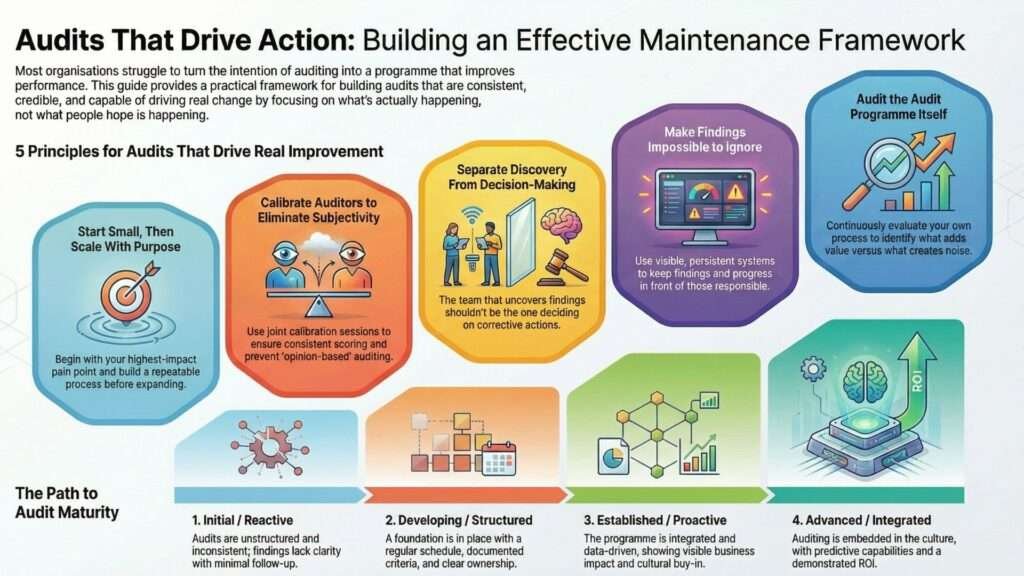
Did You Found This Article Valuable?
If this article helped sharpen your understanding of
maintenance auditing and operational performance, you’ll find plenty more here
to deepen your capability.
Below is a curated list of related articles, you can
continue learning without leaving this website.
Each link takes you directly to a detailed, practical
resource written for real industrial environments.
Building Your Maintenance Audit Framework.
This article walks you through designing a robust audit
system that reveals the truth about maintenance performance.
It covers audit structure, evidence gathering, scoring, and
how to build a repeatable audit process that drives improvement rather than
blame.
Read here: https://www.cmmssuccess.com/building-your-maintenance-audit-framework
Complete Maintenance Systems Audit Guide.
A comprehensive, consolidated guide that merges five major
audit articles into one structured resource.
It explains audit architecture, criteria, scoring, evidence
sampling, auditor behaviour, and how to turn audit findings into actionable
improvements.
Read here: https://www.cmmssuccess.com/complete-maintenance-systems-audit-guide
5 Step Maintenance Systems Auditing.
A streamlined, practical five‑step approach to assessing
maintenance systems.
It focuses on planning, execution, evidence collection,
analysis, and improvement pathways—ideal for teams wanting a simple but
effective audit method.
Read here: https://www.cmmssuccess.com/5-step-maintenance-systems-auditing
Asset Operational Performance Audits.
This article explains how to evaluate asset utilisation,
safety, cost‑effectiveness, and operational discipline.
It highlights key audit areas and provides guidance on
identifying systemic weaknesses that impact performance.
Read here: https://www.cmmssuccess.com/asset-operational-performance-audits
Maintenance Systems Audit – Parts 1, 2, 3a, 3b & 4
A multi‑part deep dive into maintenance system auditing.
Each part explores a different dimension, from planning and
evidence gathering to leadership behaviours, shutdown auditing, and system
integration.
Part 1: https://www.cmmssuccess.com/maintenance-systems-audit-part-1
Part 2: https://www.cmmssuccess.com/maintenance-systems-audit-part-2/
Part 3a: https://www.cmmssuccess.com/maintenance-systems-audit-part-3a/
Part 3b: https://www.cmmssuccess.com/maintenance-systems-audit-part-3b/
Part 4: https://www.cmmssuccess.com/maintenance-systems-audit-part-4/
Get In Control of Your Assets.
A practical guide to using BADA, Taproot, and software
tools to regain control of asset performance. It focuses on defect
identification, root cause analysis, and structured improvement pathways.
Read here: https://www.cmmssuccess.com/get-in-control-of-your-assets
Defect Elimination Management.
This article explains how to run a defect elimination
program, including bad actor analysis, prioritisation, and how to embed
continuous improvement into daily operations.
Read here: https://www.cmmssuccess.com/defect-elimination-management
Early Detection & Correction of Asset Defects.
A detailed look at why early defect detection matters, how
to identify emerging issues, and how to prevent small problems from escalating
into major failures.
Read here: https://www.cmmssuccess.com/early-detection-correction-of-asset-defects
Understanding Asset Management Metrics.
A clear explanation of the most important asset management
metrics, how to interpret them, and how to use them to drive operational and
financial performance.
Read here: https://www.cmmssuccess.com/understanding-asset-management-metrics
Analysing Maintenance Performance.
This article covers scheduled work percentage and other key
performance indicators.
It explains how to measure, review, and improve maintenance
performance using data‑driven insights.
Read here: https://www.cmmssuccess.com/analysing-maintenance-performance
Improving Your CMMS Using the Broken Window Theory.
A unique perspective on CMMS quality, showing how small
data issues create cultural and operational decline and how fixing them
improves reliability and discipline.
Read here: https://www.cmmssuccess.com/improving-your-cmms-using-the-broken-window-theory
Reliability & Maintenance Strategies.
A foundational guide to equipment reliability, maintenance
strategy development, and how to align reliability engineering with operational
goals.
Read here: https://www.cmmssuccess.com/reliability-maintenance-strategies
What Is a Maintenance Shutdown?
A clear explanation of shutdown events, why they matter,
and how to plan them effectively to minimise risk and maximise asset
availability.
Read here: https://www.cmmssuccess.com/what-is-a-maintenance-shutdown
Set Up Maintenance & Operations Systems.
A complete framework for establishing maintenance and
operations systems at a new facility, covering planning, safety, workflows, and
integration.
Read here: https://www.cmmssuccess.com/set-up-maintenance-and-operations-systems