Process-Linked Maintenance Strategies
Disclaimer.
This article provides general information about asset management practices, CMMS, EAM and ERP system configuration in lithium mining contexts.
It is not professional advice and should not be used as the sole basis for technology selection, maintenance strategy design, or regulatory decision‑making.
Lithium projects vary significantly by jurisdiction, extraction method, water regime, Environmental, Social & Governance (ESG) commitments and risk appetite, so readers should seek qualified advice and verify all practices against current standards, contracts and regulatory requirements.
Any thoughts, views, ideas and opinions expressed are those of the author only.
No warranty is provided regarding the accuracy, completeness, or applicability of this information to any specific operation. The author assumes no liability for actions taken based on this content.
Article Summary.
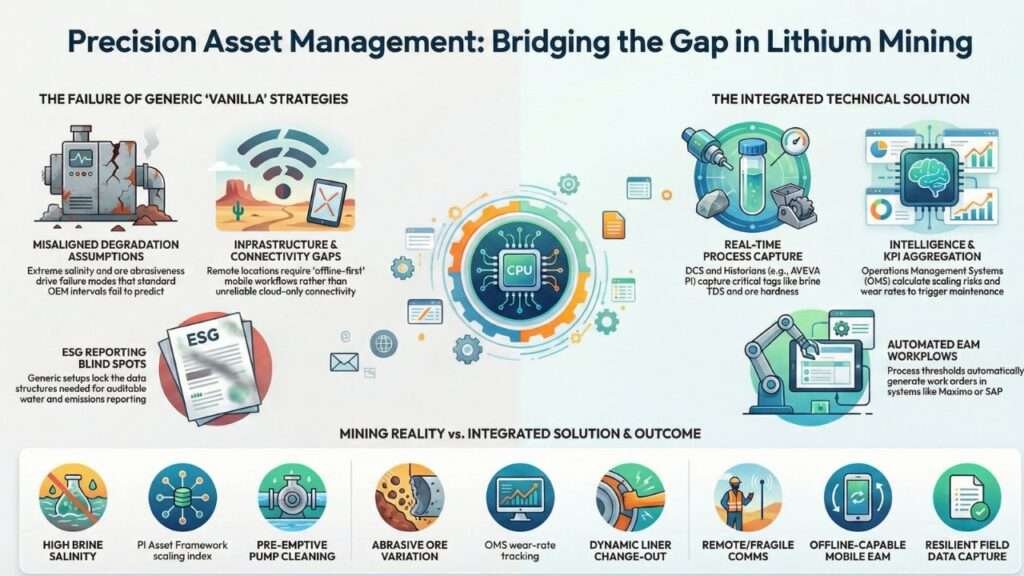
Lithium operations amplify the weaknesses of generic maintenance strategies because their degradation mechanisms, locations and regulatory expectations diverge sharply from average industrial assumptions.
Brine evaporation facilities operate with extremely high salinity and complex ion chemistry that drive corrosion, mineral scaling and sensor fouling far beyond what conventional PM templates anticipate.
Hard‑rock spodumene mines face highly abrasive, hardness‑driven wear in crushers, mills and conveying systems, where ore variability materially changes component life.
Remote locations and fragile telecommunications infrastructure make connectivity‑dependent workflows unreliable, especially for mobile work execution.
At the same time, lithium’s ESG profile attracts intense scrutiny of water usage, emissions and land disturbance, which demands EAM data structures aligned with region‑specific regulatory reporting.
Organizations that deploy ‘vanilla’ asset management configurations in this context tend to experience inflated reactive maintenance, unreliable forecasts and weak compliance evidence.
Those that deliberately align their asset strategies, master data and workflows with lithium‑specific conditions see more stable availability, lower lifecycle cost and more robust ESG reporting.
Top 6 Takeaways.
1. Lithium extraction environments have degradation mechanisms that diverge from generic industrial assumptions, so standard PM libraries and task templates are usually mis-calibrated.
2. Brine and hard‑rock operations require maintenance strategies grounded in chemistry, geology and variable operating conditions, not just OEM intervals.
3. Remote, infrastructure‑poor locations make offline‑first work execution and resilient data synchronisation essential design principles.
4. ESG and environmental monitoring expectations around water, emissions and land use require asset management structures built around specific jurisdictional reporting needs.
5. Aligning asset management configuration with lithium‑specific realities should help to improve availability, cost control and regulatory defensibility.
6. Integrated operational technology stacks beneficial for process‑linked maintenance, requiring DCS, historian, OMS, CMMS/EAM/ERP systems to work together to reflect real degradation drivers.
Table Of Contents.
1.0 Introduction.
2.0 Why Generic Maintenance Strategies Might Miss the Mark.
2.1 Misaligned Degradation Assumptions.
2.2 Master Data Structures That Ignore Chemistry and Geology.
2.3 Connectivity Dependent Workflows in Remote Locations.
2.4 ESG and Compliance Structures.
3.0 Operational Realities That Drive Failures.
3.1 Brine Evaporation: Chemistry Driven Degradation.
3.2 Hard Rock Spodumene: Abrasive, Hardness Driven Wear.
3.3 Remote Locations and Fragile Infrastructure.
3.4 Regulatory and ESG Intensification
4.0 Strategic Implications for Leaders.
4.1 Maintenance and Reliability Leadership.
4.2 Operations and Production Leadership.
4.3 CIOs and Technology Strategy.
4.4 Organisational Readiness and Change.
5.0 Enabling Technology for Process Linked Maintenance Strategies.
5.1 Core Technology Components.
5.1.1 Process Historian (AVEVA PI System).
5.1.2 Distributed Control System (Yokogawa CENTUM VP).
5.1.3 Operations Management System (OMS).
5.2 OMS Setup for Lithium Operations.
5.3 Integration Architecture to CMMS/EAM/ERP.
5.4 What an Integrated System Looks Like.
6.0 Terms and Abbreviations Used.
7.0 Conclusion.
1.0 Introduction.
Lithium has become a cornerstone mineral for batteries and
energy storage however, its extraction environments sit at the edge of what
many generic asset management implementations were originally designed to
handle.
Leaders across maintenance, operations and technology often
ask the same difficult questions such as:
1. Why do generic maintenance/asset
management strategies fail sometimes in lithium environments?
2. Why do standard PM
templates misjudge degradation?
3. Why do data
structures that work in other industries fall a bit short under lithium’s
chemistry, geology and ESG pressures?
This article does its best to shed some light on these
questions by examining the physical, operational and regulatory realities that
shape lithium extraction.
Brine operations and hard rock spodumene mines stress
equipment through combinations of chemical attack, scaling, abrasive wear and
thermal cycling that are not reflected in industry neutral asset management
templates.
As a result, the challenge is not that the commodity itself
changes the CMMS/EAM/ERP software, but that the extraction context invalidates
the assumptions baked into generic asset management strategies that would lie
within. Brine systems handle high salinity fluids with complex mixtures of
sodium, calcium, magnesium and other ions, which drive aggressive scaling and
corrosion in pumps, pipelines and evaporation equipment.
Hard rock circuits process ores with moderate to high
hardness and significant abrasiveness, creating demanding conditions for
crushers, mills and classification equipment.
These environments tend to push maintenance teams to
prioritise different inspection triggers, condition indicators and spare part holding
policies than those found in standard PM setups.
At the same time, lithium projects often sit in remote
basins, deserts or high altitude regions with limited grid power, constrained
logistics and patchy telecommunications.
ESG expectations and water related scrutiny are also higher
than in many conventional commodities because of the perceived footprint of
both brine evaporation and emerging direct lithium extraction technologies.
The result is a context where maintenance strategies should
be deliberately tuned to local realities rather than treated as generic, drop
in data.
2.0 Why Generic Maintenance
Strategies Might Miss The Mark.
Generic maintenance strategies are usually built on three
implicit assumptions:
1. That degradation
patterns are broadly predictable.
2. That connectivity is
reliable.
3. That regulatory
reporting needs are generic and minimal.
Lithium mining seems to undermine all three.
2.1 Misaligned Degradation
Assumptions.
In high‑salinity brines, dissolved solids can reach levels
far above typical industrial water systems and divalent cations such as calcium
and magnesium strongly promote scaling on heat transfer surfaces and flow
paths.
This environment accelerates corrosion of metallic
components and can drastically shorten the effective life of pump internals,
valves, level instrumentation and evaporator surfaces compared with ‘standard’
water service. Generic maintenance
strategies that assume slow, linear degradation and mild service conditions
therefore under‑specify inspection frequencies, cleaning intervals and
component change‑out rules.
In hard‑rock spodumene operations, the primary stressors are
ore hardness, abrasiveness and high‑energy comminution (the process of crushing
and grinding rock to reduce its size).
Variations in ore characteristics between benches or phases
can materially change crusher liner life, mill media consumption and conveyor
wear rates, even when nominal throughput is constant.
Maintenance strategies that assume a fixed interval for
liner changes or fully rely on OEM running‑hour guidance often either over‑maintain
or suffer unexpected failures when the ore feed changes.
2.2 Master Data Structures
That Ignore Chemistry And Geology.
Generic master data configurations frequently treat
equipment purely as mechanical assets, with attributes like manufacturer, model,
serial number and runtime statistics, but no systematic linkage to brine
chemistry, ore type, or process conditions.
In lithium environments, however, variables such as ion
composition, saturation indices, ore hardness, grind size and process
temperature materially influence failure modes.
Without data integrations/interfaces and functionality to
store, relate and trend these variables alongside maintenance histories, the
system might not support meaningful predictive or condition‑based strategies.
For example, correlating pump seal failures with brine
composition and operating temperature can reveal when chemistry shifts demand
changes in materials, filtration, or dosing strategies.
Similarly, linking crusher wear to ore hardness and
throughput can support dynamic adjustment of liner change‑out thresholds and
spares stocking levels.
Generic templates generally do not anticipate these
correlations and therefore fail to provide the fields and workflows needed to
exploit them.
2.3 Connectivity Dependent
Workflows In Remote Locations.
Many lithium projects, including those in remote regions of
Australia, operate far from established infrastructure with limited terrestrial
telecommunications and variable power reliability.
These conditions create a few challenges for cloud first
CMMS deployments that assume continuous connectivity.
Mobile technicians and contractors often need to execute and
close work orders in the field, yet cannot rely on stable online access.
When connectivity is intermittent, devices used to access
CMMS, EAM, or ERP information must allow users to continue working offline.
They need to store all data entered locally and then upload
it automatically once a connection becomes available.
This capability is essential for maintaining accurate work
execution records, asset history, and parts transactions.
Offline first design, supported by robust local caching and asynchronous synchronisation, becomes a
foundational requirement rather than an optional enhancement.
Without it, work execution slows, data becomes fragmented,
and maintenance teams lose confidence in the system’s reliability.
Generic strategies that do not anticipate connectivity
constraints tend to degrade into inconsistent processes and poor data quality.
Lithium operations that adopt offline first architectures
maintain continuity in field execution and preserve the integrity of their
asset information despite the limitations of remote environments.
2.4 ESG And Compliance
Structures.
Lithium’s role in the energy transition places exceptional
focus on water balances, emissions and community impacts, which translates into
demanding monitoring and reporting expectations.
Brine operations may be required to track withdrawal
volumes, evaporation losses, reinjection rates and water quality parameters across
multiple monitoring points. Emerging DLE technologies add new streams, reagents
and waste forms that must also be measured and reported for ESG disclosure
frameworks such as GRI, SASB and TCFD.
Generic asset management setups sometimes lack data models
and workflows to capture these environmental metrics in a structured, auditable
way linked to assets and work activities.
This gap forces operators into a parallel ecosystem of
spreadsheets and standalone tools, making it harder to demonstrate compliance,
respond to regulator queries, or provide consistent ESG narratives to
investors.
3.0 Operational Realities
That Drive Failures.
Understanding the physical realities of lithium extraction
helps clarify why generic maintenance strategies tend not to perform very well
and what ‘good’ needs to look like.
3.1 Brine Evaporation:
Chemistry Driven Degradation.
High‑salinity brines used for lithium recovery often contain
complex mixtures of sodium, calcium, magnesium and other ions that promote
scaling on evaporative and heat transfer surfaces.
As brine evaporates, concentration factors increase and
scaling risks rise, which can choke flow paths, reduce heat transfer efficiency
and foul sensors and level instrumentation.
Pumps, pipelines and valves in these systems also face
corrosive attack that can rapidly degrade seals, impellers and metallic
internals.
Effective maintenance in this context requires strategies
that explicitly integrate chemistry‑based monitoring, scaling indices and variable
inspection intervals driven by concentration and temperature rather than fixed
calendar cycles.
Asset management setups should therefore support attributes
such as brine composition, operating temperature ranges and scaling risk
indicators at the asset level, with workflows that trigger cleaning,
inspection, or material changes when thresholds are crossed.
3.2 Hard Rock Spodumene:
Abrasive, Hardness‑Driven Wear.
Hard‑rock lithium mining from spodumene involves multi‑stage
crushing, grinding and beneficiation of a moderately hard and abrasive ore.
The ore’s mechanical properties, including hardness and
abrasion index, strongly influence crusher liner wear, mill energy consumption
and media usage.
Calcination stages used to convert spodumene to more reactive
phases introduce additional thermal stresses and equipment demands.
These realities mean that maintenance strategies should be
closely tied to ore characteristics and process parameters, not just equipment
running hours.
Asset management setups that capture ore type, hardness data
and throughput alongside component condition and failure histories can support
adaptive scheduling, such as shortening liner change intervals when
particularly hard campaigns are processed.
Generic PM libraries that ignore these linkages tend to
either mis‑time critical interventions or drive unnecessary maintenance during
softer runs.
3.3 Remote Locations And
Fragile Infrastructure.
Many lithium resources are found in deserts, high plateaus,
or sparsely populated regions where road, power and telecom infrastructure are
limited.
Seasonal access constraints, long supply routes and
constrained local service capability increase the cost of unplanned failures
and lengthen repair times.
At the same time, intermittent connectivity undermines real‑time
access to cloud‑hosted CMMS, EAM or ERP platforms, especially for mobile workers.
An effective system design in this context prioritises
offline‑capable mobile apps, store‑and‑forward synchronisation and local
caching of critical asset and work data. It also incorporates supply chain
integration that reflects long lead times and the need for strategic spares,
particularly for specialised equipment exposed to high wear or corrosion.
Generic asset management setups that assume short lead times
and constant connectivity tend to generate unrealistic PM’s and unreliable historic
data.
3.4 Regulatory And ESG
Intensification.
Regulators and stakeholders increasingly expect lithium
operators to provide transparent, auditable data on water use, emissions and
ecosystem impacts.
Water balance reporting for DLE and evaporation ponds may
require quantifying withdrawals, consumptive use, recycling rates and discharge
qualities at a high temporal resolution.
ESG frameworks also drive the need for consistent metrics on
energy intensity, greenhouse gas emissions and land disturbance.
Aligning CMMS/EAM/ERP asset managment structures with these
requirements means treating environmental monitoring points, sampling campaigns
and key process parameters as managed assets with defined inspection
frequencies, calibration tasks and data capture workflows.
When environmental data remains disconnected from asset and
maintenance records, it is harder to demonstrate that equipment condition,
process control and compliance are being managed in a coherent way.
4.0 Strategic Implications
For Leaders.
For leaders in the maintenance, operations and engineering
departments, the key implication is that ‘generic’ is itself a risk category in
lithium environments.
4.1 Maintenance And Reliability
Leadership.
Maintenance managers need to ensure that maintenance strategies
and master data configurations are explicitly linked to lithium‑specific
degradation mechanisms and this could mean:
1. Grounding preventive
and predictive programs in chemistry, geology and process conditions, not just standard
reliability engineering data tables.
2. Capturing relevant
variables in asset records, including brine chemistry ranges, ore hardness
bands, key process temperatures and scaling indices.
3. Building inspection
and condition‑based tasks that trigger on changes in those variables, such as
increased scaling risk or shifts in ore feed hardness.
Without these structures, teams are limited to time‑based
maintenance and retrospective analysis, which tends to produce higher reactive
work and weaker equipment availability.
4.2 Operations And Production
Leadership.
Operations leaders carry the production risk associated with
system misalignment. In brine operations, failures in pumping, evaporation, or
reinjection systems can disrupt water balances and evaporation cycles, leading
to prolonged recovery times.
In hard‑rock circuits, unexpected failures of crushers,
mills, or classification equipment can rapidly reduce output and drive costly
overtime or emergency maintenance.
To manage these risks, operations leaders should insist on:
1. Maintenance
Strategies that reflect realistic equipment life under current chemistry and
ore conditions.
2. Integrated materials
management that recognises long lead times and ensures critical & insurance
spares are held for high‑risk assets.
3. Feedback loops where
production changes (new ore sources, process adjustments) are quickly reflected
in maintenance strategies and system configuration.
4.3 CIOs And Technology
Strategy.
Technology leaders must design architectures that are robust
to connectivity constraints and aligned with data governance requirements for
both operations and ESG. Priority areas typically include:
1. Offline‑first mobile
execution, with secure, reliable synchronisation to central CMMS/EAM/ERP
platforms.
2. Data models that link
asset performance, maintenance events, environmental monitoring and ESG metrics
in a consistent, auditable way.
3. Integration with IoT
sensors and process historians where appropriate, so that key condition
indicators can drive automated triggers or analytics without excessive manual
entry.
Cybersecurity and access control also become more important
as remote monitoring, cloud hosting and third‑party analytics platforms are
introduced into the mining ecosystem.
4.4 Organisational Readiness
And Change.
Even the best‑configured system will fail if people,
processes and governance do not align with lithium‑specific realities. Leaders
should consider:
1. Role‑based training
that explicitly links asset care practices to the chemistry and geology of
lithium operations.
2. Governance structures
that keep master data, PM libraries and environmental metrics under disciplined
control.
3. Continuous improvement
cycles where lessons from failures, inspections and ESG reporting feed back
into CMMS configuration and strategy.
This emphasis on organisational readiness is often the
decisive factor that differentiates operations that extract value from tailored
configurations from those that fall back into reactive habits.
5.0 Enabling Technology
For Process Linked Maintenance Strategies.
Achieving the linkage between lithium‑specific degradation
mechanisms and CMMS/EAM strategies requires an integrated operations technology
stack, where real‑time process data from historians and DCS flows into asset
systems via standard interfaces.
This setup leverages established tools like Process Historian
(AVEVA PI System), Yokogawa DCS (CENTUM VP), and Operations Management Systems
(OMS), connected to CMMS/EAM (e.g., IBM Maximo, Infor EAM) and ERP (e.g., SAP
S/4HANA) through APIs, middleware, and data connectors.
5.1 Core Technology Components.
5.1.1 Process Historian (AVEVA PI
System).
This captures high‑frequency time‑series data from plant
instruments, such as brine TDS, temperature, pH, ore hardness proxies (e.g.,
power draw) and flow rates. PI Asset Framework (AF) models assets
hierarchically and enriches tags with context like “Pump‑P101: Scaling Risk = f(TDS, Temp)”, making data
contextual and queryable.
Just
to explain, AVEVA PI System is a
complete data management platform where the historian functionality
is provided by its core PI Data Archive component.
Quick Structure Breakdown.
AVEVA PI System = Suite of Tools
├── PI Data Archive (the actual
*historian* database – stores time-series data)
├── PI Asset Framework (AF)
(models assets, calculates derived values like Scaling Risk)
├── PI Connectors/Interfaces
(collect data from DCS/PLC)
├── PI Integrator (pushes data to
EAM/ERP)
└── PI Vision/ProcessBook
(dashboards)
When I mention ‘Process
Historian (AVEVA PI System)’, I’m referring to:
1.
PI Data Archive as the time-series storage engine (the literal
historian)
2.
Plus PI AF for asset context (brine chemistry → pump degradation models)
3.
Plus connectors that feed it from Yokogawa DCS
In practice: Your DCS streams brine TDS data → PI Data Archive stores it → PI AF calculates “Scaling Risk Score” → PI Integrator sends score to Maximo to trigger pump
inspection.
The PI System is the
full ecosystem; Data Archive is the historian heart. Both get casually
called “PI” in industry conversation.
5.1.2 Distributed
Control System (DCS, e.g., Yokogawa CENTUM VP).
This manages real‑time
control loops, alarms and HMI visualization for brine evaporation, crushing circuits, or flotation cells.
It exposes process
variables via OPC UA/DA or proprietary protocols for upstream archiving.
Yokogawa
CENTUM VP is Yokogawa’s flagship Distributed Control System (DCS), it’s a
robust, scalable platform for real-time process automation and control in
industries like mining, chemicals, and oil & gas.
Core Purpose.
A DCS like CENTUM VP
acts as the ‘central nervous system’ of a processing
plant, managing thousands of control loops (e.g., brine pumps, crusher speeds,
flotation pH) across distributed controllers rather than a single centralized
computer.
It continuously reads
sensors, executes control logic, adjusts valves/actuators, and presents
operator interfaces, all with 99.99999%
availability via redundant ‘pair & spare’ architecture.
Key Components &
Structure.
CENTUM VP DCS = Complete Control Platform.├──Field Control Stations (FCS): Distributed controllers (redundant CPUs) executing process logic
├──Human Interface Stations (HIS): Operator HMI screens for monitoring/control
├──Vnet/IP Network: 1Gbps redundant backbone (fiber/UTP) connecting everything
├──N-IO/FIO Modules: Universal I/O (AI/AO/DI/DO) with built-in signal conditioning
├──Engineering Workstation: Logic configuration & database management
└──Unified Gateway Station (UGS): Interfaces to Modbus, Ethernet/IP, Profibus, etc.
Lithium Mining Context.
1.
Brine
evaporation: Controls pond levels,
pump speeds, chemical dosing based on TDS/chemistry loops streamed to AVEVA PI
historian.
2.
Hard-rock
processing: Manages crusher load,
mill power draw, flotation reagent addition with real-time alarming & trending.
3.
Remote
deployment: FCS controllers can be
field-mounted (Zone 2 hazardous areas) with N-IO baseplates handling intrinsic
safety.
Data Flow To
Historian/CMMS.
Sensors→N-IO→FCS Controller→Vnet/IP→AVEVA PI Data Archive
↓
Operator HIS (alarms, trends)↓
OPC UA→PI Integrator→Maximo EAM (triggers)
Key
Integration Points:
1.
OPC UA/DA: Exposes 10,000+ live process tags (brine TDS, crusher
amps) to historians.
2.
Fieldbus
Support: FOUNDATION Fieldbus,
Profibus-DP for smart instruments.
3.
Pair
& Spare Redundancy: Dual CPUs compare
outputs continuously; <1ms failover.
Example Operator View.
HIS screen shows:
Pump P-101: Speed 75%, TDS 210k ppm↑, Scaling Alert Active
↓Auto-generate WO in Maximo via PI threshold breach
CENTUM VP has evolved
since 1975, with R7 (2025) adding AI operator assistance, Windows 11 support,
and virtualization to reduce server footprints.
In lithium plants, it
delivers the real-time process
backbone that feeds degradation data into historians for
maintenance intelligence.
5.1.3 Operations
Management System (OMS).
This
Sits above DCS/historian to aggregate data into KPIs,
trends, and operator workflows (often part of DCS or historian suites like
AVEVA Operations Center). In lithium contexts, OMS dashboards might display
brine chemistry trends or crusher wear indicators for operator awareness.
5.2 OMS Setup For Lithium
Operations.
The OMS needs to be configured with asset hierarchies
and calculated tags that reflect lithium‑specific drivers:
1. Brine evaporation: OMS calculates
scaling propensity indices (e.g., Langelier Saturation Index) from DCS inputs
like conductivity, temperature, and ion proxies, alerting on thresholds that
correlate with fouling.
2. Hard‑rock processing: Tracks cumulative
“abrasive ton‑hours” or hardness‑adjusted wear rates by combining throughput,
power consumption, and periodic lab assays.
3. Remote resilience: Edge processing and
local buffering ensure data availability during connectivity gaps, with secure
sync to central OMS.
This creates a unified view of process health that
maintenance can reference without manual reconciliation.
This sub section refers to configuring a high-level operational oversight
platform (like AVEVA Operations Center, Yokogawa Exaquantum, or DCS-integrated
dashboards) to aggregate, contextualize and visualize process data specifically
for lithium extraction challenges.
Core Purpose.
OMS sits above DCS and historian as an operations intelligence layer,
turning raw tags (TDS, crusher power) into actionable KPIs, alerts, and trends
for shift operators and supervisors.
In lithium plants, it
bridges real-time control with maintenance foresight by calculating degradation proxies from process
signals.
Key Lithium-Specific
Configurations.
OMS Hierarchy for Lithium Plant├──Area: Brine Evaporation Ponds
│├──KPI: Scaling Risk Index = f(TDS, Temp, pH) > Threshold→Alert
│├──Pond P-101: Level, Evap Rate, Chemistry Trends
│└──Pump Fleet: Cumulative Runtime @ High Salinity
├──Area: Hard-Rock Processing
│├──KPI: Abrasive Wear Rate = f(Power Draw, Throughput, Ore Proxy)
│├──Crusher C-001: Liner Life Remaining (%), Ore Hardness Trend
│└──Mill Circuit: Grind Efficiency vs. Media Wear
└──Site-Wide: Water Balance, Energy Intensity, Remote Sync Status
Setup Steps.
1. Calculated Tags for Degradation
Proxies.
Brine Scaling Alert:IF (TDS > 200k ppm AND Temp > 55°C for 24h) THEN Scaling_Index = (Ca_hardness * Mg_ratio * Temp_factor)OMS displays: "PUMP INSPECTION DUE"→DCS alarm→PI event→EAM WO
Crusher Wear Proxy:Abrasion_Hours = Throughput_tph * Power_kW * Hardness_Factor (lab assay avg)When Abrasion_Hours > Liner_Threshold→"LINER CHANGE SOON" dashboard
2. Lithium-Relevant Dashboards.
Operator
Shift Handover Screen:
ACTIVE ALERTS: Brine Pump P-103 (Scaling Risk: HIGH)
TRENDS: Crusher C-002 power spiked +18% (hard ore campaign)
WATER BALANCE: Pond fill 82%, evap loss 1.2ML/day OK
MAINTENANCE: 2x pump WOs auto-generated via PI Integrator
3. Remote Lithium Site Resilience.
1.
Edge
Computing: Local OMS server caches
72hrs data during satcom outage.
2.
Prioritized
Sync: Critical KPIs (scaling risk, wear
rates) sync first when reconnected.
3.
Mobile
Access: Supervisors view KPIs
via tablet (4G/satcom) 50km from site.
4. Integration Points.
DCS (Yokogawa CENTUM VP)→Historian (PI Data Archive)→OMS
↓Raw Tags (1000s)↓Compressed (100s)↓KPIs/Alerts (10s)
Brine TDS 210k ppm Scaling_Index = 1.8 "INSPECT PUMPS"Example Operator Workflow.
08:15: OMS dashboard flashes "CRUSHER LINER RISK: 92% consumed"08:16: Operator checks trend: Ore hardness +22% vs baseline08:17: OMS auto-emails planner: "C-001 liner change recommended by EOD"08:18: DCS adjusts crusher speed -5% to extend life08:30: Maintenance WO appears in Maximo with embedded OMS trend chartVendor Examples in Lithium
Context.
1.
AVEVA
Operations Center: Plant-wide KPI
rollups, role-based views (operator vs. manager)
2.
Yokogawa
Exaquantum: DCS-native, integrates
CENTUM VP alarms with PI historian
3.
AspenTech
APM: Process-focused, strong on
calculated degradation indices
Outcome.
Operators see “Pump scaling risk: HIGH”
instead of raw TDS=210kppm. Maintenance gets preemptive work orders with context.
Executives track fleet-wide wear trends across
brine/hard-rock assets.
The OMS becomes the single pane of glass where process
meets maintenance.
This setup transforms
generic process data into lithium-specific
operational intelligence without custom coding—just deliberate
tag math and hierarchy design.
5.3 Integration Architecture
To CMMS/EAM/ERP.
Data flows from OMS to enterprise systems via bidirectional
interfaces, enabling context‑aware maintenance:
|
Layer |
Technology |
Data Flow Example |
Protocol/Method |
|
Process |
DCS
(Yokogawa) →
Historian (AVEVA PI) |
Real‑time
brine TDS, crusher power draw |
OPC
UA, PI Connectors |
|
Operations |
OMS
(AVEVA Operations Center) |
Aggregated
KPIs (e.g., Scaling Risk Score) |
PI
AF Events, PI Notifications |
|
Asset |
CMMS/EAM
(Maximo/Infor) |
Auto‑populate
asset attributes; trigger PMs (e.g., inspect when Scaling Score > 1.5) |
PI
Integrator for EAM, REST APIs, PI Web API |
|
Enterprise |
ERP
(SAP) |
Parts
forecasting from wear rates; compliance reports |
ERP
Connectors (e.g., PI to SAP IDoc), Kafka/MQ |
1. Historian to EAM: AVEVA PI Integrator
pushes enriched tags (e.g., “Ore Hardness Avg”) as meter readings or work
triggers into EAM, updating asset contexts dynamically.
2. OMS to CMMS: Event notifications
(e.g., “High Corrosion Threshold Breached”) auto‑generate work orders or adjust
PM intervals.
3. EAM to ERP: Maintenance events
and failure modes feed back for spares planning and cost allocation, closing
the loop.
Middleware like OSIsoft PI Integrator, Kepware, or Azure IoT
Hub handles protocol translation and data normalization for remote sites.
5.4 What Might An Integrated
System Looks Like?
1. Planner’s view (EAM): Work order for
brine pump shows linked PI trends: ‘TDS spiked to 250k ppm last cycle, recommend
seal inspection’ with embedded charts.
2. Operator’s view
(OMS/DCS):
Dashboard flags ‘Crusher Liner Risk: High (Ore Hardness +15% vs. baseline)’,
prompting feed adjustments before maintenance handover.
3. Executive view (ERP): Reports forecast ‘$X
increased spares due to abrasive campaign’, tied to process data for capex
justification.
This architecture seems to be well supported in this current
era of in mining (e.g., Barrick Goldstrike uses AVEVA PI for compliance and
performance).
It shifts maintenance from reactive calendars to process‑aware
intelligence without requiring custom development—just disciplined integration.
6.0 Terms And
Abbreviations Used.
This section defines key technical terms and abbreviations
used throughout the article, incorporating detailed explanations of core
operational technology components relevant to lithium mining asset management.
6.1 Key Terms.
1. Asset Framework (AF): Modeling layer in
AVEVA PI System that organizes time-series data into equipment hierarchies with
calculated attributes (e.g., “Scaling Risk Index” derived from brine
TDS and temperature).
2. AVEVA PI System: Comprehensive data
management platform where PI Data Archive serves as the core time-series
historian database, PI Asset Framework (AF) adds asset context, and PI
Integrator pushes data to EAM/ERP systems.
3. Bill of Materials
(BOM):
Structured list of spare parts and components linked to assets in CMMS/EAM for
repair planning and inventory management.
4. Brine Evaporation: Lithium extraction
process where saline groundwater is concentrated in solar ponds, creating
extreme scaling and corrosion conditions for pumps and pipelines.
5. CENTUM VP: Yokogawa’s
distributed control system (DCS) featuring Field Control Stations (FCS), Human
Interface Stations (HIS), Vnet/IP network, and N-IO universal I/O modules for
real-time process control.
6. Condition-Based
Maintenance (CBM): Maintenance triggered by real-time equipment condition
data (e.g., scaling risk thresholds) rather than fixed calendar intervals.
7. Distributed Control
System (DCS): Plant automation backbone (e.g., Yokogawa CENTUM VP)
managing thousands of control loops across redundant controllers with operator
HMI interfaces.
8. Degradation
Mechanisms:
Equipment wear processes unique to lithium operations, including brine-induced
corrosion/scaling and spodumene ore abrasiveness.
9. Enterprise Asset
Management (EAM): Advanced CMMS platforms (e.g., IBM Maximo, Infor EAM)
supporting reliability analytics, condition-based strategies, and whole-life
asset optimization.
10. Enterprise Resource Planning
(ERP):
Business platform (e.g., SAP S/4HANA) integrating finance, procurement, and
supply chain with EAM data flows.
11. Failure Modes and
Effects Analysis (FMEA): Risk assessment methodology identifying equipment failure
causes and mitigation strategies to inform PM libraries.
12. Field Control Station
(FCS):
Distributed controller in CENTUM VP executing process control logic with
pair-and-spare redundancy.
13. Human-Machine
Interface (HMI): Operator workstations (HIS in CENTUM VP) displaying
process trends, alarms, and control functions.
14. Master Data: Foundational
CMMS/EAM information including asset hierarchies, task templates, custom
attributes (e.g., “Ore Hardness”), and BOMs.
15. N-IO: Yokogawa’s
universal I/O system with built-in signal conditioning for field instruments in
hazardous areas.
16. Operations Management
System (OMS): Intelligence layer (e.g., AVEVA Operations Center,
Yokogawa Exaquantum) aggregating DCS/historian data into lithium-specific KPIs
like scaling risk and wear rates.
17. PI Data Archive: Core time-series
database component of AVEVA PI System storing compressed process data (tags)
with timestamps and quality flags.
18. Process Historian: High-frequency
time-series database optimized for industrial sensor data (e.g., AVEVA PI Data
Archive, Aspen IP.21).
19. Reliability Centered
Maintenance (RCM): Structured methodology defining maintenance strategies
based on failure consequences and detection methods.
20. Spodumene: Lithium-bearing
hard-rock mineral requiring crushing, grinding, and calcination, creating
variable abrasive wear patterns.
21. Vnet/IP: Yokogawa’s 1Gbps
redundant industrial network backbone connecting DCS components.
6.2 Abbreviations.
|
Abbreviation |
Full Form |
Description |
|
AF |
Asset
Framework |
PI
System asset modeling layer |
|
BOM |
Bill
of Materials |
Asset
component inventory |
|
CBM |
Condition-Based
Maintenance |
Real-time
condition triggered work |
|
CMMS |
Computerized
Maintenance Management System |
Work
order and scheduling software |
|
DCS |
Distributed
Control System |
Real-time
plant control platform (CENTUM VP) |
|
EAM |
Enterprise
Asset Management |
Advanced
asset lifecycle management |
|
ERP |
Enterprise
Resource Planning |
Enterprise
business integration |
|
ESG |
Environmental,
Social & Governance |
Sustainability
reporting framework |
|
FCS |
Field
Control Station |
CENTUM
VP process controller |
|
FMEA |
Failure
Modes and Effects Analysis |
Equipment
failure risk analysis |
|
HMI |
Human-Machine
Interface |
Operator
control screens |
|
HIS |
Human
Interface Station |
CENTUM
VP operator workstation |
|
OMS |
Operations
Management System |
Process
KPI aggregation layer |
|
PI |
PI
System (AVEVA) |
Industrial
data infrastructure |
|
PM |
Preventive
Maintenance |
Scheduled
reliability tasks |
|
RCM |
Reliability
Centered Maintenance |
Risk-based
strategy design |
|
TDS |
Total
Dissolved Solids |
Brine
salinity measure (ppm) |
|
UGS |
Unified
Gateway Station |
CENTUM
VP external protocol interface |
7.0 Conclusion.
Lithium extraction environments do not
necessarily require new CMMS, EAM, or ERP technologies, but they do benefit
from deliberate integration of proven operational systems that address the
shortcomings of generic, template driven strategies.
Brine operations and hard‑rock spodumene circuits create
corrosion, scaling and abrasive wear patterns that DCS platforms such as Yokogawa CENTUM
VP capture in real time.
Process historians like AVEVA PI System
archive and contextualise these signals, and Operations Management Systems
convert them into maintenance intelligence that reflects actual operating
conditions.
Remote lithium sites with fragile
connectivity require offline first EAM configurations supported by process
aware data flows rather than calendar based assumptions.
Increasing ESG scrutiny demands auditable
environmental metrics linked directly to asset performance records, not
isolated spreadsheets or manual reporting.
Organizations that persist with
disconnected, generic maintenance strategies and overall asset management
setups face ongoing reactive maintenance, unreliable degradation forecasting
and fragmented compliance reporting.
Those that do the clever work (although
this comes at a cost) and integrate their DCS, historian, OMS, EAM and ERP systems
around lithium specific realities such as brine chemistry thresholds, ore
hardness variability and water balances achieve predictive maintenance
capability, resilient remote execution, and defensible sustainability metrics.
The technology required to support this already exists
across all major vendors. Success belongs to operations that configure it with
discipline, linking process reality to asset strategy across the full lifecycle
of their lithium infrastructure.