Facility Management
Facility management has always been one of those disciplines that sits quietly in the background until something goes wrong.
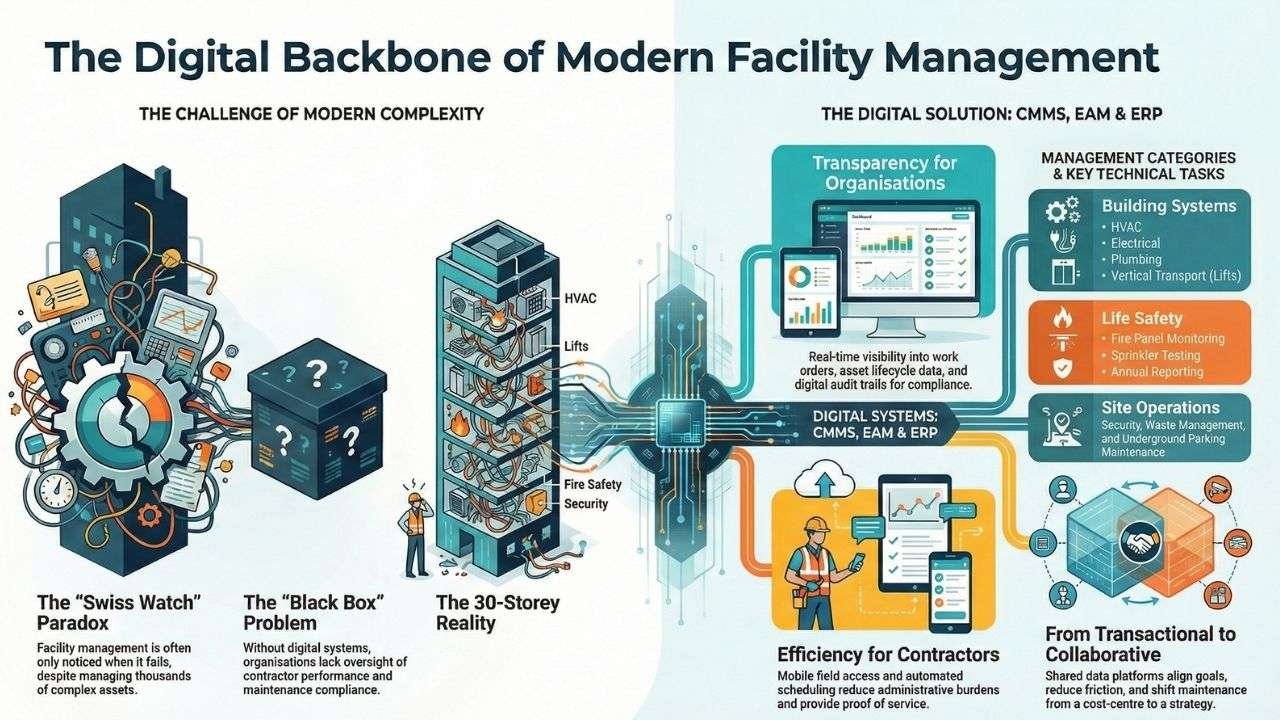
When it’s working well, nobody notices, other than a general appreciation that everything is running beautifully like a Swiss watch; when it fails, everyone seems to be a Facility Management Expert and tend to express their dissatisfaction in great detail.
At its core, facility management is the coordinated process of maintaining buildings, infrastructure and services so organisations can operate safely, efficiently, and reliably.
However, the modern landscape has changed dramatically. Buildings are bigger, more complex, companies are packing more people into spaces, compliance requirements are stricter and expectations for transparency and performance have never been higher.
This is where CMMS, EAM, and ERP systems become very useful, not just for the organisations that engage facility management contractors, but also for the contract companies that perform this work.
What Facility Management Really Encompasses.
Facility management covers a wide spectrum of responsibilities: asset maintenance, cleaning, HVAC, electrical systems, fire protection, groundskeeping, security, waste management, energy optimisation, and much more. It blends technical maintenance with service delivery, compliance, and customer experience.
In many organisations, especially in commercial property, healthcare, education, and government, these services are outsourced to specialist facility management contractors.
The challenge is that facility management is inherently complex.
There are thousands of assets, hundreds of service tasks, strict regulatory requirements, and constant pressure to reduce costs while improving service quality. Without a structured system, it’s easy for work to become reactive, undocumented, or inconsistent.
Why CMMS/EAM/ERP Systems Are So Valuable in Facility Management.
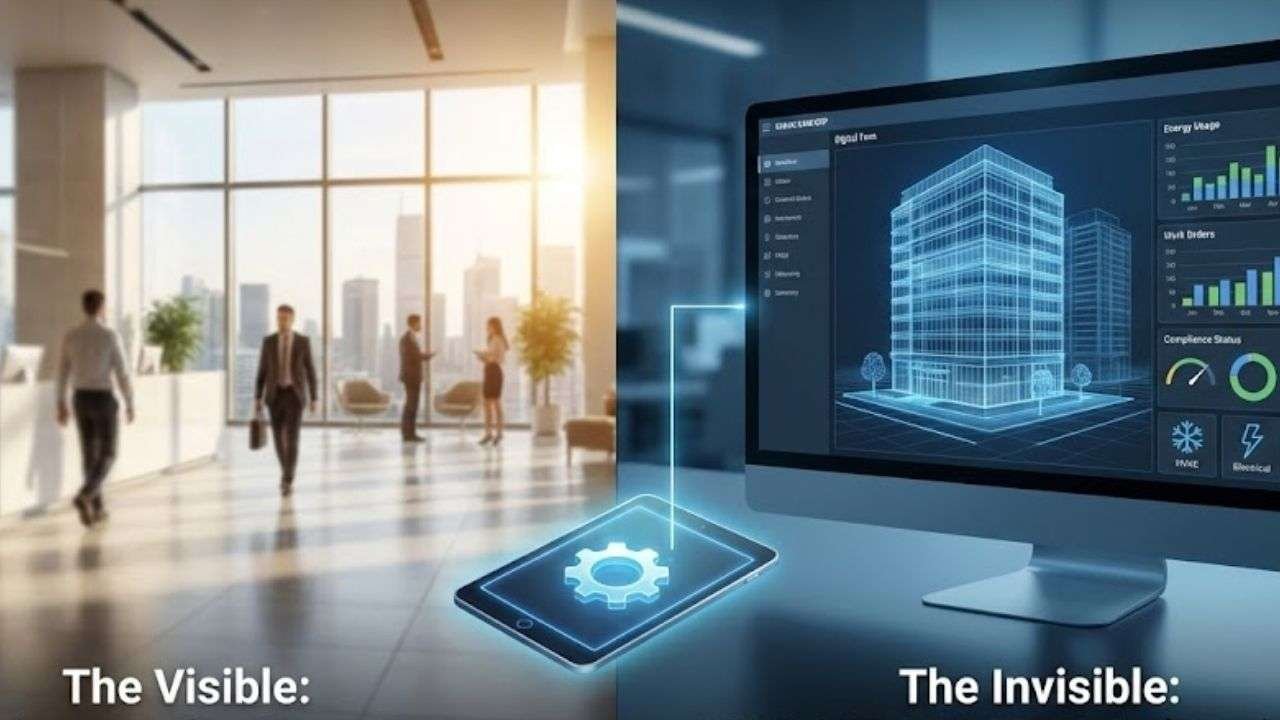
A CMMS (Computerised Maintenance Management System), EAM (Enterprise Asset Management), or ERP (Enterprise Resource Planning) system provides the digital backbone that supports all facility management activities.
These systems centralise data, standardise processes, and create transparency between the client organisation and the contractor.
For organisations that engage facility management contractors, the system becomes a source of truth. For contractors, it becomes the operational engine that drives efficiency and accountability.
How CMMS/EAM/ERP Systems Help the Engaging Organisation.
1. Visibility and Transparency.
One of the biggest frustrations for organisations is not knowing what work is being done, when it’s being done, or whether it’s being done to the required standard. A CMMS/EAM/ERP system provides real‑time visibility into:
- Work order status.
- Preventive maintenance compliance.
- Asset condition and lifecycle data.
- Contractor performance metrics.
This transparency builds trust and eliminates the “black box” problem where contractors operate without oversight.
2. Improved Compliance and Risk Management.
Facilities are subject to strict regulations—fire systems, electrical safety, HVAC standards, water quality, accessibility, and more. A CMMS ensures:
- Scheduled compliance tasks.
- Digital audit trails.
- Evidence of completion.
- Automated reminders and escalations.
This reduces organisational risk and ensures that compliance isn’t dependent on memory or manual tracking.
3. Better Budgeting and Cost Control.
With accurate data on labour, materials, asset performance, and failure patterns, organisations can make informed decisions about:
- Budget forecasting.
- Contract negotiations.
- Repair vs replace decisions.
- Energy and utility optimization.
This shifts facility management from a cost centre to a strategic contributor.
4. Standardised Service Delivery.
A CMMS enforces consistent processes across all contractors and sites. This ensures:
- Uniform service levels.
- Consistent documentation.
- Clear expectations and KPIs.
Standardisation is especially valuable for organisations with multiple buildings or campuses.
5. Data‑Driven Decision Making.
With years of asset and maintenance data stored in the system, organisations can analyse trends, identify inefficiencies, and plan long‑term improvements. This is essential for capital planning and lifecycle management.
How CMMS/EAM/ERP Systems Help Facility Management Contractors.
Contractors benefit just as much—sometimes more—because these systems streamline operations, reduce administrative burden, and improve service quality.
1. Efficient Work Management.
A CMMS provides contractors with:
- Clear work orders.
- Mobile access in the field.
- Automated scheduling.
- Real‑time updates.
This reduces confusion, eliminates paperwork, and ensures technicians always know what to do next.
2. Proof of Service and Accountability.
Contractors can easily demonstrate compliance and performance through:
- Timestamped work orders.
- Photos and digital signatures.
- Asset history logs.
This protects them from disputes and strengthens their credibility.
3. Improved Resource Allocation.
With visibility into workload, asset criticality, and service frequency, contractors can optimise:
- Technician scheduling.
- Route planning.
- Inventory and spare parts.
This reduces downtime and increases productivity.
4. Stronger Client Relationships.
When contractors use the client’s CMMS, or integrate their own, they demonstrate professionalism and transparency.
This builds trust and often leads to contract renewals or expanded scope.
5. Performance Benchmarking and Continuous Improvement.
Contractors can analyse their own performance across multiple clients, identifying:
- Recurring issues.
- Training needs.
- Process inefficiencies.
This helps them deliver higher‑quality service and differentiate themselves in a competitive market.
The Shared Benefits: A Collaborative Ecosystem.
When both parties use the same system—or integrated systems—the relationship becomes collaborative rather than transactional.
The CMMS/EAM/ERP becomes a shared platform where:
- Expectations are clear.
- Performance is measurable.
- Communication is streamlined.
- Data drives decisions.
This reduces friction, improves service quality, and ensures that facility management supports the organisation’s broader goals.
Why This Matters More Than Ever.
Modern facilities are complex ecosystems of mechanical, electrical, digital, and environmental systems.
Without a structured digital platform, it’s impossible to manage them effectively. CMMS/EAM/ERP systems bring order, visibility, and intelligence to a domain that historically relied on manual processes and tribal knowledge.
For organisations, this means safer buildings, lower costs, and better service.
For contractors, it means efficiency, accountability, and competitive advantage.
For both, it means a more mature, transparent, and data‑driven partnership.
Typical Facilities Management Tasks.
# 30‑Storey Office Building #
1. Building Systems & Technical Maintenance.
HVAC (Heating, Ventilation, Air Conditioning).
- Routine inspections of air handling units.
- Filter replacements on scheduled cycles.
- Chiller and cooling tower maintenance.
- Monitoring BMS alarms and adjusting setpoints.
- Seasonal performance testing.
Electrical Systems
- Testing and maintaining switchboards and distribution panels.
- Emergency lighting inspections.
- UPS and generator testing.
- RCD testing and compliance checks.
- Lighting repairs and sensor calibration.
Plumbing & Water Systems.
- Inspection of toilets, sinks, showers, and drainage.
- Hot water system maintenance.
- Legionella testing and flushing routines.
- Leak detection and repairs.
Fire & Life Safety Systems.
- Fire panel monitoring and fault resolution.
- Sprinkler and hydrant testing.
- Extinguisher inspections.
- Evacuation system testing (EWIS, alarms).
- Annual fire safety compliance reporting.
Vertical Transport (Elevators).
- Monthly lift servicing.
- Emergency phone and alarm testing.
- Door safety sensor checks.
- 24/7 breakdown response coordination.
2. Floor‑Level Facilities Tasks (Floors 1–29).
Office Space.
- Daily cleaning of desks, floors, and common areas.
- HVAC vent cleaning and airflow checks.
- Carpet and upholstery maintenance.
- Pest control monitoring.
Toilets & Change Rooms.
- Daily cleaning and restocking.
- Shower drainage and waterproofing inspections.
- Locker maintenance and lock repairs.
- Exhaust fan and ventilation checks.
Kitchen / Break Areas.
- Cleaning and sanitisation of benches and appliances.
- Dishwasher servicing and filter cleaning.
- Grease trap inspections (if applicable).
- Waste and recycling management.
3. Top Floor – Executive & CEO Areas.
Executive Offices.
- High‑standard cleaning and presentation tasks.
- Furniture and décor maintenance.
- IT/AV coordination for executive equipment.
Boardrooms & Conference Areas.
- AV system testing before meetings.
- Climate and lighting adjustments for events.
- Catering coordination and room resets.
- Whiteboard, screen, and conferencing equipment maintenance.
4. Underground Parking & Bicycle Storage.
Parking Area.
- Lighting inspections and replacements.
- Ventilation and CO sensor testing.
- Line marking and signage upkeep.
- Security patrols and CCTV monitoring.
- Drainage and sump pump maintenance.
Bicycle Storage Room.
- Access control system maintenance.
- Bike rack and anchor point inspections.
- Cleaning and floor safety checks.
- Lighting and CCTV checks.
5. Cleaning & Hygiene Services.
- Daily cleaning of all floors and amenities.
- Waste and recycling collection.
- Glass and façade cleaning (scheduled).
- Deep cleaning of carpets and upholstery.
- Sanitisation of high‑touch surfaces.
6. Security & Access Control.
- Monitoring CCTV and access logs.
- Maintaining access cards and permissions.
- Alarm system testing.
- Visitor management coordination.
- Emergency response drills.
7. Grounds & External Areas.
- Landscaping and garden maintenance.
- Footpath and entryway cleaning.
- Stormwater drain inspections.
- Façade inspections and minor repairs.
8. Compliance, Reporting & Administration.
- Maintaining asset registers and service logs.
- Coordinating statutory inspections.
- Managing contractor inductions and permits.
- Budget tracking and invoice reconciliation.
- Updating the CMMS/EAM with completed work.
9. Tenant & Occupant Services.
- Responding to comfort complaints (temperature, lighting).
- Managing meeting room bookings.
- Coordinating moves, adds, and changes (MAC).
- Supporting events and after‑hours functions.
Summary.
A building of this scale requires a coordinated, system‑driven approach. A CMMS or EAM platform becomes the backbone that schedules preventive maintenance, tracks compliance, logs work orders, manages contractors, and provides transparency to both the building owner and the facility management provider.