Cost Control

Cost control is often misunderstood and even underappreciated in maintenance intensive industries. Some organisations treat it as a budgeting exercise, a procurement challenge, or a possibly even a mandate to “spend less.”
However, in environments where reliability, safety and production continuity depend on disciplined maintenance, cost control is not about reducing expenditure, it is about controlling the drivers of cost.
It is the structured, evidence‑based management of the decisions, behaviours and systems that determine how much an organisation ultimately spends to keep its assets running.
In maintenance, the related costs are inevitable but they are not a simple financial metric. It is a reflection of maturity, discipline, data integrity, asset strategy, and leadership behaviour.
When cost control is done well, it strengthens reliability, reduces risk and improves long‑term asset value.
When done poorly, it accelerates degradation, increases downtime and creates a cycle of reactive spending that is far more expensive than the organisation might realise.
Cost control, therefore, is not a financial function, it’s an operational philosophy.
The True Nature of Maintenance Cost.
Most organisations dramatically underestimate how many factors influence maintenance cost. Labour and spare parts are visible, but they are not the primary drivers. The real cost of maintenance is shaped by:
- Upstream decisions: How assets are designed, specified, installed and commissioned.
- Operational discipline: How equipment is run, loaded and monitored.
- Maintenance strategy quality: Whether PMs prevent failure or simply consume labour.
- Data integrity: Whether decisions are based on evidence or assumptions
- Work management maturity: Planning, scheduling, backlog control and prioritization.
- Failure behaviour: Whether failures are predictable, preventable or chaotic.
- Organisational culture: Whether teams surface issues early or hide them.
In this context, cost control is not about cutting. It is about controlling the conditions that create unnecessary cost.
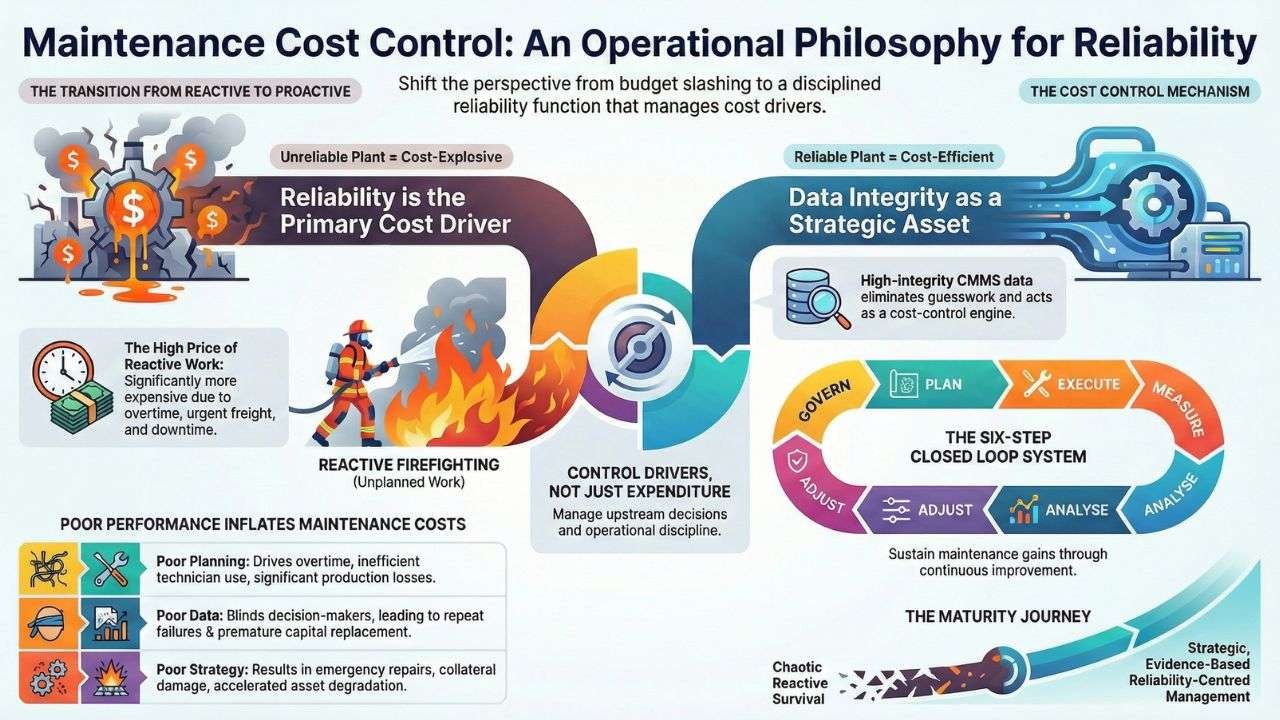
Reactive maintenance is typically the most expensive form of maintenance and is often the result of poor performance in four areas.
- Poor planning can end up being expensive.
- Poor data can end up being expensive.
- Poor strategy can end up being expensive.
- Poor leadership behaviour can end up being expensive.
| Poor Performance Area |
Cost Impact of Reactive Maintenance |
| Poor Planning |
Tasks executed under time pressure with incomplete scopes, unclear priorities, and missing materials.
Drives overtime labour, repeated visits, inefficient technician use, longer outages, and production losses exceeding direct maintenance costs. |
| Poor Data |
Inaccurate failure codes, incomplete histories, and unreliable asset registers blind decision-makers.
Repeat failures stay hidden, ineffective tasks persist, critical risks missed—leading to misplaced spending, higher lifecycle costs, more breakdowns, and premature capital replacement. |
| Poor Strategy |
Static or misaligned strategies ignore actual failure modes, operating context, and risk profile.
Critical failures unaddressed, low-value inspections consume effort—resulting in emergency repairs, collateral damage, production interruptions, and accelerated asset degradation requiring early replacement. |
| Poor Leadership Behaviour |
Leaders reward firefighting over planning, ignore data quality, defer preventive work.
Creates culture of workarounds, bypassed standards, dishonest reporting.
Pays through chronic instability: higher incidents, burnout, turnover, vendor dependence, and inability to escape breakdown cycles. |
Cost control can often be the discipline that prevents these inefficiencies from becoming normalised.
Cost Control as a Reliability Function.
In asset‑intensive environments, cost and reliability are inseparable. Every dollar saved through short‑term cuts that reduce reliability will return as a larger cost later, often multiplied by downtime, safety risk, and lost production.
Cost control is therefore a reliability function, not a finance function.
A reliable plant is a cost‑efficient plant. An unreliable plant is a cost‑explosive plant.
The organisations that spend the least on maintenance over the long term are not the ones that cut the most, they are the ones that:
- Prevent Failures rather than respond to them.
- Plan And Schedule work rather than chase breakdowns.
- Use Data To Refine strategies rather than repeat outdated tasks.
- Invest In Capability, tools and systems that reduce chaos.
- Treat Maintenance As A Lifecycle Investment, not a cost centre.
Cost control is the discipline that ensures reliability is designed, not hoped for.
The Cost Control Loop: A Closed‑Loop System.
Just like Continuous Improvement, cost control is a closed‑loop system. It operates through a cycle of:
- Plan, Define strategies, budgets, standards and expectations
- Execute, Perform work to standard, using disciplined processes
- Measure, Track cost, performance, compliance and failure behaviour
- Analyse, Identify cost drivers, inefficiencies and systemic issues
- Adjust, Refine strategies, eliminate waste, optimise intervals
- Govern, Standardise changes, enforce discipline, sustain gains
Cost control fails when organisations focus only on the “measure” step, reporting cost, without analysing or adjusting the underlying drivers.
A CMMS/EAM system is essential here, not as a cost ledger but as a visibility engine. Without accurate work order history, failure codes, labour hours and material usage, cost control becomes guesswork.
The Hidden Costs That Can Destroy Budgets.
Typically, maintenance budgets are not blown out by large, dramatic failures, although it certainly can happen on occasion.
The most common reasons for not keeping a lid on the maintenance budget is that the costs have gone north via a plethora of small inefficiencies that have compounded over time and these can include:
- Unplanned Work: Unplanned work is often a few times more expensive than planned work due to overtime, urgent freight, production loss and inefficiency.
- Poor Planning and Scheduling: A technician without can end up spending a sizeable portion of their day walking around searching for defects that need fixing, or possible waiting in the crib room or keeping themselves busy doing improvement work. This labour inefficiency can end up being one of the largest hidden costs in maintenance.
- Ineffective Preventive Maintenance: PM tasks that do not prevent failure are a waste of labour and create false confidence. PM tasks that are too frequent waste resources. PM tasks that are too vague produce poor data and means the technician needs to work out what the PM is suppose to require prior to starting work.
- Poor Spare Parts Management: Excess inventory ties up capital (overhead cost) but there are times where it’s actually a much better situation to be in than not having enough of the right parts on the shelves etc as insufficient inventory causes additional downtime and adds the cost of urgent provision. Poorly controlled inventory leads to shrinkage, duplication and emergency procurement, parts optimization is great but there must be rules in the equation to prevent removing insurance or highly critical spares from the inventory as they will often be identified as slow moving and potentially obsolete by the optimization programs.
- Data Quality Failures: Bad data leads to poor performance in all areas of maintenance (purchase, identify, plan, schedule, execute, analyse & improve), bad decisions end up getting made and this leads to unnecessary costs. Data integrity is not clerical, it is strategic.
- Cultural Behaviours: “Pencil‑whipped” PMs, hidden failures, ‘blame’ & ‘not my problem’ culture and silly shortcuts all create invisible costs that eventually becomes visible through either breakdowns or strange spikes in maintenance costs.
Cost control is the discipline that exposes and eliminates these hidden drains.
Cost Control and Maintenance Strategy.
A maintenance strategy is one of the most powerful cost control tools an organisation has. But only if it is treated as a living system.
A static PM program is a cost‑inflation machine. An adaptive PM program is a cost‑control engine.
Cost control usually requires:
- Removing PM tasks that do not prevent failure.
- Adjusting intervals based on evidence, not tradition.
- Adding tasks that address emerging risks.
- Aligning PM effort with asset criticality.
- Ensuring PMs are specific, measurable and auditable.
- Validating PM effectiveness through failure analysis.
When strategy evolves, cost stabilises. When strategy stagnates, cost escalates.
The Role of CMMS/EAM/ERP in Cost Control.
A CMMS is not a cost‑tracking tool, it is the institutional memory that enables cost control. It provides:
- Asset history.
- Labour utilization.
- Material consumption.
- Failure mode visibility.
- Backlog health.
- Planning and scheduling discipline.
- Cost trends and variance analysis.
The system only works if the data is accurate, as such, cost control depends on:
- Standardised failure codes.
- Complete work orders.
- Accurate labour hours.
- Correct material usage.
- Consistent asset hierarchies.
- Disciplined close‑out processes.
A CMMS with poor data is a cost‑distortion engine.
A CMMS with high‑integrity data is a cost‑control engine.
Leadership Behaviour and Cost Control.
Leadership behaviour is the single greatest determinant of cost control success.
Leaders who chase short‑term savings create long‑term cost explosions.
Leaders who prioritise reliability create long‑term cost stability.
Effective cost control leadership:
- Reinforces planning and scheduling discipline.
- Protects preventive maintenance from production pressure.
- Demands accurate data, not convenient data.
- Rewards transparency, not heroics.
- Invests in capability, tools and systems.
- Treats failures as learning opportunities.
- Aligns cost decisions with lifecycle value.
Cost control is not achieved by demanding lower spend. It is achieved by demanding higher discipline.
Cost Control and Organisational Maturity.
Cost control evolves with maintenance maturity:
- Reactive Stage: Cost is chaotic, unpredictable and dominated by breakdowns. Cost control is impossible because the organisation is in survival mode.
- Preventive Stage: Cost stabilises but may increase due to over‑maintenance. Cost control focuses on eliminating waste and improving planning.
- Predictive Stage: Cost becomes more predictable. Cost control focuses on optimising intervals and reducing unplanned work.
- Reliability‑Centred Stage: Cost aligns with risk and criticality. Cost control becomes strategic and evidence‑based.
- Optimised Stage: Cost is stable, predictable and aligned with lifecycle value. Cost control is embedded in culture, systems and leadership.
Cost control is not a destination, it is a maturity journey.
The Human Dimension of Cost Control.
Technicians, planners and supervisors are the frontline of cost control. Their behaviours determine:
- Data quality.
- PM compliance.
- Work execution quality.
- Failure reporting.
- Planning accuracy.
- Material usage.
- Operational discipline.
If they feel rushed, blamed or unsupported, cost control collapses. If they feel trusted, trained and valued, cost control thrives.
Psychological safety is therefore a cost control mechanism. Transparency is a cost control mechanism. Engagement is a cost control mechanism.
Cost control is not just technical, it is cultural.
Cost Control as a Long‑Term Investment.
The most cost‑efficient organisations are often those that:
- Invest in planning and scheduling.
- Invest in training and capability.
- Invest in CMMS configuration and data integrity.
- Invest in root cause analysis.
- Invest in reliability engineering.
- Invest in standardisation and governance.
These investments reduce long‑term cost by reducing chaos. Cost control is not about spending less, it is about spending wisely.
Cost Control by Design, Not by Pressure.
In maintenance and asset‑intensive environments, cost control is not a financial exercise. It is the disciplined management of the systems, behaviours and decisions that determine how much an organisation ultimately spends to keep its assets reliable.
Cost control can be described as the 6 A’s, as follows:
- A reliability function.
- A leadership behaviour.
- A cultural discipline.
- A data‑driven process.
- A closed‑loop system.
- A maturity journey.
When done well, it stabilises cost, strengthens reliability and protects asset value. When done poorly, it creates a cycle of reactive spending that becomes increasingly difficult to escape.
True cost control isn’t about slashing your budget to shreds, it’s about taking the time to meticulously engineer enduring reliability.