Compliance Management
Why Discipline, Governance and Culture Matter More Than Rules.
Compliance Management is sometimes misunderstood as a bureaucratic obligation, a collection of checklists, audits and regulatory requirements that organisations must “get through” to avoid penalties.
In heavy industrial environments that are maintainable asset intensive, this view doesn’t help at all. Compliance is not an administrive burden, it’s not a box‑ticking exercise and it’s not a time wasting exercise imposed by regulators.
Compliance Management is the disciplined system through which an organisation ensures that its assets, people and processes operate safely, legally and reliably.
It is the governance framework that protects the organisation from risk, preserves asset integrity and ensures that maintenance decisions align with standards, legislation and internal expectations.
In industries where equipment failure can lead to injury, environmental harm, production loss or reputational damage, Compliance Management is the backbone of operational integrity.
What Compliance Management Really Means.
Compliance Management is the structured process of ensuring that an organisation meets all relevant legal, regulatory, industry and internal requirements. In maintenance environments, this includes:
- Safety legislation and codes of practice.
- Environmental regulations.
- Electrical, mechanical and pressure equipment standards.
- OEM requirements and warranty conditions.
- Internal policies, procedures and engineering standards.
- Audit requirements and certification frameworks.
- Risk management and governance obligations.
Compliance is not simply about avoiding fines. It is about ensuring that the organisation operates in a way that is safe, predictable and defensible.
In heavy industries, compliance failures rarely occur because people don’t care.
They occur because systems are weak, processes are unclear, data is unreliable or leadership signals are inconsistent.
Compliance Management is the discipline that prevents these failures from becoming normalised.
Compliance As A Risk‑Control System.
Compliance is fundamentally a risk‑control mechanism. It ensures that:
- Assets are maintained to a standard that prevents failure.
- Work is performed safely and consistently.
- Hazards are identified and controlled.
- Regulatory obligations are met.
- decisions are traceable and defensible.
- the organisation can demonstrate due diligence.
In maintenance, risk is everywhere: rotating equipment, electrical systems, confined spaces, pressure vessels, hazardous chemicals, working at heights, mobile plant.
Compliance Management ensures that these risks are controlled through:
- Training and competency.
- Inspection regimes.
- Engineering controls.
- Audit trails.
- Governance structures.
Without compliance, risk becomes invisible. And invisible risk is the most dangerous kind.
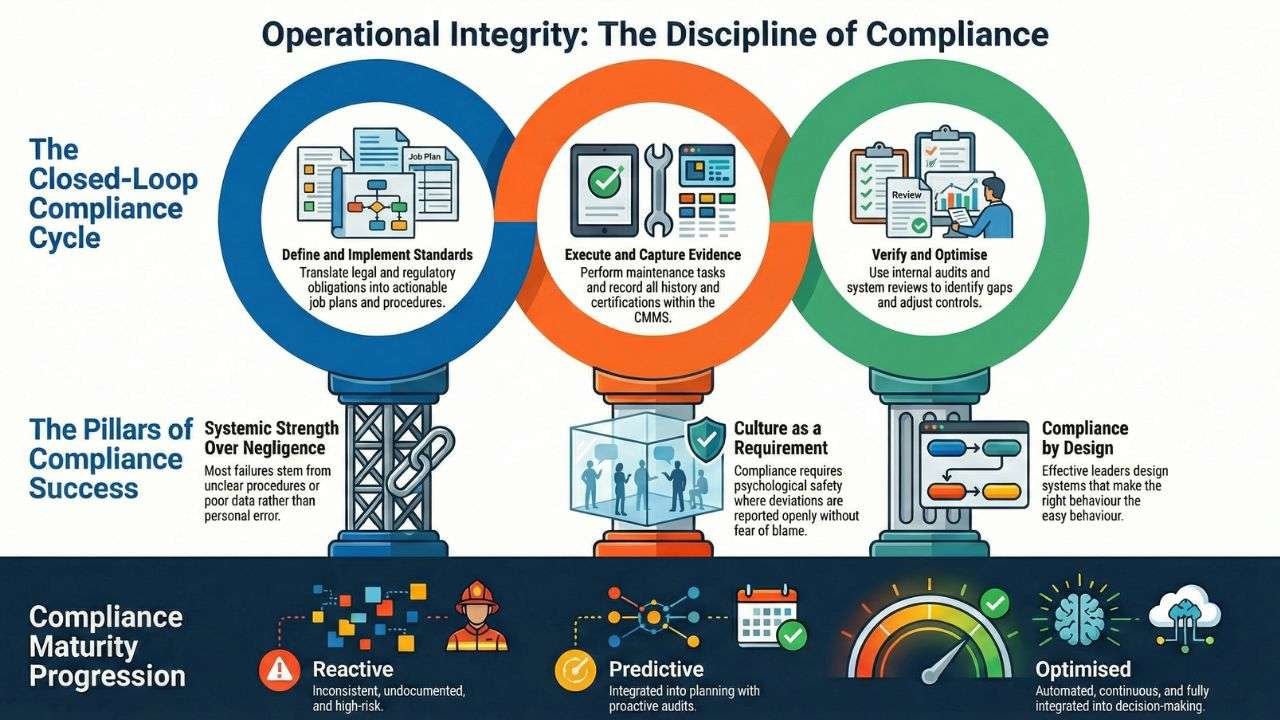
The Compliance Management Cycle: A Closed‑Loop System.
Like Continuous Improvement and cost control, Compliance Management is a closed‑loop system and it operates through a cycle of:
- Define Requirements: Identify all legal, regulatory, industry and internal obligations. Translate them into clear, actionable standards.
- Implement Controls: Develop procedures, job plans, training, engineering controls and workflows that ensure compliance is achievable.
- Execute Work: Perform maintenance tasks in accordance with standards, using trained personnel and approved processes.
- Capture Evidence: Record work order history, inspections, certifications, permits, calibrations and test results in the CMMS/EAM system.
- Verify and Audit: Conduct internal audits, compliance checks, field inspections and system reviews to confirm adherence.
- Analyse and Improve: Identify gaps, failures, trends and systemic issues. Adjust processes, training and controls accordingly.
- Govern and Standardise: Ensure changes are documented, approved and embedded into the system so compliance is sustained.
Compliance fails when organisations focus only on execution, doing the work, without capturing evidence, verifying performance or governing changes.
The Hidden Drivers of Compliance Failure.
Most compliance failures are not caused by negligence (although that’s certainly possible), quite often they are caused by systemic weaknesses that accumulate over time and these include:
- Unclear Procedures: If procedures are vague, outdated or inconsistent, compliance becomes subjective.
- Poor Data Quality: If work orders lack detail, failure codes are incorrect or inspections are incomplete, compliance cannot be demonstrated.
- Inadequate Training: If technicians are not trained or assessed as competent, compliance becomes accidental rather than intentional.
- Weak Governance: If changes to job plans, strategies or system configurations are uncontrolled, compliance becomes fragmented.
- Cultural Barriers: If people fear blame, they hide deviations rather than report them.
- Over‑reliance on Individuals: If compliance depends on “the one person who knows how to do it,” the system is fragile.
Compliance Management is the discipline that exposes and eliminates these vulnerabilities.
Compliance and Maintenance Strategy.
Maintenance strategy is one of the most powerful compliance tools an organisation has. A well‑designed strategy ensures that:
- Statutory inspections occur on time.
- Safety‑critical tasks are prioritized.
- OEM requirements are met.
- Warranty conditions are preserved.
- Risk‑based maintenance is aligned with regulatory expectations.
- Asset integrity is maintained throughout the lifecycle.
‘A Static PM Program’ is a compliance risk, whereas a ‘A Living PM Program’ is a compliance safeguard.
Compliance Management typically requires:
- Mapping regulatory requirements to PM tasks.
- Ensuring PMs are specific, measurable and auditable.
- Linking PMs to asset criticality.
- Validating PM effectiveness through inspection results.
- Updating PMs when regulations or conditions change.
Compliance is not achieved by having a strategy. Compliance is achieved by maintaining a strategy.
The Role of CMMS/EAM/ERP Systems in Compliance.
A CMMS or EAM system is the backbone of Compliance Management. It provides:
- Asset registers and hierarchies.
- Inspection schedules and statutory tasks.
- Work order history and evidence of execution.
- Permit‑to‑work integration.
- Calibration and certification tracking.
- Audit trails and version control.
- Document management and procedure control.
- Risk and criticality frameworks.
But naturally the system only works if the data is accurate at specification and compliance depends on:
- Complete work orders.
- Correct failure codes.
- Accurate labour hours.
- Documented inspections.
- Attached certifications.
- Controlled workflows.
- Standardised naming conventions.
- Disciplined close‑out processes.
A CMMS with poor data is a compliance liability. A CMMS with high‑integrity data is a compliance asset.
Compliance As A Cultural System.
Compliance is not achieved through rules. It is achieved through culture.
A compliant organisation is one where:
- People follow procedures because they understand why.
- Deviations are reported, not hidden.
- Leaders reinforce discipline, not shortcuts.
- Technicians feel safe raising concerns.
- Planners and supervisors value accuracy over speed.
- Audits are seen as learning tools, not threats.
- Transparency is rewarded.
- Blame is replaced with curiosity.
Psychological safety is therefore a compliance requirement. Without it, compliance becomes a façade.
Leadership and Compliance Management.
Leadership behaviour is the strongest predictor of compliance performance.
Leaders who prioritise production over process create environments where shortcuts become normalised.
Leaders who reinforce discipline create environments where compliance becomes habitual.
Effective compliance leadership:
- Sets clear expectations.
- Ensures procedures are practical and current.
- Invests in training and competency.
- Demands accurate data.
- Supports audits and investigations.
- Protects statutory tasks from operational pressure.
- Models the behaviours they expect from others.
- Treats non‑compliance as a system issue, not a personal failure.
Compliance is not achieved by demanding adherence. Compliance is achieved by designing adherence.
Compliance and Organisational Maturity.
Compliance maturity evolves alongside maintenance maturity:
- Reactive Stage: Compliance is inconsistent, undocumented and dependent on individuals. Audits reveal gaps. Risk is high.
- Preventive Stage: Compliance becomes more structured. PMs are aligned with statutory requirements. Evidence is captured but not always reliable.
- Predictive Stage: Compliance is integrated into planning and scheduling. Data quality improves. Audits become proactive rather than corrective.
- Reliability‑Centred Stage: Compliance is embedded in strategy, governance and culture. Evidence is robust. Risk is controlled.
- Optimised Stage: Compliance is continuous, automated where possible and fully integrated into decision‑making. The organisation is audit‑ready at all times.
Compliance is not a destination. It is a maturity journey.
Why Compliance Management Matters.
Compliance Management protects the organisation from:
- Safety incidents.
- Environmental harm.
- Legal penalties.
- Production loss.
- Reputational damage.
- Asset degradation.
- Operational chaos.
- Leadership liability.
But more importantly, it protects the people who operate, maintain and rely on the assets.
Compliance is not about avoiding punishment. It is about ensuring that everyone goes home safe, every day.
Compliance by Design, Not by Chance.
In maintenance and asset‑intensive environments, Compliance Management is not a bureaucratic obligation.
It is the disciplined system that ensures assets are safe, reliable and legally compliant.
It connects people, processes and technology into a coherent governance framework that protects the organisation from risk and ensures operational integrity.
In A Nutshell, Compliance Management Is:
- A risk‑control system.
- A cultural discipline.
- A leadership behaviour.
- A data‑driven process.
- A closed‑loop system.
- A maturity journey.
When done well, it strengthens reliability, reduces risk and builds trust.
When done poorly, it creates hidden vulnerabilities that eventually become visible through incidents, failures or audits.
- Compliance is not achieved by chance.
- Compliance is achieved by designing systems that make the right behaviour the easy behaviour.