
What Is A Maintenance Shutdown
What Is A Maintenance Shutdown Event? Maintenance shutdown events are critical events when industrial facilities plan to temporarily halt operations
What Is A Maintenance Shutdown Read More »

Maintenance shutdowns, also known as turnarounds or outages, are among the most complex and strategically important events in industrial operations.
Whether in manufacturing, mining, refining, chemical processing, or power generation, these planned outages are essential for restoring asset health, addressing hidden risks and ensuring long‑term reliability.
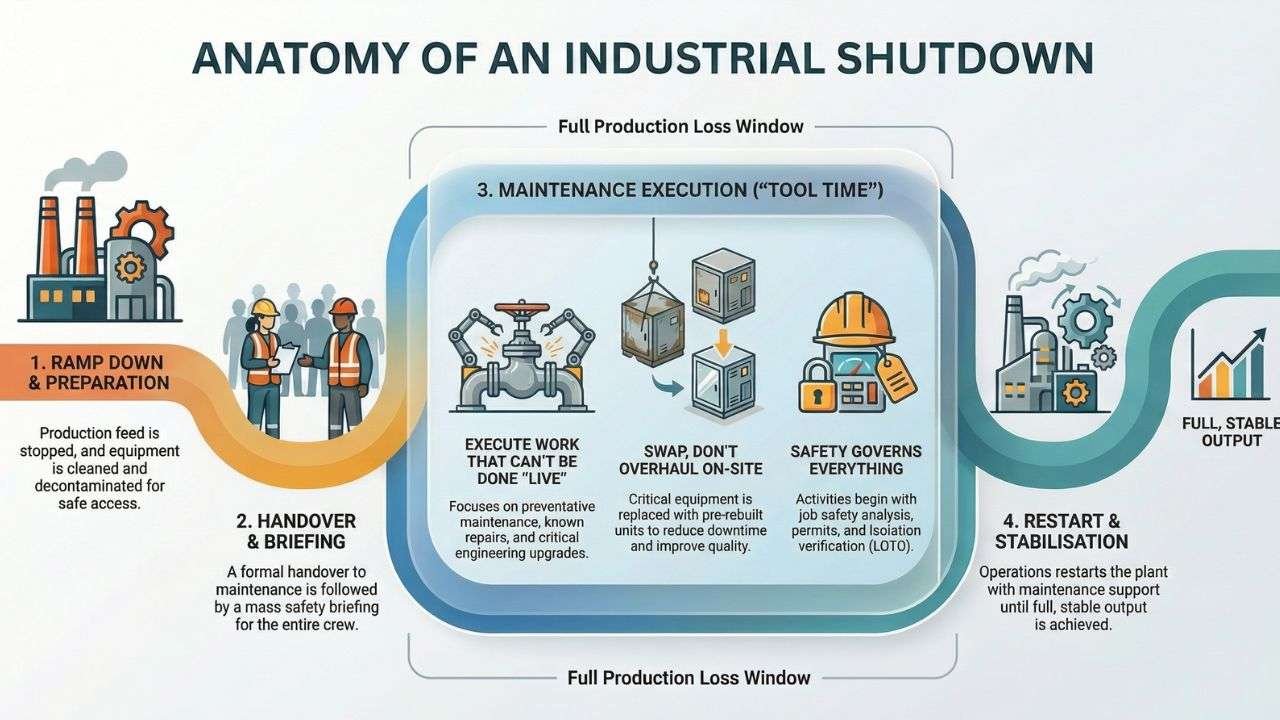
A shutdown is governed by the approved shutdown maintenance window, often referred to as the “tool time” available for maintenance execution.
This window sits inside a much larger production loss period that begins when feed to the plant is turned off and ends when feed is turned back on and production stabilises.
Understanding this full window is essential to understanding what actually happens during a shutdown day.
The shutdown begins the moment feed to the plant is turned off and it ends only when feed is turned back on and the plant reaches stable output.
Everything in between is counted as production loss.
The full window typically includes:
Operations stop the incoming feed and allow material already in the system to run through or be processed out. This reduces waste, prevents contamination and ensures equipment is safe to open.
Operations staff, often supported by contractors, clean equipment, flush lines, remove residual product and prepare the plant for safe maintenance access. This is one of the most time‑consuming and critical phases.
Only once the plant is clean, isolated and verified safe does maintenance receive control of the work-front. This handover is formal, documented and essential for safety.
This is the period allocated for maintenance execution. All inspections, corrective work, PMs, engineering tie‑ins and shutdown‑specific tasks must fit within this approved window.
Maintenance supervisors verify readiness for operations to take back control, ensuring all work is complete and the plant is safe to restart.
Operations restart the plant, reintroduce feed and ramp up production.
A small maintenance support crew remains on site to address any issues that arise during ramp‑up until the plant reaches and sustains full output.
Both the run‑down plan and the start‑up plan are just as important as the maintenance work itself.
Before the maintenance window officially opens, the night shift often includes a joint walkthrough between operations and maintenance. During this walkthrough, maintenance explains:
This alignment is essential because insufficient cleaning is one of the most common causes of early shutdown delays.
The walkthrough ensures operations understand exactly what “ready for maintenance” means.
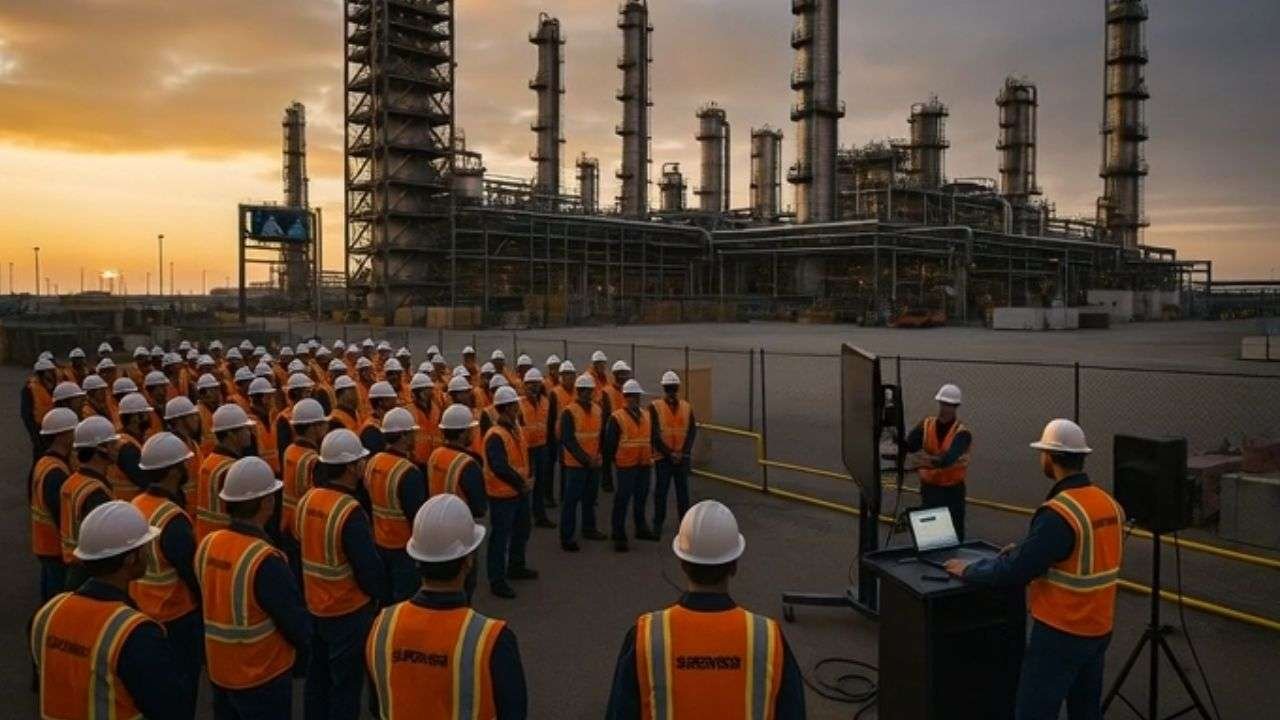
Shutdown days do not begin with a small handover between shifts. Instead, the day starts with a large‑scale central gathering, often involving a workforce ten times larger than the normal maintenance team.
This briefing sets the tone for the entire day. Shutdown leadership deliver a structured overview of:
Because shutdowns rely heavily on contractors, most of the people assembled are not part of the site’s regular maintenance crew.
These contractors have been vetted and approved to perform the specific work they are assigned.
Once the briefing concludes, workers break off to find their assigned supervisors, which will be either site supervisors or contractor supervisors approved to lead their own teams.
Teams conduct JSAs for the day’s tasks, reviewing hazards, controls, PPE, drop zones and communication protocols.
Permits are completed and authorized, hot work, confined space, electrical isolation, working at heights and more.
Teams then collect any parts or materials that could not be staged at the job site beforehand. While the Work Execution Preparation Process aims to pre‑stage as much as possible, some items must be stored centrally until the shift begins.
Most contractors arrive already familiar with their work-fronts because they have reviewed the scope off‑site, conducted pre‑shutdown site visits (where necessary) and assessed crane requirements, other task interactions, crane lifting paths and any potential bottlenecks (anything that might cause the job to run over the allocated time).
If not already completed, the early part of the maintenance window focuses on confirming that the plant is safely offline. This includes:
Last minute materials delivered overnight to site are received/checked in and staged but likely also delivered to the job site.
Missing parts/time spent looking for parts at the beginning of a shutdown can and will prevent jobs from starting and are an unacceptable waste of precious planned outage time.
Shutdowns can sometimes be defined by major/specific tasks, aside from those jobs, the work that is performed during these events are those tasks that cannot be completed during typical ‘running plant’ maintenance. Shutdown jobs will naturally vary dramatically between industries however, it typically falls into a few broad categories:
Tasks required to maintain asset health and regulatory compliance, especially for equipment that cannot be serviced while running.
Repairs to known issues that require the plant to be offline.
Engineering teams often use shutdown windows to:
It’s not uncommon for the engineering project work to be the main driving force of the shutdown event. These tasks are usually pre‑fabricated and pre‑tested off‑site to minimise time required during the shutdown.
Shutdowns won’t usually involve major on‑site overhauls of repairable equipment. In modern plants, this is almost never the case.
Most critical equipment that can be rebuilt/overhauled is part of a repairables/rotables strategy:
This reduces shutdown duration, improves quality and avoids long-duration on-site work.
Once equipment is opened up, cleaned, made safe and accessed, specialty teams are brought in for this work.
Each contractor team often maintains its own Gantt chart.
Team supervisors update these throughout the day and feed them into the master shutdown schedule, often displayed at the central gathering area.
Managers, superintendents, planners and engineers often walk the shutdown area performing safety observations and gathering real‑time insights as well.
Shutdowns can at times generate significant waste. Continuous clean-up ensures:
Teams document completed work (what was done), flag any defects that could not be done during the event but can be done either next shutdown or during normal running plant maintenance.
They will prepare notes for the next day’s regular maintenance team morning meeting. Post Shutdown any remaining unused parts are returned back to the warehouse for credit and any repairable/rotable items of equipment that are yet to be taken there are delivered as well.
Obviously this will differ for multi shift/multi day shutdowns.
Even after maintenance has completed its work and the plant is handed back to operations, the shutdown is not truly over.
A small, skilled team, usually the core maintenance crew plus a few key contractors, remains on site past the normal finishing time.
Their role is to:
Only once the plant is stable does this support crew stand down.
Shutdowns Are Reasonably Intense Maintenance Events.
A shutdown day is a controlled sprint within a large, carefully orchestrated production loss window.
Every phase, run‑down, cleaning, maintenance, testing, start‑up and stabilisation, contributes to the success of the event.
This is the reality of shutdown work: a blend of precision, pressure, managing risks and teamwork that keeps industrial facilities safe, reliable and productive.
What Is A Maintenance Shutdown Event? Maintenance shutdown events are critical events when industrial facilities plan to temporarily halt operations
What Is A Maintenance Shutdown Read More »

Effective Work Scheduling Process & Your CMMS. When it comes to managing a high-risk heavy industrial business, one of the
Maintenance Work Scheduling Read More »

Important tips for those people thinking about planning a Shutdown Note: This article should be read in conjunction with Maintenance
Thinking About Planning A Shutdown? Read More »
Complete Maintenance Systems Audit – Part 3a The article is intended to be read in association with: Maintenance Systems Audit
Maintenance Systems Audit Part 3a Read More »
Execute And Complete Maintenance Work Orders. Effective maintenance management is crucial for the smooth operation of any facility. This article outlines
Exectute Maintenance Work Orders Read More »