Identifying and Correcting Issues
In every heavy industrial environment, from manufacturing plants to power stations, from mining operations to chemical processing facilities, the ability to identify and correct issues early is one of the most powerful forms of protection an organisation can have.
Defects rarely stay small. A minor leak becomes a major rupture, a faint vibration becomes a catastrophic failure and a slight temperature rise becomes a fire risk.
The organisations that excel in safety, reliability and cost control are the ones that treat early defect detection as a shared responsibility, not just a maintenance task, but a whole‑site discipline.
At the heart of this approach is a simple truth: the sooner an issue is identified, the easier, safer and cheaper it is to correct.
Early detection prevents escalation, protects people and preserves assets.
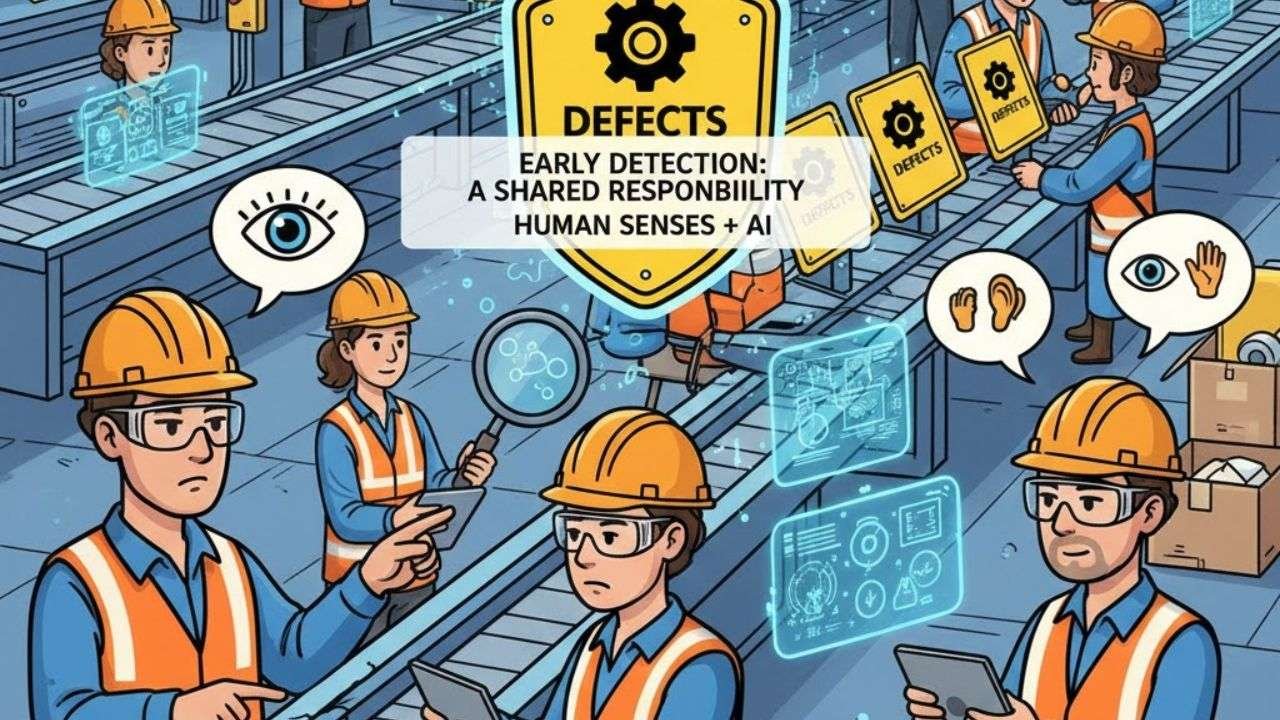
To achieve this, organisations must harness two powerful forces working together, the five human senses and modern monitoring technology and they must also recognise the value of something less tangible but equally vital: operator intuition.
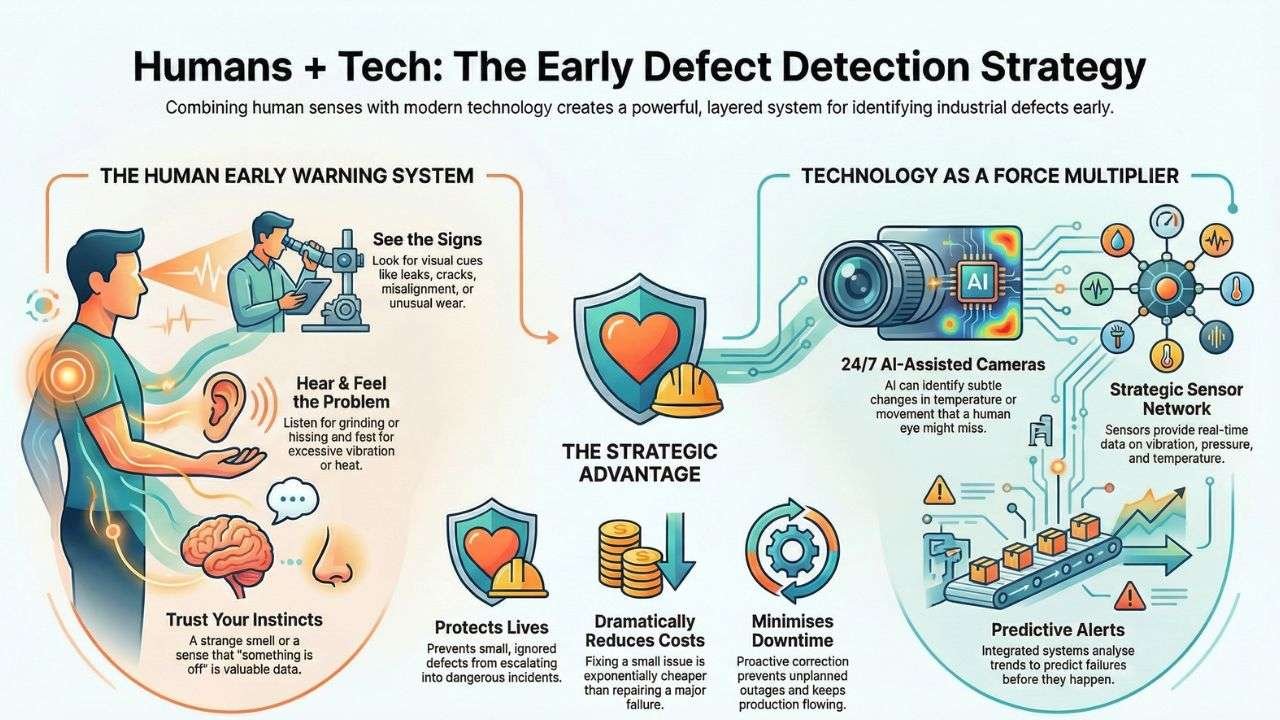
Everyone on Site: Five Senses on High Alert.
Human perception remains one of the most effective defect‑detection tools ever created. When people are trained to stay alert and empowered to speak up, they become a living, breathing early‑warning system.
- Sight catches early visual cues: leaks, cracks, misalignment, discoloration, fouled heat‑exchanger tubes, burned paint on motors, or lubricant that looks “wrong.” These subtle signs often appear long before instruments detect a measurable deviation.
- Hearing picks up early warnings that sensors may not yet register, gravel‑like pump cavitation, squealing belts, rhythmic scraping in gearboxes, or a motor that suddenly “sounds different today.” These auditory cues often emerge gradually, evading automated detection until the problem escalates.
- Touch reveals excessive vibration, shuddering, or unexpected heat, a hotter‑than‑normal bearing housing, uneven temperatures in seal lines, or a pump casing that feels “off.” These tactile cues provide immediate feedback that digital monitors may delay due to sampling intervals or calibration drift.
- Smell detects burning insulation, chemical leaks, overheated components, or shifting process odors. In many cases, a strange smell is the first sign of an electrical or mechanical failure.
Even intuition, the sense that something is “off”, matters. Experienced operators develop a deep familiarity with “normal” equipment behaviour.
They integrate multisensory cues, pattern recognition and contextual understanding in ways that instruments cannot. This gut‑level awareness often flags issues long before alarms trigger.
This is not guesswork. It is the rapid connection of environmental clues to stored knowledge, a form of expertise that emerges only through years of exposure.
In drilling operations, for example, operators often detect ambiguous risks that instruments cannot interpret.
When organisations encourage people to trust their instincts, they gain a powerful safety advantage.
Technology As A Force Multiplier: Sensors, AI & Continuous Monitoring.
While human senses and intuition are powerful, they cannot be everywhere at once. Modern technology fills that gap, providing continuous, precise and data‑driven monitoring that enhances early detection.
- AI‑assisted cameras detect subtle changes in movement, temperature, alignment, or behaviour that the human eye may miss. They operate 24/7, never fatigue and can identify patterns invisible to manual inspection.
- Strategically placed sensors, vibration, temperature, pressure, flow, acoustic, electrical load, create a real‑time picture of asset health. These sensors can detect micro‑changes long before a defect becomes visible or audible.
- Condition‑monitoring systems integrate this data, providing alerts, trend analysis and predictive insights. Instead of reacting to failures, maintenance teams can intervene at the earliest sign of deterioration.
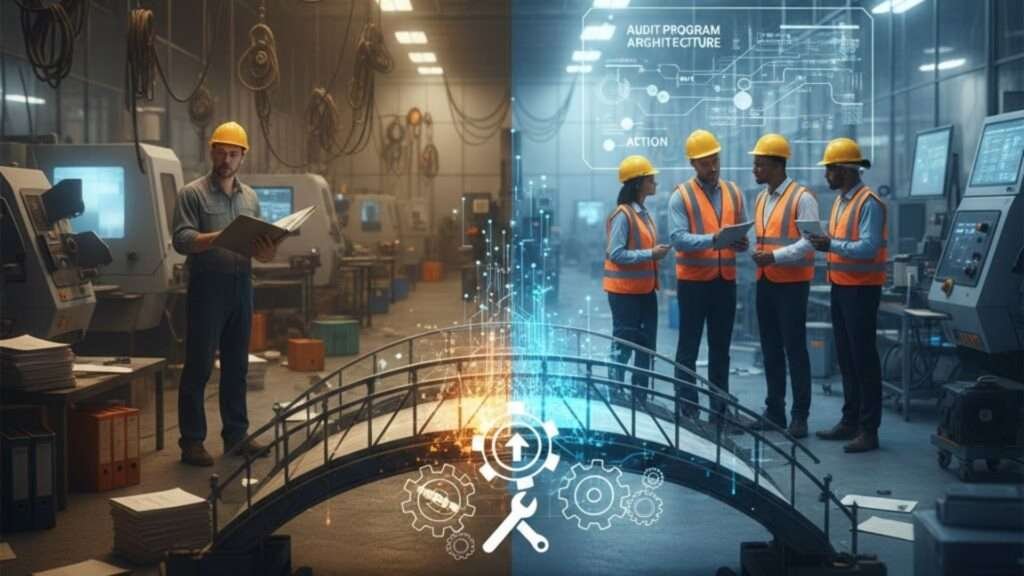
The combination of human awareness and technological intelligence is where true excellence emerges.
People catch what machines miss; machines catch what people cannot see. Together, they create a layered, resilient detection system that dramatically reduces risk.
Why This Applies Across All Heavy Industries.
Whether the environment is a refinery, a mine, a power station, or a manufacturing line, the fundamentals are the same: complex machinery, high‑risk processes and the need for both human oversight and technological support.
Operators in these environments develop an intimate familiarity with equipment behaviour. They know how a pump should sound, how a turbine should feel, how a gearbox should smell when running normally.
This deep, embodied knowledge allows them to detect deviations that instruments may not register until the problem worsens.
This universal applicability is why early detection is not just a maintenance principle, it is a cross‑industry safety philosophy.
The Organisational Advantage: Culture, Cost and Resilience.
Empowering people to act on their instincts and report abnormalities fosters a proactive safety culture. It reduces reliance on reactive measures and strengthens organisational resilience.
The benefits are significant:
- Lives are protected. Many serious incidents begin with small, ignored defects.
- Costs are dramatically reduced. Early correction prevents expensive breakdowns.
- Downtime is minimised. Issues are resolved before they disrupt production.
- Assets last longer. Proactive care slows deterioration and extends equipment life.
- The organisation becomes more resilient. Fewer surprises, fewer emergencies, fewer crises.
Training programs that build this “storehouse of knowledge” and encourage people to trust it, turn individual intuition into collective safety strength.
Conclusion.
Identifying and correcting issues early is the foundation of safe, reliable and cost‑effective operations.
When every person on site keeps their senses alert, when intuition is respected and when technology provides continuous monitoring and predictive insight, defects are caught before they grow, risks are controlled before they escalate and assets are protected before they fail.
This is the future of maintenance: a partnership between human awareness, human intuition and intelligent technology, working together to create safer workplaces, stronger assets and more resilient organisations.