
Computers Powering Australian Businesses.
Disclaimer.
This article is provided for general informational purposes only.
It does not constitute financial, legal, technical, cybersecurity, procurement, or professional advice, and should not be relied upon as a substitute for consultation with qualified experts.
While every effort has been made to ensure the accuracy, relevance, and currency of the information presented, no guarantee is given that the content is complete, up to date, or free from error.
All data points, specifications, pricing, forecasts, and technology references are subject to change without notice based on market conditions, vendor updates, regulatory developments, and emerging research.
Any views, interpretations, projections, or opinions expressed are solely those of the author and do not represent the positions of any organisation, employer, government body, or vendor referenced in this article.
Mention of specific technologies, products, companies, or services does not constitute endorsement or recommendation.
Readers are strongly encouraged to conduct their own assessments and seek independent professional advice before making decisions related to hardware procurement, cloud adoption, cybersecurity strategy, AI deployment, regulatory compliance, or operational transformation.
The author accepts no responsibility or liability for any loss, damage, or consequences arising from the use of, reliance on, or interpretation of the information contained herein.
Article Summary.
Australia is entering a decisive decade in computing, defined by the convergence of artificial intelligence, quantum breakthroughs, cloud expansion and escalating cybersecurity and sustainability pressures.
With national IT spending surpassing $133 billion in 2024 and cloud investment projected to exceed $30 billion by 2033, organisations are moving beyond traditional digital transformation toward intelligent, autonomous, data‑driven operations.
This shift is most visible in the evolution of CMMS, AMS, and ERP platforms. Once reliant on manual data entry and reactive workflows, these systems now integrate predictive analytics, real‑time sensor intelligence, and autonomous decision-making.
To support these capabilities, Australian organisations require a new class of hardware, including NPUs capable of 40–50+ TOPS, high‑bandwidth memory, and advanced GPUs, alongside scalable cloud, edge, and hybrid architectures.
At the same time, Australia is emerging as a global deep‑tech leader. Landmark investments such as the $940 million PsiQuantum project and world‑class research from Silicon Quantum Computing (SQC) position the nation at the forefront of quantum computing, with a projected $6 billion economic impact by 2045.
These developments will reshape industries from healthcare and energy to logistics and advanced manufacturing.
However, the Intelligent Operations Era also brings significant challenges.
AI‑capable servers now cost $25,000 to $200,000+, cyber threats are escalating with AI‑powered attacks, and Australia’s e‑waste output, already 570,000 tonnes annually, is rising as hardware refresh cycles accelerate. Organisations must balance innovation with sustainability, security, and long‑term cost management.
Despite these pressures, the operational benefits of AI are profound. Predictive maintenance, autonomous workflows and AI‑driven optimisation are delivering measurable gains across Australian industry, reducing downtime by 28–42% and generating 200–400% ROI within months.
The most transformative AI is not consumer‑facing, it is embedded deep within operational systems, quietly reshaping productivity, safety, and asset performance.
This article provides a comprehensive guide to the technologies, infrastructure, risks, and opportunities defining Australia’s next decade of computing.
It outlines the hardware required for AI‑era operations, the rise of hybrid and edge architectures, the nation’s quantum leadership, sector‑wide impacts, cybersecurity and sustainability imperatives, and the strategic roadmap organisations need to prepare for the Intelligent Operations Era.
Top 5 Takeaways.
1. AI-Ready Hardware Is Now a Strategic Necessity, Not an Upgrade Option: Australian organisations can no longer rely on traditional CPU-centric devices. Modern CMMS, AMS and ERP platforms require NPUs (40–50+ TOPS), high-bandwidth memory and advanced GPUs to support predictive analytics, local LLM inference and real-time decision-making. Hardware capability is now directly tied to operational performance.
2. Hybrid Cloud Architectures Are Becoming the Dominant Operating Model: While cloud platforms continue to expand rapidly, the most resilient and efficient organisations are adopting hybrid and edge-enabled architectures. These models balance sovereignty, latency and scalability, especially in IoT-heavy industries where local processing is essential for safety and uptime.
3. Australia Is Emerging as a Global Deep Tech Leader: With landmark investments such as the $940 million PsiQuantum project and world-class research from Silicon Quantum Computing (SQC), Australia is positioning itself at the forefront of quantum computing. This shift is reshaping industries from healthcare to energy and creating a projected $6 billion quantum economy by 2045.
4. The Hidden Costs of the AI Era Are Growing, Hardware, Cybersecurity and E-Waste: AI adoption brings significant financial and environmental challenges. AI-capable servers can cost $25,000 to $200,000+, cyber threats are escalating with AI-powered attacks and Australia’s 570,000-tonne e-waste crisis is intensifying as device refresh cycles accelerate. Innovation now requires equal investment in sustainability and security.
5. Predictive, Autonomous Operations Are Delivering Massive ROI Across Australian Industry: The most transformative AI isn’t in chatbots, it’s embedded in operational systems. Predictive maintenance, autonomous workflows and AI-driven optimisation are reducing downtime by 28–42%, improving asset life and delivering 200–400% ROI within months. Organisations that embrace intelligent operations are gaining a decisive competitive edge.
Table of Contents.
1. Introduction: The Shift to Intelligent Operations
2. The Historical Context: From CSIRAC to AI Dominance
o 2.1 CSIRAC: Australia’s First Leap (1940s–1950s)
o 2.2 Mainframes and Minicomputers (1960s–1970s)
o 2.3 The PC Revolution (1980s–1990s)
o 2.4 Internet and Mobile Era (2000s–2010s)
o 2.5 AI and Cloud Dominance (2020s–Present)
3. Modern Hardware Requirements in the AI Era
o 3.1 Neural Processing Units (NPUs)
o 3.2 Graphics Processing Units (GPUs)
o 3.3 Memory and Storage
o 3.4 Processor Architectures
4. Portable and Stationary Computing Choices
o 4.1 AI-Powered Laptops
o 4.2 High-Performance Desktops and Workstations
5. Transforming Business Systems: CMMS, AMS and ERP
o 5.1 From Reactive to Predictive
o 5.2 Autonomous Workflows.
o 5.3 Infrastructure Upgrade Triggers.
6. Infrastructure and Deployment Models.
o 6.1 Cloud (SaaS).
o 6.2 On-Premise.
o 6.3 Hybrid Models.
7. Quantum Computing: Australia’s Global Leadership.
o 7.1 PsiQuantum.
o 7.2 Silicon Quantum Computing (SQC).
o 7.3 Economic Impact.
8. Sector-Wide Impacts.
o 8.1 Healthcare.
o 8.2 Agriculture.
o 8.3 Manufacturing.
o 8.4 Government.
9. Cybersecurity and Sustainability.
o 9.1 Cybersecurity (2024–2025).
o 9.2 Sustainability and E-Waste.
10. Implementation Roadmap and RO .
o 10.1 Total Cost of Ownership (TCO).
o 10.2 Return on Investment (ROI).
11. Future Trends.
12. Beyond the Hype: Five Realities Reshaping Australia’s Tech Revolution .
o 12.1 A Near Billion-Dollar Leap Into the Quantum Future.
o 12.2 The Hidden Cost of AI: Hardware That Can’t Keep Up.
o 12.3 Forget Chatbots: The Real AI Revolution Is Saving Millions.
o 12.4 Australia’s Digital Ghost: A 570,000-Tonne E-Waste Crisis.
o 12.5 The New Cyber Threat: Smarter, Faster and More Relentless.
13. Glossary of Terms and Abbreviations.
14. Conclusion: Preparing for the Intelligent Era.
15. Bibliography.
1.0 Introduction: The Shift to Intelligent Operations.
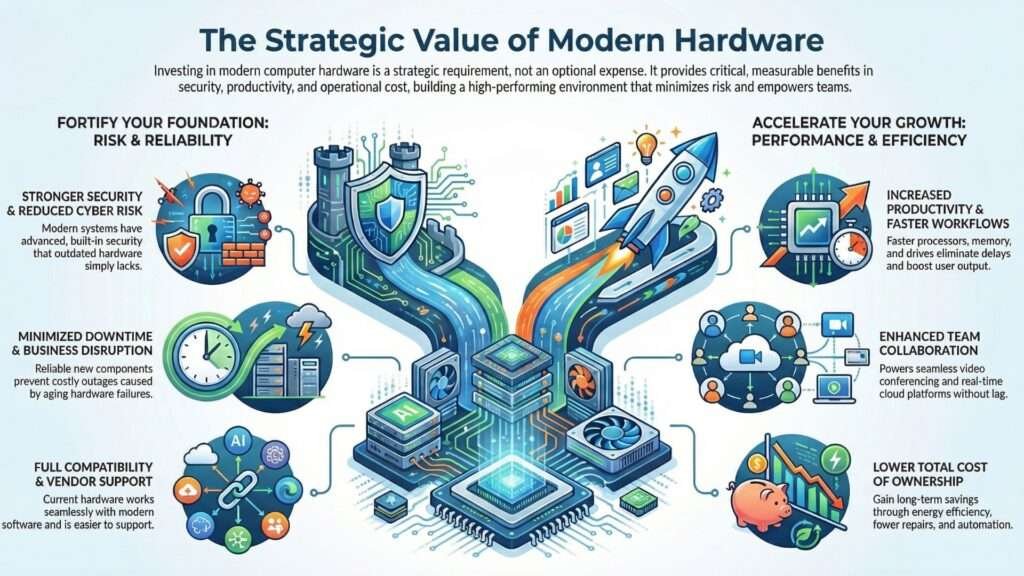
Australian organisations are undergoing a profound transformation as artificial intelligence becomes embedded in core operational systems.
Platforms that once relied on traditional CPU-based computing now depend on AI-capable hardware, cloud-native architectures and real-time data processing.
This shift marks the end of the reactive era and the beginning of the Intelligent Operations Era, where predictive insights, automation and data-driven decision-making define competitive advantage.
The rise of AI-enhanced CMMS, AMS and ERP systems is reshaping how businesses manage assets, schedule maintenance, allocate resources and respond to operational risks.
These systems no longer simply record information, they interpret it, learn from it and act on it.
The organisations that recognise this transition as foundational rather than incremental are positioning themselves for sustained success in an increasingly complex and competitive landscape.
2.0 The Historical Context: From CSIRAC to AI Dominance.
Australia’s computing evolution spans eight decades and mirrors global technological progress while maintaining a uniquely Australian trajectory.
Understanding this history provides essential context for the current transformation.
2.1 CSIRAC: Australia’s First Leap (1940s–1950s).
CSIRAC, developed in the late 1940s, was the world’s fourth stored-program electronic computer and the first to play digital music.
Built by the Council for Scientific and Industrial Research (CSIR), it established Australia as an early innovator in computational science.
CSIRAC’s legacy demonstrates that Australia has consistently punched above its weight in technological innovation.
2.2 Mainframes and Minicomputers (1960s–1970s).
Government agencies, banks and research institutions adopted mainframes to accelerate data processing.
This era transformed public service delivery, enabling faster processing of applications, financial transactions and scientific research.
The computational infrastructure built during this period laid the groundwork for Australia’s modern digital economy.
2.3 The PC Revolution (1980s–1990s).
Affordable personal computers democratised computing across Australia. Small businesses gained access to digital record-keeping, spreadsheets and early database systems.
Australia’s software development sector expanded rapidly, creating thousands of jobs and establishing local expertise in business applications.
2.4 Internet and Mobile Era (2000s–2010s).
The rise of the internet and mobile devices redefined communication, commerce and remote work.
E-commerce, mobile banking and digital government services became mainstream. This era established the digital infrastructure and consumer expectations that underpin today’s AI-driven transformation.
2.5 AI and Cloud Dominance (2020s–Present).
AI has moved from research labs into everyday business functions. With billions invested in cloud infrastructure and AI-capable hardware, Australia is now positioned for a decade of intelligent automation and digital transformation.
This period represents not merely an upgrade but a fundamental reimagining of how organisations operate.
3.0 Modern Hardware Requirements in the AI Era.
AI workloads demand far more than traditional CPU power. Modern CMMS, AMS and ERP environments require hardware capable of handling local LLM inference, real-time sensor data processing, predictive analytics, image and video analysis and autonomous workflow execution.
The gap between AI ambition and hardware capability is widening and organisations that fail to address this gap risk falling behind competitors who have made strategic investments.
3.1 Neural Processing Units (NPUs).
NPUs are specialised processors designed specifically for AI operations. Unlike CPUs, which handle general computing tasks sequentially, NPUs are optimised for the parallel processing required by machine learning algorithms.
NPU capability is measured in TOPS (Trillions of Operations Per Second):
· 40 TOPS – Minimum for Microsoft Copilot+ certification.
· 45–50 TOPS – Ideal for multi-tasking and business AI workloads.
· 50+ TOPS – Required for local LLM execution and advanced AI tasks.
For organisations deploying AI-enhanced CMMS or AMS systems, NPU capability directly impacts system responsiveness and the complexity of AI models that can run locally.
3.2 Graphics Processing Units (GPUs).
GPUs remain essential for local LLM inference, predictive maintenance modelling, image and video processing and AI model training.
While GPUs were originally designed for graphics rendering, their parallel processing architecture makes them ideal for AI workloads.
Recommended VRAM:
· 12–16GB – Moderate workloads such as predictive analytics dashboards.
· 24GB+ – Professional AI development and complex model training.
For organisations considering on-premise AI infrastructure, GPU selection represents one of the most significant hardware decisions, directly affecting processing speed and the scale of models that can be deployed.
3.3 Memory and Storage.
AI applications are memory-intensive, requiring rapid access to large datasets and model parameters. Insufficient memory creates bottlenecks that dramatically reduce AI system performance.
Minimum specifications:
· 16GB RAM minimum for basic AI-enhanced applications.
· 32GB+ ideal for production environments.
· NVMe SSDs for rapid model loading and data access.
· High memory bandwidth to avoid processing bottlenecks.
3.4 Processor Architectures.
Leading processor options for Australian businesses include Intel Core Ultra, AMD Ryzen AI, Qualcomm Snapdragon X and Apple M-series chips.
All feature integrated AI acceleration and energy-efficient architectures designed to handle modern workloads without excessive power consumption or thermal output.
4.0 Portable and Stationary Computing Choices.
The hardware decision extends beyond specifications to form factor. Different roles within an organisation have different mobility and processing requirements.
4.1 AI-Powered Laptops.
These devices provide mobility without sacrificing AI capability, making them ideal for field technicians, maintenance planners and mobile asset inspectors.
Leading models available in Australia:
1. ASUS Zenbook S 14 – 48 TOPS, 24-hour battery life, lightweight design.
2. Lenovo ThinkPad T14s Gen 6 – 45 TOPS, 21+ hours battery, enterprise durability.
3. Apple MacBook Air M4 – 38 TOPS Neural Engine, unified memory architecture.
4. ASUS ROG Strix Scar 18 – 1,837 TOPS combined (NPU + GPU), designed for developers.
4.2 High-Performance Desktops and Workstations.
For planners, analysts and developers who require maximum processing power, desktops offer superior cooling, upgradeability and performance per dollar.
Recommended configurations:
· Dell XPS / HP Z-Series – Up to 128GB RAM, NVIDIA RTX 4090 GPUs.
· Custom Builds (Scorptec, PLE, Mwave) – AMD Ryzen 9 / Intel Core i9, 64–128GB RAM, multi-NVMe storage configurations.
Desktops provide the flexibility to upgrade components as AI requirements evolve, making them a cost-effective long-term investment for organisations with significant on-premise processing needs.
5.0 Transforming Business Systems: CMMS, AMS and ERP.
AI is fundamentally reshaping asset management and operational planning.
The transformation extends far beyond interface improvements to redefine the core logic of how these systems operate.
5.1 From Reactive to Predictive.
Traditional systems relied on fixed maintenance schedules based on manufacturer recommendations or historical averages.
AI-powered systems use IoT sensors and machine learning to predict failures before they occur, shifting organisations from reactive to predictive operations.
Impact: A 2024 IBM Watson study found that AI-based condition monitoring reduced unplanned downtime by 28% within six months of implementation. For asset-intensive industries, this translates directly to millions in avoided losses and improved operational reliability.
5.2 Autonomous Workflows.
Modern AI agents can now identify low stock levels, evaluate supplier options based on predefined criteria, generate purchase orders and optimise maintenance schedules without human intervention.
This represents a fundamental shift from automation (which follows fixed rules) to autonomy (which makes contextual decisions).
The efficiency gains are substantial. Tasks that previously required hours of human analysis can now be completed in seconds, freeing skilled workers to focus on strategic decision-making rather than routine data processing.
5.3 Infrastructure Upgrade Triggers.
Organisations should assess their AI needs across three levels:
Level 1 (Light AI): Chatbots, semantic search.
- Existing hardware typically sufficient.
- Focus on software integration.
Level 2 (Moderate AI): Cloud-based forecasting, analytics dashboards.
- Requires high-speed internet (500Mbps+).
- Standard business hardware adequate.
Level 3 (Advanced AI): Real-time sensor processing, local model training.
- Requires GPU-accelerated servers.
- Substantial RAM (64GB+).
- NVMe storage arrays.
6.0 Infrastructure and Deployment Models.
The choice between cloud, on-premise, or hybrid infrastructure represents one of the most consequential strategic decisions organisations face in the AI era.
6.1 Cloud (SaaS).
Cloud platforms remain the default choice for most organisations due to lower upfront costs, automatic updates and massive scalability.
Major investments by AWS ($20 billion) and Microsoft ($5 billion) have significantly expanded Australian data centre capacity, improving latency and data sovereignty compliance.
Advantages:
1. Minimal capital expenditure.
2. Automatic scaling during demand peaks.
3. Regular security updates and patches.
4. Pay-as-you-go pricing model.
6.2 On-Premise.
On-premise infrastructure is preferred for data sovereignty requirements, ultra-low latency applications and sensitive environments where external connectivity poses security risks.
Cost considerations: A mid-range AI server with dual NVIDIA L40S GPUs costs $70,000–$95,000 AUD.
For organisations with substantial processing requirements, this investment can deliver lower total cost of ownership over five years compared to cloud alternatives.
6.3 Hybrid Models.
Hybrid architectures combine cloud and local processing, allowing organisations to optimise for cost, performance and compliance simultaneously.
Typical configuration:
1. Cloud platforms handle computationally intensive AI workloads.
2. Edge devices preprocess IoT data locally for immediate response.
3. On-premise systems manage sensitive data subject to sovereignty requirements.
7.0 Quantum Computing: Australia’s Global Leadership.
While AI dominates current headlines, Australia is simultaneously positioning itself at the forefront of the next great computing paradigm: quantum computing.
7.1 PsiQuantum.
The Australian and Queensland governments have committed $940 million to partner with US-based PsiQuantum to build the world’s first utility-scale, fault-tolerant quantum computer in Brisbane by late 2027.
This represents one of the largest quantum computing investments globally and positions Australia as a potential quantum superpower.
7.2 Silicon Quantum Computing (SQC).
SQC is pioneering uniquely Australian silicon-based qubit technology.
Unlike other approaches that require exotic materials and extreme cooling, silicon-based qubits leverage existing semiconductor manufacturing infrastructure, potentially accelerating commercialisation.
7.3 Economic Impact.
Quantum technology is projected to be worth $6 billion and employ 19,400 Australians by 2045.
The technology promises breakthroughs in drug discovery, materials science, optimisation problems and cryptography that are simply impossible for classical computers.
8.0 Sector-Wide Impacts.
Modern computing and AI are transforming every corner of the Australian economy, creating new possibilities while disrupting established practices.
8.1 Healthcare.
AI assists in diagnostic imaging, drug discovery and personalised treatment planning. Telemedicine platforms expanded dramatically during the pandemic and continue to improve access for rural and remote communities.
Predictive analytics help hospitals optimise resource allocation and reduce wait times.
8.2 Agriculture.
Precision farming uses IoT sensors and AI to optimise irrigation, fertilisation and pest control. Livestock monitoring systems track animal health in real-time, enabling early intervention.
Climate modelling helps farmers adapt to changing conditions and manage risk.
8.3 Manufacturing.
Smart factories utilise digital twins to simulate production processes before implementation, reducing costly errors.
Robotics and automation increase efficiency while reducing workplace injuries. Predictive maintenance minimises unplanned downtime.
8.4 Government.
AI-enhanced citizen services improve response times and service quality. Infrastructure monitoring systems detect maintenance needs before failures occur. Fraud detection algorithms protect public resources while reducing administrative burden.
9.0 Cybersecurity and Sustainability.
As technology advances, so do the risks and responsibilities that organisations bear. Two challenges stand out as particularly urgent: cybersecurity threats and environmental sustainability.
9.1 Cybersecurity (2024–2025).
Australia faces an escalating threat landscape characterised by ransomware, AI-powered phishing and supply chain attacks.
High-profile breaches at Optus (9.8 million customers affected) and Medibank (9.7 million customers affected) demonstrate that no organisation is immune.
According to the Australian Cyber Security Centre (ACSC), direct cybersecurity incidents increased by 11%, while notifications of potential threats surged by 83%. Attackers are probing Australian organisations more aggressively than ever before.
Essential defences include:
1. Zero-trust architecture requiring continuous verification.
2. Multi-factor authentication (MFA) for all access points.
3. Regular security audits and penetration testing.
4. Employee training on social engineering tactics.
5. Compliance with the Privacy Act 1988 and mandatory breach notification requirements.
9.2 Sustainability and E-Waste.
Australia generates approximately 570,000 tonnes of e-waste annually, one of the highest per capita rates globally. The AI era is accelerating this challenge as device refresh cycles shorten due to rising hardware demands.
Key strategies include:
1. Participation in the National Television and Computer Recycling Scheme (NTCRS).
2. Procurement of ENERGY STAR certified hardware.
3. Extending device lifecycles through regular maintenance and upgrades.
4. Adoption of modular, repairable systems.
5. Implementation of circular economy principles in IT asset management.
10.0 Implementation Roadmap and ROI.
Strategic hardware investment should be viewed as a competitive edge rather than a cost centre.
Organisations that approach technology investment with a clear understanding of total cost and expected return are better positioned to make decisions that deliver lasting value.
10.1 Total Cost of Ownership (TCO).
Cloud and on-premise costs often converge over five years. While cloud platforms offer lower upfront costs, ongoing subscription fees accumulate.
Conversely, on-premise infrastructure requires substantial capital expenditure but lower ongoing costs.
The break-even point typically occurs between years four and six, depending on usage patterns.
10.2 Return on Investment (ROI).
Organisations implementing AI-enabled predictive maintenance frequently report 200–400% ROI through reduced downtime, extended asset life and improved resource allocation.
A mid-sized Victorian food processing company reduced unplanned downtime by 42% and achieved full ROI within five months of implementing AI-powered predictive maintenance.
11.0 Future Trends.
The pace of technological change continues to accelerate. Organisations that monitor emerging trends and prepare strategically are better positioned to capitalise on new capabilities as they mature.
Key developments to watch:
1. 6G Networks: Promising speeds up to 1 Tbps and sub-millisecond latency.
2. Edge AI: Moving intelligence from cloud to device for faster, more private processing.
3. Agentic AI: Autonomous systems capable of planning and executing multi-step tasks with minimal supervision.
4. Spatial Computing: AR/VR interfaces for field operations and remote assistance.
5. Quantum-Safe Cryptography: Preparing security infrastructure for the post-quantum era.
12.0 Beyond the Hype: Five Realities Reshaping Australia’s Tech Revolution.
Australia’s digital transformation is often framed as a story of cloud adoption, AI acceleration and record-breaking IT investment.
Yet beneath the polished narrative lies a more complex and revealing picture, one defined by billion-dollar bets, hidden costs, environmental consequences and a rapidly evolving threat landscape.
These five realities highlight the deeper forces shaping Australia’s technological future and the contradictions that organisations navigate as they enter the Intelligent Operations Era.
12.1 A Near Billion-Dollar Leap Into the Quantum Future.
While global headlines focus on AI, Australia is quietly positioning itself at the forefront of the next great computing paradigm: quantum computing.
The Australian and Queensland governments have committed $940 million to partner with US-based PsiQuantum to build the world’s first utility-scale, fault-tolerant quantum computer in Brisbane.
This is not incremental innovation, it is a moonshot.
A utility-scale quantum computer could solve problems that today’s fastest supercomputers cannot touch, unlocking breakthroughs in healthcare (drug discovery, protein modelling), renewable energy (battery chemistry, grid optimisation), materials science (superconductors, advanced alloys) and logistics and supply chains (optimised routing at national scale).
The quantum industry is projected to be worth $6 billion and employ 19,400 Australians by 2045, positioning Australia as a global deep tech leader.
12.2 The Hidden Cost of AI: Hardware That Can’t Keep Up.
The shift toward on-device AI has fundamentally changed hardware economics. It’s no longer enough to have a fast CPU, modern AI workloads require Neural Processing Units (NPUs), high-bandwidth memory and advanced GPUs capable of running large models locally.
This transition comes with a rather steep price curve.
AI Infrastructure Costs in Australia (2024–2025):
1. Entry-level AI server: $25,000–$35,000 AUD
2. Mid-range AI server: $80,000–$200,000 AUD
3. Single NVIDIA H100 GPU: $40,000–$70,000 AUD
For many organisations, the hardware investment required to support advanced AI workloads is now one of the largest barriers to adoption.
The gap between AI ambition and hardware capability is widening and it is reshaping IT budgets across the country.
12.3 Forget Chatbots: The Real AI Revolution Is Saving Millions.
While public attention gravitates toward generative AI and chatbots, the most transformative AI applications are happening behind the scenes in operational systems.
The shift from reactive to predictive operations is delivering enormous financial impact.
Case Example: A mid-sized Victorian food processing company implemented AI-powered predictive maintenance.
Within five months, the company reduced unplanned downtime by 42% and achieved full ROI on its AI investment while improving asset reliability across its production line.
This aligns with broader industry research. A 2024 IBM Watson study found that AI-based condition monitoring reduced unplanned downtime by 28% within six months.
This is the quiet revolution, AI embedded directly into CMMS, AMS and ERP systems, delivering measurable operational gains without fanfare or hype.
12.4 Australia’s Digital Ghost: A 570,000-Tonne E-Waste Crisis.
Australia generates approximately 570,000 tonnes of e-waste every year, one of the highest per capita rates in the world.
This is equivalent to discarding the weight of three Sydney Harbour Bridges in laptops, phones and servers annually.
The AI era is accelerating this problem.
As device refresh cycles shorten due to rising hardware demands, Australia’s e-waste output is projected to increase by 20–25% by 2030.
Key drivers include:
1. Rapid obsolescence of non-AI-capable hardware.
2. Increased GPU and server turnover.
3. Growth in IoT and edge devices.
4. Consumer demand for AI-enabled personal devices.
This environmental burden is the hidden cost of Australia’s digital acceleration and one that organisations address through circular economy strategies, recycling programs and sustainable procurement practices.
12.5 The New Cyber Threat: Smarter, Faster and More Relentless.
Cybercriminals are now using AI to automate, personalise and scale attacks at unprecedented speed.
AI-powered phishing can generate highly convincing messages tailored to individuals, making traditional detection methods far less effective.
This evolution comes at a time when Australia is already grappling with the fallout of major breaches:
· Optus: 9.8 million customers affected.
· Medibank: 9.7 million customers affected.
· HWL Ebsworth: Exposed critical supply chain vulnerabilities.
According to the Australian Cyber Security Centre (ACSC), direct cybersecurity incidents increased by 11%, while notifications of potential threats surged by 83%. The message is clear: attackers are probing Australian organisations more aggressively than ever before.
Cyber resilience is no longer a technical requirement, it is a national imperative.
13. Glossary of Terms and Abbreviations.
Term / Abbreviation | Definition | Practical Example |
AI (Artificial Intelligence) | Computer systems that perform tasks requiring human intelligence. | AI predicts equipment failures in CMMS before they occur. |
AI-Powered Phishing | Cyberattacks using AI to generate personalised, convincing phishing messages. | Attackers generate emails mimicking a CEO’s writing style. |
AMS (Asset Management System) | Software for tracking and optimising physical assets. | Councils use AMS platforms to manage roads, parks and fleet assets. |
AWS (Amazon Web Services) | Major global cloud provider with Australian data centres. | Businesses host ERP systems on AWS for scalability. |
CMMS (Computerized Maintenance Management System) | Software for managing maintenance operations and asset history. | A factory uses CMMS to schedule preventive maintenance. |
CPU (Central Processing Unit) | The main processor for general computing tasks. | CPUs handle spreadsheets, email and basic business applications. |
CSIRAC | Australia’s first digital computer; the world’s fourth stored-program computer. | CSIRAC played the first digital music and ran early scientific calculations. |
Cyber Resilience | Ability to prepare for, respond to and recover from cyberattacks. | A business continues operating during a ransomware attack due to strong backups. |
Digital Twin | A virtual model of a physical asset or system. | Engineers simulate a water treatment plant digitally before making changes. |
Edge Computing | Processing data locally rather than in the cloud. | IoT sensors analyse vibration data on-site to detect machine faults instantly. |
ERP (Enterprise Resource Planning) | Integrated software managing finance, HR, procurement and operations. | A mining company uses ERP to unify purchasing, payroll and inventory. |
E-Waste (Electronic Waste) | Discarded electronic devices and components. | Old laptops and servers sent to recycling programs under NTCRS. |
GPU (Graphics Processing Unit) | Processor designed for parallel computation; essential for AI. | GPUs run local LLMs or train predictive maintenance models. |
HPC (High-Performance Computing) | Systems capable of extremely fast data processing. | Universities use HPC clusters for climate modelling and genomics. |
Hybrid Cloud | Mix of on-premise and cloud infrastructure. | Sensitive data stays on-premise while analytics run in Azure. |
IoT (Internet of Things) | Network of connected devices collecting and exchanging data. | Temperature sensors in cold storage facilities send alerts when thresholds are exceeded. |
Latency | Delay between action and system response. | Low latency is critical for real-time AI in autonomous vehicles. |
LLM (Large Language Model) | AI model trained to understand and generate human-like text. | LLMs summarise maintenance logs or generate safety reports. |
MFA (Multi-Factor Authentication) | Security requiring multiple verification methods. | Logging in requires a password plus a phone authentication code. |
ML (Machine Learning) | AI that learns from data to improve over time. | ML models detect anomalies in equipment vibration patterns. |
NPU (Neural Processing Unit) | Processor designed specifically for AI workloads. | NPUs accelerate on-device AI features like Copilot+ and local LLM inference. |
NTCRS | National Television and Computer Recycling Scheme. | Businesses recycle old IT equipment through approved NTCRS partners. |
On-Device AI | AI processing performed locally on a device. | A laptop runs transcription and summarisation without internet access. |
On-Premise Infrastructure | Servers and hardware located within an organisation’s facility. | Hospitals keep patient data on-premise for sovereignty and privacy. |
Predictive Maintenance | AI-driven maintenance that predicts failures before they occur. | A pump is serviced early because AI detects abnormal vibration. |
Privacy Act 1988 | Australia’s legislation governing personal information handling. | Companies notify customers of data breaches under the Act. |
Qubit | Basic unit of quantum information. | Qubits allow quantum computers to perform complex calculations rapidly. |
Quantum Computing | Computing using quantum mechanics to solve problems classical computers cannot. | Quantum systems model new battery materials for renewable energy. |
ROI (Return on Investment) | Financial return relative to investment cost. | Predictive maintenance delivers 300% ROI by reducing downtime. |
SaaS (Software as a Service) | Cloud-based software accessed via subscription. | CMMS platforms delivered as SaaS require no local installation. |
SQC (Silicon Quantum Computing) | Australian company pioneering silicon-based quantum technology. | SQC develops qubits using silicon chips instead of exotic materials. |
TCO (Total Cost of Ownership) | Full cost of owning and operating technology over time. | Cloud ERP may cost less upfront but similar TCO over five years. |
TOPS (Trillions of Operations Per Second) | Measurement of AI processing capability. | Copilot+ PCs require at least 40 TOPS for on-device AI features. |
Zero-Trust Architecture | Cybersecurity model requiring continuous verification. | Every user and device authenticates for every access request. |
14. Conclusion: Preparing for the Intelligent Era
Australia’s technological transformation is no longer a distant horizon, it is here, accelerating and reshaping every layer of business, government and society.
The rise of AI-capable hardware, hybrid cloud ecosystems, predictive maintenance and quantum computing marks the beginning of a new operational era defined by intelligence, automation and unprecedented computational power.
Yet as this guide makes clear, this revolution is not without contradictions. Australia is simultaneously building billion-dollar quantum machines while confronting a 570,000-tonne e-waste crisis.
Businesses are unlocking millions in operational savings through predictive AI, even as the hardware required to power these systems becomes more expensive and complex.
Cyber threats are evolving faster than ever, exploiting the same AI capabilities that organisations rely on for efficiency and insight.
The path forward requires balance, between innovation and responsibility, ambition and sustainability, speed and security. Organisations that thrive in the Intelligent Operations Era will be those that invest strategically in AI-ready infrastructure, strengthen cyber resilience as a core business function, embrace hybrid and edge architectures for flexibility, adopt circular economy principles to reduce environmental impact and prepare for quantum disruption long before it arrives.
The future belongs to businesses that recognise that intelligence is not just a feature, it is an operating model.
By aligning technology investments with long-term resilience, ethical responsibility and sustainable growth, Australian organisations can turn this era of rapid change into an era of enduring advantage.
Australia’s tech revolution is not simply about faster machines or smarter algorithms. It is about building a nation capable of solving bigger problems, creating stronger industries and shaping a digital future that is both innovative and responsible.
The organisations that act now, thoughtfully, strategically and boldly, will more than likely define that future.
15.0 Bibliography
1. Artificial Intelligence: Foundations, Theory, and Algorithms – Springer
2. Quantum Computing: An Applied Approach (3rd Edition) – Jack D. Hidary
3. Cloud Computing for Dummies (3rd Edition) – Judith S. Hurwitz
4. Sustainable IT Playbook for Technology Leaders – Niklas Sundberg
5. AI 2041: Ten Visions for Our Future – Kai-Fu Lee & Chen Qiufan
6. Architecting the Cloud: Design Decisions for Cloud Computing Service Models – Michael J. Kavis
7. Machine Learning Yearning – Andrew Ng
8. Data and Goliath: The Hidden Battles to Collect Your Data and Control Your World – Bruce Schneier
9. Quantum Computation and Quantum Information (10th Anniversary Edition) – Michael A. Nielsen & Isaac L. Chuang
10. The Cloud Adoption Playbook – Moe Abdula & Ingo Averdunk
11. Cybersecurity and Cyberwar: What Everyone Needs to Know – P.W. Singer & Allan Friedman
12. AI Superpowers: China, Silicon Valley, and the New World Order – Kai-Fu Lee
13. Green IT Strategies and Applications: Using Environmental Intelligence – Bhuvan Unhelkar
14. Managing the Digital Transformation: Australian Perspectives – CSIRO Publishing
15. Artificial Intelligence and Big Data Analytics for Smart Healthcare – Miltiadis Lytras & Aboul Ella Hassanien
16. Australia’s Spending on IT to Reach Record $133 Billion in 2024 – Gartner
17. Australian Government and Queensland Partner with PsiQuantum – Queensland Government
18. Silicon Quantum Computing: About and Research – Silicon Quantum Computing
19. Australia’s Tech Future: A Blueprint for Growth – Australian Department of Industry, Science and Resources
20. Cyber Threat Report 2023–24 – Australian Cyber Security Centre (ACSC)
21. State of AI in Australia 2024 – CSIRO’s Data61
22. IBM Institute for Business Value: Predictive Maintenance ROI – IBM
23. Australia’s E-Waste Problem Explained – ABC Science
24. Hybrid Cloud Trends in 2025 – IDC
25. AWS Investment in Australian Infrastructure – Amazon Web Services News
26. Microsoft Expands Australian Data Centre Regions – Microsoft Australia
27. Quantum Industry Roadmap 2030 – Australian Government (DISR)
28. Australia’s Electronic Waste and Circular Economy Policy – Department of Climate Change, Energy, the Environment and Water
29. AI Hardware Landscape 2025: IDC Market Forecast – IDC
30. Six Emerging Tech Trends That Will Define the Next Decade – McKinsey & Company